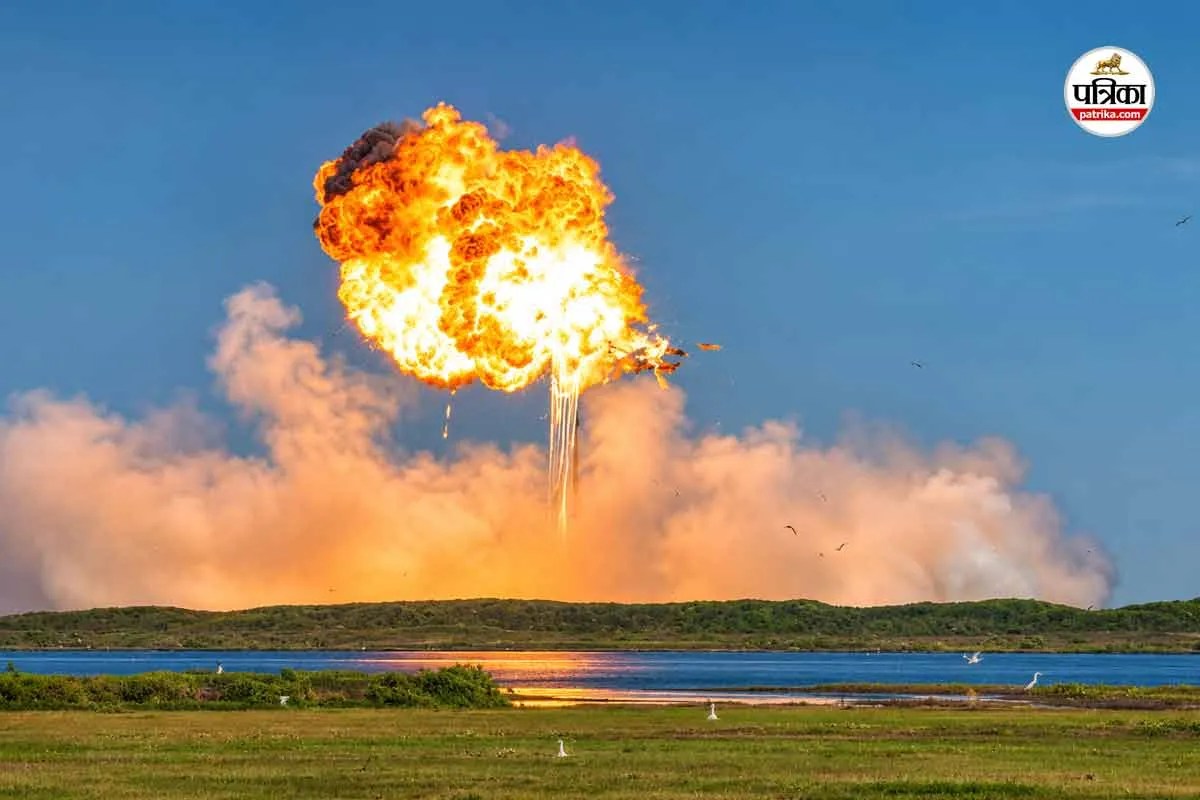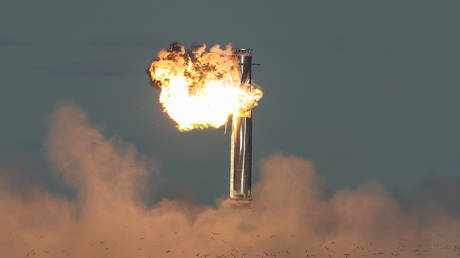
When a 23-story stainless steel cylinder slams into the Gulf of Mexico and detonates in a fireball, casual observers see an expensive failure. Legacy aerospace executives see something else entirely. They see a production line moving at a pace they cannot match.
SpaceX recently launched its massive Starship and Super Heavy stack—the largest, most powerful rocket ever built—only to lose the Super Heavy booster in a fiery ocean crash during its return phase. Mainstream headlines immediately fixated on the explosion. That framing misses the actual story by a wide margin. The explosion wasn't an accident; it was the cost of admission for a development philosophy that has completely broken the traditional aerospace playbook.
The Economics of Hardware-Rich Testing
For sixty years, the aerospace industry operated under a strict mandate: failure is unacceptable. When NASA built the Saturn V or the Space Shuttle, and later when Boeing and Lockheed Martin developed the Space Launch System (SLS), every single component had to be verified on the ground before a vehicle ever touched a launch pad. Billions of dollars were spent on simulations, wind tunnels, and paperwork. The result was pristine, remarkably safe hardware that cost over $2 billion per launch and took decades to build.
SpaceX inverted that model. Instead of spending billions trying to predict every aerodynamic anomaly on a supercomputer, the company builds dozens of prototypes on an assembly line in Boca Chica, Texas, and flies them until they break.
Think of it as hardware-rich development. Steel is cheap. Methane and liquid oxygen are cheap. Engineering hours spent trying to model chaotic hypersonic plasma flow in a virtual environment are astronomically expensive—and often wrong. When SpaceX loses a booster in a fiery crash, the telemetry gathered during those final, violent seconds of reentry provides data that no wind tunnel on Earth could ever replicate.
The Iterative Loop in Action
To understand how fast this cycle moves, look at what happens immediately after a flight ends in a fireball. In a traditional aerospace program, a mishap triggers a multi-year investigation, congressional hearings, and a complete freeze on manufacturing.
At Starbase, the next booster is already standing in the high bay.
- Rapid Hardware Turnover: SpaceX does not build one rocket at a time; it builds a fleet. By the time Booster A leaves the pad, Booster B is undergoing cryo-proofing, and Booster C is having its thrust puck welded.
- Real-Time Telemetry: Thousands of sensors stream pressure, temperature, and structural load data back to ground stations right up until the moment of structural failure.
- Immediate Design Pivots: If a specific hydraulic actuator fails or a propellant slosh baffle buckles under high-G deceleration, engineers modify the CAD files the next morning. The fix is welded onto the next airframe within weeks, not years.
Consider a hypothetical comparison between two ways of designing a heat shield. The traditional approach spends five years testing individual ceramic tiles in an arc-jet facility, spending hundreds of millions of dollars to ensure zero tiles fall off. The SpaceX approach glues 18,000 tiles onto a steel tank, launches it to orbital velocity, and watches on live high-definition cameras to see which ones peel off during peak heating. It looks messy. It produces dramatic fireball videos for the evening news. And it gets a working orbital vehicle flying in half the time at a fraction of the cost.
What Actually Happened to the Super Heavy Booster
To grasp why the recent booster loss matters, you have to look at the sheer physics of what SpaceX is attempting to pull off. The Super Heavy booster is not just a bigger version of the Falcon 9 first stage. It is an entirely different beast.
Standing over 230 feet tall and powered by 33 Raptor engines, the booster generates roughly 16.7 million pounds of thrust at liftoff. That is more than double the thrust of the Saturn V moon rocket. Getting that mass off the pad without melting the concrete—a lesson SpaceX learned the hard way during early integrated flight tests—is an engineering triumph in itself.
The real magic, and the extreme difficulty, happens after stage separation.
The Physics of the Hot-Stage and Boostback
In early orbital rockets, the first stage simply burned until its fuel was depleted, detached, and fell into the ocean. SpaceX changed the game with Falcon 9 by saving enough propellant to flip the booster around, fire its engines to cancel its horizontal velocity, and guide it back to a pinpoint landing.
Super Heavy takes that choreography to an absurd extreme.
First, it executes a hot-staging maneuver. Instead of shutting down all engines and waiting for the upper stage to drift away, Starship ignites its six Raptor engines while still physically attached to the booster. A vented interstage ring deflects the superheated exhaust away from the top of the booster's liquid oxygen tank. This saves precious momentum, increasing payload capacity to orbit by roughly 10 percent. It also subjects the top of the booster to violent thermal and acoustic shockwaves.
Once separated, the booster must execute a flip maneuver, reignite a cluster of its central engines for a boostback burn, and plummet back through the atmosphere at supersonic speeds. During this descent, the booster relies on four massive, waffle-shaped titanium grid fins to steer. Unlike the Falcon 9, which uses aluminum grid fins that can melt if they get too hot, Super Heavy uses cast titanium structures the size of small cars just to survive the friction of atmospheric reentry.
When a booster fails during this phase, it is almost always due to one of three brutal physical realities:
- Propellant Slosh and Cavitation: As the massive tanks empty, the remaining liquid methane and liquid oxygen slosh violently during the flip maneuver. If gas bubbles get sucked into the Raptor engine turbopumps instead of pure liquid, the pumps lose pressure, spin out of control, and shred themselves in milliseconds.
- Thermal Overload: Even with engines relighting to create a protective plume of exhaust against the oncoming airflow, the base of the rocket experiences intense heating. A single compromised thermal blanket or damaged propellant line can trigger a cascading engine-bay fire.
- Structural G-Loads: Slamming a 200-ton empty steel tube into the thickening lower atmosphere creates immense aerodynamic drag. If the flight computer commands an aggressive pitch angle to hit its landing target, the structural shear forces can exceed the yield strength of the stainless steel skin.
When the booster crashes into the water and explodes, it means one of those margins was slightly too thin. SpaceX doesn't mourn the loss of the hardware. They isolate the exact millisecond the telemetry diverged from the model, thicken the steel or tweak the software, and prepare the next one.
The Stainless Steel Gamble
To appreciate how radical this program is, you have to look at the material itself. In the late 2010s, the entire aerospace sector was moving toward advanced carbon-fiber composites. Boeing built the 787 Dreamliner out of composites. Rocket Lab built the Electron out of carbon fiber. Even SpaceX initially spent millions building gigantic carbon-fiber mandrels to construct its next-generation ship.
Then, Elon Musk scrapped the whole thing and switched to 300-series stainless steel.
Industry veterans thought he had lost his mind. Stainless steel is heavy. In rocketry, mass is the enemy; every extra pound of dry structure is a pound of payload you cannot take to orbit. Carbon fiber is dramatically lighter and stronger at room temperature.
On paper, steel looked like a massive step backward. In practice, it unlocked the entire Starship architecture.
Why Steel Beats Carbon Fiber at Mach 25
Carbon fiber has a fatal flaw when it comes to reusability: it hates heat. The epoxy resins that bind carbon fibers together begin to weaken and delaminate at around 300 to 400 degrees Fahrenheit. To survive atmospheric reentry, a carbon-fiber rocket requires a thick, heavy, fragile thermal protection system across its entire body.
Stainless steel laughs at heat. It maintains its structural integrity up to 1,500 degrees Fahrenheit. By building the rocket out of steel, SpaceX drastically reduced the thickness of the heat shield tiles required on the belly of the ship, and eliminated the need for thermal protection on the leeward side entirely.
Even better, steel gets stronger when it gets cold. When filled with cryogenic liquid oxygen and liquid methane at minus 300 degrees Fahrenheit, the strength of stainless steel increases by roughly 50 percent.
Most importantly, steel is cheap and easy to work with. Carbon fiber costs roughly $135 to $200 per kilogram, requires massive autoclaves to cure, and is notoriously difficult to repair if damaged. Stainless steel costs about $3 per kilogram. You can weld it outside in a tent in South Texas using off-the-shelf industrial equipment. That single material choice is the reason SpaceX can afford to lose boosters in fiery crashes without bankrupting the company.
The Raptor Engine Problem
A rocket is ultimately just a plumbing system wrapped around an engine, and the Raptor is the beating heart of Starship. To make full and rapid reusability work, SpaceX could not use the Merlin engines that power the Falcon 9. They needed something vastly more complex.
Raptor is the first flight-proven full-flow staged combustion rocket engine in history. Both the Soviet Union in the 1960s and the U.S. Air Force in the early 2000s built prototypes of this engine cycle, and both abandoned them because the metallurgy required to keep the engines from melting was deemed too difficult.
In a traditional rocket engine, a small amount of fuel and oxidizer is burned in a pre-burner to spin the turbopumps, and that exhaust is dumped overboard—wasting energy. In a full-flow staged combustion engine, all of the propellant flows through two separate pre-burners before entering the main combustion chamber. One pre-burner runs oxygen-rich; the other runs fuel-rich.
The advantage is immense chamber pressure—over 300 bar, more than triple the pressure of the Merlin engine. High pressure equals high efficiency and massive thrust from a relatively compact engine.
The downside is that hot, oxygen-rich gas will violently ignite almost any metal it touches. Keeping 33 of these engines running simultaneously during ascent, shutting most of them down, and then reliably relighting a dozen of them while plummeting backward through the atmosphere is an unprecedented engineering tightrope walk.
Every time a Super Heavy booster crashes during its landing burn, the root cause almost always traces back to the terrifying complexity of feeding liquid methane and liquid oxygen into those Raptor engines under extreme dynamic loads.
Why Competitors Cannot Copy This Model
If this iterative, hardware-rich approach works so well, why aren't Boeing, Northrop Grumman, Blue Origin, or European space agencies doing the exact same thing?
The answer has nothing to do with physics and everything to do with financial incentives and political reality.
Traditional aerospace contractors operate primarily on cost-plus contracts funded by taxpayers. Under a cost-plus model, the government pays the contractor for all allowable expenses, plus a guaranteed profit percentage. If a program runs five years over schedule and billions of dollars over budget, the contractor still makes a profit. In fact, delays often increase total revenue.
Under that system, blowing up a rocket on live television is catastrophic. Congress threatens to cut funding. Shareholders panic. Program managers get fired. Therefore, legacy aerospace companies optimize for avoiding failure, not for achieving speed.
SpaceX operates as a private company funded largely by its own commercial launch revenue and its Starlink satellite internet constellation. When SpaceX blows up a booster, they do not have to ask a congressional committee for permission to build the next one. They answer only to their own balance sheet.
The Gravity of the Cost-Per-Kilogram Collapse
The industry refuses to admit how dire the math has become for traditional launch providers.
Historically, launching cargo to Low Earth Orbit (LEO) cost between $10,000 and $20,000 per kilogram. The Falcon 9, with its partially reusable first stage, drove that cost down to roughly $2,700 per kilogram. That price drop alone allowed SpaceX to capture over 80 percent of the global commercial launch market.
Starship is designed to push that number below $100 per kilogram.
If SpaceX nails the booster catch and rapid turnaround—even if it takes ten more fiery crashes to get there—the economics of spaceflight change forever. A fully reusable Starship can put over 100 metric tons into orbit in a single flight. By comparison, the massive SLS rocket built by NASA and Boeing can lift roughly 95 metric tons, costs over $2 billion per launch, and throws the entire vehicle into the ocean every single time.
You cannot compete with a reusable commercial airliner if you are building single-use airplanes that crash into the sea after every flight.
The Hidden Risks of the SpaceX Gamble
Writing off SpaceX's crashes as mere "data collection" ignores genuine vulnerabilities in their strategy. The company is walking a razor's edge, and several significant roadblocks could still derail their timeline.
First, there is the regulatory bottleneck. Launching the world's largest rocket from a coastal wetland in Boca Chica puts SpaceX directly in the crosshairs of the Federal Aviation Administration (FAA) and the U.S. Fish and Wildlife Service. Every fiery crash, every piece of debris falling outside a designated hazard zone, and every environmental complaint triggers mandatory mishap investigations and environmental reviews. SpaceX can build a new booster in three weeks, but it routinely waits three to six months for federal bureaucrats to sign off on the next launch license. Engineering speed means nothing if the rocket is grounded by paperwork.
Second, orbital refueling remains completely unproven. For Starship to fulfill its primary contracts—such as landing NASA astronauts on the Moon under the Artemis program—it cannot simply reach Low Earth Orbit. It has to stay there while SpaceX launches up to a dozen "tanker" Starships to transfer hundreds of tons of cryogenic propellant in zero gravity. No one has ever transferred cryogenic fluids at that scale in orbit. Boil-off rates, docking mechanics, and fluid management in microgravity represent massive unsolved engineering hurdles that no amount of booster crashes in the Gulf of Mexico will solve.
Finally, there is the question of true rapid reusability. Landing a booster is one thing; flying it again the next day is another. SpaceX proved with Falcon 9 that boosters can fly more than twenty times, yet they still require weeks of refurbishment between flights. Starship's business model relies on airline-style turnaround times—landing a booster, inspecting it, stacking a new ship on top, fueling it, and launching again within hours. If the 33 Raptor engines require weeks of teardown and component replacement after every flight, the promised $100-per-kilogram launch cost evaporates.
The Verdict on the Fireball
The next time a headline flashes across your screen announcing that a SpaceX rocket exploded in a fiery crash, look past the flames. Look at the launch pad.
In Boca Chica, the gantry cranes are already lifting the next stainless steel giant onto the orbital launch mount. While legacy aerospace executives issue press releases celebrating successful PowerPoint presentations and minor wind-tunnel milestones, SpaceX is burning through steel, methane, and oxygen to brute-force its way into a monopoly on heavy lift. The explosions aren't signs of a company failing to reach orbit; they are the sound of an entire industry being rendered obsolete in real time.