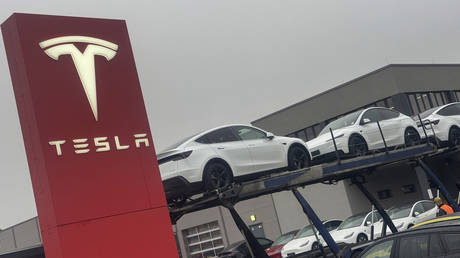
Your car isn't just a vehicle anymore. It's a rolling surveillance rig packed with high-definition cameras, cabin microphones, radar, and constant cellular uplinks. Most drivers think of those sensors as convenient parking aids or autopilot helpers, yet German counterintelligence officials see a massive security liability parked right next to sensitive military bases.
Stephan Kramer, head of the domestic intelligence agency (BfV) in the German state of Thuringia, triggered headlines across Europe after telling Handelsblatt that Germany shouldn't give allied automakers a free pass on espionage risks. His exact warning cut straight through polite diplomatic assumptions: "We should not rely on there being no spying among friends". While Washington and Brussels have spent the past couple of years sounding the alarm over Chinese electric vehicles from BYD, Geely, and NIO, Kramer pointed out an uncomfortable truth. A Tesla built in Grünheide or Fremont uses the exact same physical sensor architecture to map its surroundings and beam telemetry back to corporate servers in the United States. Discover more on a connected issue: this related article.
If you're following this story, you're probably wondering whether American intelligence agencies are actually using Model Ys to spy on Berlin, or if German officials are just overreacting. Let's look at the hardware reality, the new Bundeswehr parking restrictions, and what happens when national security collides with modern automotive tech.
Why Stephan Kramer Targeted Allied Automakers
For years, the global debate over connected-car security revolved almost exclusively around Beijing. U.S. regulators moved to ban Chinese and Russian hardware and software from connected vehicles, framing the issue as an authoritarian threat. European policymakers largely echoed that framing, worrying about what happens when Chinese state-backed companies gain access to European road networks and driver habits. Further analysis by Engadget highlights similar views on the subject.
Kramer refused to play along with that double standard. Speaking to Handelsblatt right after the German armed forces (Bundeswehr) tightened rules on connected vehicles, he argued that intelligence services cannot afford to assume allied nations won't harvest data when given a technical opening. History backs him up. Allies routinely monitor each other's diplomatic communications, defense contractors, and infrastructure. Treating a U.S.-headquartered tech giant differently from a Chinese one makes zero sense from a pure counterintelligence standpoint.
Here is the distinction most surface-level news reports miss: Kramer isn't claiming Washington has a secret backdoor installed at the Tesla factory. Handelsblatt explicitly noted that German authorities have found no concrete evidence of connected cars being actively used for state espionage. Instead, the concern is structural. Under U.S. legal frameworks like the CLOUD Act and Section 702 of the Foreign Intelligence Surveillance Act, American authorities hold broad legal mechanisms to compel U.S.-based companies to turn over data stored on servers they control—even if that data originated inside Europe.
How Connected Cars Function as Mobile Sensor Grids
Modern electric vehicles generate staggering amounts of environmental data every single second they're powered on. When you drive a Tesla past a government ministry, a power substation, or a military barracks, the vehicle doesn't just move through space. It actively perceives and digitizes that environment.
Think about what a standard modern EV carries on board:
- External surround cameras: Eight or more high-resolution optical sensors constantly scanning license plates, building entrances, perimeter fences, security checkpoints, and personnel movements.
- Cabin microphones and interior cameras: Hardware designed for voice commands and driver-attention monitoring that, if compromised or improperly accessed, can capture private conversations inside the vehicle.
- Radar and ultrasonic arrays: Sensors that map physical geometry, gate structures, and obstacle layouts with precision.
- Always-on cellular modems: Over-the-air telemetry systems built to upload crash clips, fleet-learning video snippets, and diagnostic logs directly to cloud infrastructure.
I've spent years analyzing enterprise IoT and automotive telemetry architectures, and the biggest misconception among everyday drivers is thinking "Sentry Mode" or autopilot cameras only record when you explicitly hit save. Fleet-learning vehicles routinely capture short video clips triggered by specific driving edge cases and transmit them back to engineering servers to train neural networks.
We already know human eyes sometimes look at those feeds. In 2023, a Reuters investigation revealed that groups of Tesla employees had privately shared sensitive videos and images recorded by customer car cameras—including footage inside private garages—via internal messaging systems between 2019 and 2022. If corporate staff could circulate those clips internally, a determined state intelligence agency or a sophisticated cyber threat actor doesn't need to invent new hardware to exploit the pipeline. The collection mechanism is already bolted onto the chassis.
What the New Bundeswehr Rules Actually Change on the Ground
Germany hasn't issued a nationwide ban on driving Teslas or Chinese EVs on public roads. You won't see police pulling over Model 3 owners in Munich or confiscating vehicles at the border. Instead, the German Defense Ministry rolled out targeted, site-specific security protocols aimed at protecting high-value installations.
Under the updated Bundeswehr guidelines reported by Der Spiegel and Handelsblatt, local security officers at individual military facilities now hold the authority to restrict where connected vehicles can drive or park. If a soldier or civilian contractor drives a vehicle equipped with external cameras, microphones, and radar onto a sensitive base, they can be ordered to leave it outside the security perimeter in designated outer parking zones.
Kramer noted that critical infrastructure operators—think energy grids, telecommunications hubs, water facilities, and defense manufacturers—need to run similar risk assessments. Blanket bans across entire cities aren't practical or necessary. Setting up buffer zones and keeping sensor-heavy vehicles away from restricted perimeters solves 90% of the physical reconnaissance risk without paralyzing daily transport.
Interestingly, Germany's approach contrasts sharply with Washington's blanket country-of-origin bans. Berlin's Defense Ministry emphasized technological sovereignty and risk-based assessments focused on sensor capabilities rather than simply blacklisting every brand from a single nation. That's why Tesla, BYD, Geely, and NIO all land under the same operational umbrella when approaching sensitive German gates. Even German automakers like Mercedes-Benz, BMW, and Volkswagen build connected cars packed with similar sensor suites, though domestic manufacturers operate under strict European data localization and German security oversight.
The Geopolitical Irony Nobody Mentions
If this entire controversy feels vaguely familiar, it should. Back in 2021, China's military banned Tesla vehicles from entering its housing complexes and military bases over the exact same camera-recording concerns. At the time, Elon Musk pushed back hard, stating publicly that Tesla would be shut down immediately if its cars were ever used for espionage in China or anywhere else.
Fast forward to late 2026, and the geopolitical wheel has turned full circle. China enforced strict data localization laws requiring automakers to store all locally collected vehicle data on servers inside mainland China. Now, a senior German counterintelligence chief is applying Beijing's exact logic to American vehicles operating on European soil.
It's a sobering wake-up call for Europe. Germany is home to Tesla's massive European Gigafactory in Grünheide, just outside Berlin. The country welcomed the investment, the jobs, and the EV manufacturing capacity. Yet welcoming an American factory doesn't erase the reality that vehicle software architecture, cloud routing, and cryptographic keys remain controlled across the Atlantic. When critical infrastructure relies on foreign-managed software ecosystems, sovereignty becomes an illusion.
What This Means for Drivers and Security Teams
You don't need to panic and sell your electric car tomorrow, nor should you treat every parked EV as a covert CIA listening post. Still, understanding how connected vehicles handle data helps you avoid rookie privacy mistakes—especially if you work near government offices, defense contractors, or sensitive corporate R&D sites.
If you drive a Tesla or any modern connected vehicle, take three practical steps right now to tighten your data footprint:
- Audit your data-sharing permissions in the vehicle menu. Open your car's privacy and data-sharing settings and toggle off analytics sharing, road-segment data collection, and cabin camera analytics unless an active driver-assistance feature strictly requires them.
- Manage Sentry Mode and dashcam storage locally. Keep Sentry Mode disabled when parking inside private residential garages or near restricted workplace facilities, and regularly wipe the local USB drive so sensitive footage isn't sitting unencrypted in your glovebox.
- Respect facility buffer zones without pushback. If you work in defense, energy, public administration, or tech R&D, check your employer's updated parking guidelines before pulling a camera-equipped EV into an underground garage or secure lot.
For corporate security officers and facility managers, the takeaway from Stephan Kramer's warning is even clearer. Stop evaluating vehicle security risks by looking at the badge on the hood or the nationality of the CEO. Evaluate the sensors on the bumper, the microphones in the headliner, and the destination of the cellular uplink.
German Intelligence Warns Tesla Cars Could Be Used for US Espionage, How Is That Possible?
This video breaks down the technical mechanisms behind how modern connected vehicles collect environmental data and why German intelligence flagged potential surveillance risks.