Commercial aviation operates on an asymmetric threat model where the financial and operational cost of responding to a security signal is orders of magnitude higher than the cost of generating that signal. When a wave of coordinated or opportunistic bomb threats targets air traffic across a region such as Europe, the resulting diversions and emergency landings expose vulnerable structural bottlenecks in airspace management, airline fleet deployment, and ground operation protocols. Resolving these disruptions requires moving past basic news reporting to analyze the systemic mechanics of airspace capacity, emergency protocols, and the compounded economic impact on civil aviation.
The Operational Mechanics of Diversion Decisions
When a bomb threat is received against an airborne commercial flight, the decision matrix relies on a standardized risk assessment framework governed by international aviation protocols, primarily ICAO Annex 17. Threats are evaluated along a spectrum ranging from non-specific (low credibility) to specific (high credibility). A specific threat—naming a targeted flight number, specific route, or precise mechanism—forces an immediate operational pivot.
Once a threat is deemed credible, the flight crew and ground controllers initiate a structured response protocol:
- Air Traffic Control (ATC) Isolation and Routing: ATC clears the immediate surrounding airspace to give the affected aircraft priority. The aircraft is routed toward the nearest suitable airport equipped to manage emergency responses, often avoiding high-density urban airspaces or congested hubs where ground risks are elevated.
- Flight Deck Management: The flight crew executes emergency descent procedures if depressurization or rapid landing is deemed necessary, while maintaining discrete communication with ATC using dedicated transponder codes (such as Mode S Squawk 7700 for general emergencies).
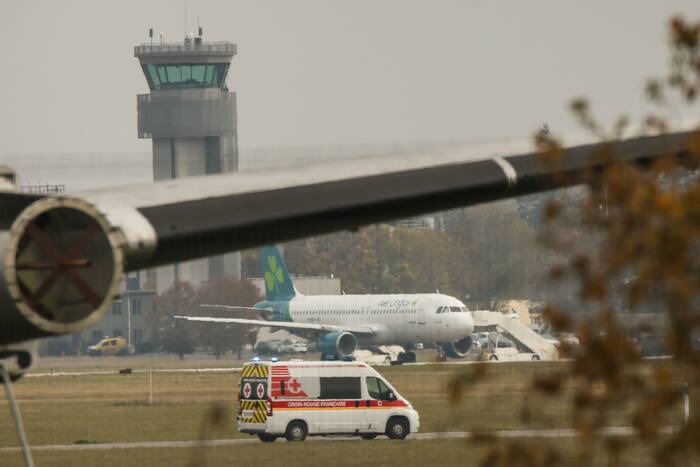
- Ground Emergency Response Setup: The receiving airport activates its emergency operations center, clearing dedicated runway capacity and positioning airport rescue and firefighting (ARFF) services, explosive ordnance disposal (EOD) units, and local law enforcement along designated isolated aircraft parking positions (often referred to as the "tactical pad" or "de-isolation bay").
The Asymmetric Cost Function of Airspace Disruptions
The financial damage caused by coordinated threat campaigns extends far beyond the immediate fuel burned during a flight diversion. The true economic cost is governed by a multi-tiered cost function that compounds as the disruption propagates through a carrier's network.
- Direct Variable Operational Costs: Diversions incur immediate, unrecoverable costs: additional aviation fuel consumption during tactical rerouting and holding patterns, unplanned landing fees at diversion airports, extended crew duty pay, and emergency ground handling charges.
- Secondary Passenger Support and Duty of Care Costs: Under regulatory frameworks such as EU261, airlines are legally obligated to provide duty of care to passengers stranded at diversion points. This includes overnight hotel accommodations, ground transport, meal vouchers, and rebooking on alternative flights. For long-haul or international routes, these passenger welfare costs often exceed the direct operational cost of the flight itself.
- Network Cascade and Rotational Disturbance: Modern airlines utilize tight tail-assignment schedules, where a single aircraft operates multiple flight legs per day. When an aircraft is diverted and grounded for hours due to security sweeping and EOD clearance, downstream flights assigned to that specific tail are delayed or canceled. Crew duty-time limits are breached, requiring stand-by crew activations and repositioning of deadheading crew members, which can paralyze a carrier's schedule for up to 48 hours.
Structural Bottlenecks in Multi-Jurisdictional Airspace
A surge of simultaneous diversions across Europe highlights severe bottlenecks in cross-border air traffic management. European airspace is one of the most complex and congested environments globally, managed by multiple national Air Navigation Service Providers (ANSPs) coordinated under Eurocontrol.
When multiple flights alter their trajectories simultaneously, several operational bottlenecks manifest immediately:
- Capacity Constraints at Secondary Airports: Diversion airports selected during inflight emergencies are often regional facilities. While adequate for isolated incidents, these airports quickly run out of isolated parking stands, qualified ground staff, and specialized EOD equipment when forced to absorb multiple high-priority diversions concurrently.
- Airspace Sector Congestion: Diverting aircraft interrupt established flow management procedures (Standard Instrument Departures and Standard Terminal Arrival Routes). Controllers must manually create buffer zones around diverting flights, reducing the overall throughput capacity of adjacent sector airspaces and causing cascading airborne delays for uninvolved commercial traffic.
- Information Dissemination Latency: Cross-jurisdictional threat evaluation requires seamless real-time coordination between intelligence agencies, national law enforcement, military air command, ANSPs, and airline operations centers. Communication friction between national entities during fast-evolving threat vectors delays the re-classification of threats, prolonging unnecessary ground hold times for searched aircraft.
Strategic Imperatives for Aviation Risk Management
Mitigating the vulnerability of the global aviation network to high-volume threat campaigns requires shifting from reactive emergency management to predictive, integrated risk assessment protocols.
Airlines and civil aviation authorities must prioritize the implementation of real-time threat verification channels that integrate cyber-intelligence directly into airline flight operations controls (FOC). Establishing standardized international protocols for rapid digital triage of digital and telephone threats will reduce the operational friction that forces low-credibility incidents into full inflight diversions. Furthermore, ANSPs must incorporate multi-flight diversion contingency modeling into automated air traffic management systems to prevent regional airspace saturation when multiple emergencies are declared simultaneously.