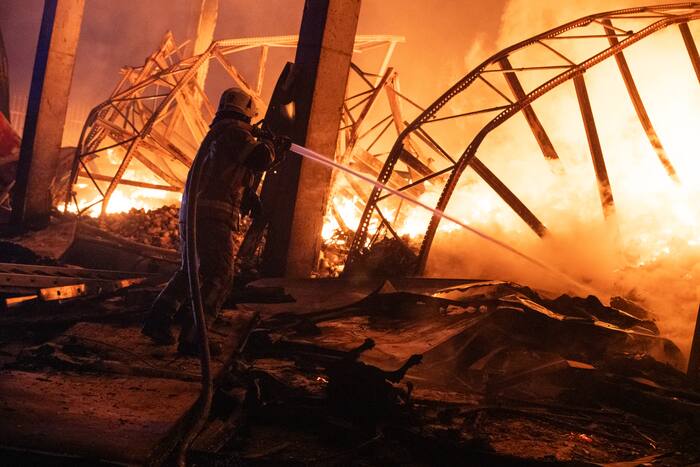
Simultaneous kinetic escalation and diplomatic negotiation is not a contradiction in international relations; it is the standard operating mechanism of coercive bargaining. When Russia and Ukraine exchange long-range airstrikes at the exact moment diplomats convene in Brussels to structure reconstruction funds and security guarantees, both actors are executing a synchronized strategy to alter the terms of trade before a single euro is committed. Conventional reporting treats these two events as a paradox—war happening alongside peace and rebuilding talks. In reality, the airstrikes are the direct input variables into the Brussels negotiation equations, designed to manipulate risk premiums, discount rates, and the perceived durability of post-war infrastructure.
Understanding the intersection of battlefield attrition and institutional capital allocation requires stripping away diplomatic rhetoric and examining the underlying game theory and financial mechanics. The Brussels summits represent an attempt to price the future of a state whose physical assets are actively being degraded in real time. Building on this theme, you can also read: The Dirty Secret of Invasive Species Tracking and Why Volunteers With Dogs Are the Only Way Out.
The Mechanics of Coercive Bargaining
In classical military strategy, popularized by Thomas Schelling, violence is rarely used solely for physical destruction; it is used as a signaling mechanism to influence an adversary's expectations of future pain. When diplomatic summits convene in Brussels, the negotiating room becomes a clearinghouse for leverage generated on the battlefield.
Signaling Through Kinetic Escalation
Long-range airstrikes timed to coincide with multilateral conferences serve three distinct operational functions: Observers at The Guardian have provided expertise on this situation.
- Demonstrating Escalation Dominance: By launching coordinated drone and missile salvos during high-profile diplomatic gatherings, the aggressor signals to European financiers that it retains the capacity to invalidate any reconstruction agreement at will. The strike is aimed less at the physical target and more at the risk-assessment models of Western treasuries and institutional investors.
- Testing Air Defense Saturation Thresholds: Beyond political signaling, synchronized exchanges force the defender to expend finite, high-cost interceptor munitions. Every Patriot or IRIS-T missile fired to protect an energy substation represents a direct transfer of Western fiscal capital from long-term reconstruction budgets into immediate operational defense expenditures.
- Establishing Counter-Value Deterrence: When Ukraine conducts reciprocal deep-strike operations against Russian energy infrastructure, logistics hubs, or airfields during these exact windows, it executes a counter-value strategy. The objective is to prove to Brussels that Kyiv possesses an indigenous capability to impose symmetrical economic costs on Moscow, thereby reducing the perception that Ukraine is solely a passive consumer of Western security subsidies.
This creates a continuous feedback loop between the kinetic theater and the conference room. A successful strike against a power grid in eastern Ukraine immediately alters the agenda in Belgium, shifting the conversation from multi-year municipal bond issuances to emergency procurement of autotransformers and mobile gas turbines.
The Economics of Wartime Reconstruction
Standard post-conflict reconstruction models—such as the Marshall Plan or the Balkan stabilization frameworks—rely on a sequential timeline: cessation of hostilities, establishment of a secure perimeter, assessment of damages, and deployment of capital. The Brussels talks operate under a fundamentally different and vastly more complex constraint: capital deployment during active, high-intensity warfare.
The Discount Rate Dilemma
From a corporate finance perspective, investing in physical infrastructure inside an active warzone faces an extreme discount rate problem. The net present value (NPV) of a rebuilt bridge, factory, or power plant drops precipitously when the probability of kinetic destruction within twelve months exceeds standard actuarial thresholds.
Private capital will not enter a market where the risk of total asset loss is uninsurable. Commercial insurers exclude acts of war from standard policies, leaving a massive underwriting gap. To bridge this, the Brussels frameworks must rely on sovereign guarantees, first-loss capital tranches provided by multilateral development banks, and state-backed war risk insurance facilities.
The kinetic exchanges directly attack this financial architecture. Every Russian ballistic missile that penetrates Ukrainian air defenses forces European underwriters to recalculate the probability of default on sovereign-backed infrastructure loans. If the actuarial cost of insuring a rebuilt facility exceeds its projected economic output, the project becomes mathematically unviable, regardless of political willpower in Brussels.
Capital Destruction vs. Capital Formation
An analytical breakdown of wartime economics reveals a stark asymmetry between the cost of destruction and the cost of restoration:
- Asymmetric Cost Ratios: A mass-produced one-way attack drone costs tens of thousands of dollars. The high-voltage substation transformer it destroys costs millions of dollars and requires up to eighteen months of specialized manufacturing lead time.
- The Sisyphus Effect in Infrastructure: Allocating capital to rebuild static, centralized infrastructure without first establishing an impenetrable air defense umbrella results in negative capital formation. Funds are consumed in a cycle of build, destroy, and rebuild, draining donor budgets without expanding the recipient nation's productive capacity.
- Decentralization as a Financial Hedge: Consequently, reconstruction strategy must shift from restoring legacy Soviet-era centralized grids to funding distributed, hardened, and modular systems. Small-scale distributed generation, underground substations, and dispersed industrial parks drastically reduce the return on investment for an adversary's missile strikes, altering the cost-exchange ratio in favor of the defender.
Security Guarantees as Financial Instruments
In Brussels, security talks and reconstruction talks are treated as separate tracks—one handled by defense ministries, the other by finance ministries and the European Commission. In operational reality, they are the exact same instrument. A security guarantee is simply a credit enhancement mechanism for sovereign reconstruction debt.
The Deterrence-Investment Nexus
Without credible security architecture, reconstruction capital is merely a subsidy for future rubble. Western policymakers face a structural trilemma when designing these guarantees:
- Full Collective Defense (Article 5 Equivalents): Provides the maximum possible risk reduction for private capital, unlocking institutional investment at scale. However, it carries the highest political and escalation cost for Western governments, who must commit their own militaries to direct confrontation if deterrence fails.
- Bilateral Security Compacts (The "Porcupine" Model): Focuses on long-term arms supply, intelligence sharing, and domestic defense-industrial integration rather than direct troop commitments. While politically palatable for Western capitals, this model leaves a residual risk premium that keeps private institutional capital on the sidelines, forcing public taxpayers to shoulder the bulk of reconstruction costs.
- Neutrality or Demilitarized Buffer Zones: Reduces immediate kinetic friction but creates a permanent state of frozen ambiguity. Institutional investors treat unresolved territorial disputes as chronic political risk, leading to stagnant foreign direct investment and capital flight.
The bilateral security agreements negotiated alongside European Union accession frameworks attempt to thread this needle. By binding Ukraine's defense procurement and regulatory standards to European institutions, Brussels seeks to create a de facto security perimeter that lowers borrowing costs over a ten-to-twenty-year horizon, even in the absence of immediate treaty-alliance membership.
Structural Bottlenecks in the Brussels Architecture
While diplomatic communiqués emphasize unity and long-term commitment, operational execution faces severe institutional friction. Identifying these bottlenecks is critical to understanding why reconstruction pledges rarely translate into immediate physical reality on the ground.
The Absorption Capacity Constraint
Capital injection is limited by the recipient economy's physical and administrative absorption capacity. Years of war have severely depleted Ukraine's domestic labor force through military mobilization and outward migration. Simultaneously, domestic construction materials—cement, structural steel, glass—face supply chain disruptions due to energy rationing and damaged logistics corridors.
Pouring billions of euros into an economy with rigid supply constraints does not accelerate physical reconstruction; it generates localized inflation, driving up the unit cost of every kilometer of road or megawatt of power restored. Effective capital allocation requires pacing financial disbursements to match actual physical logistics capacity and labor availability, alongside targeted programs to incentivize the return of skilled workers.
Governance, Conditionality, and Speed
European financial institutions operate on strict compliance, anti-corruption, and environmental, social, and governance (ESG) frameworks. These mechanisms are designed to prevent capital leakage and ensure fiduciary responsibility over multi-year timelines. However, wartime survival requires speed.
A strict conditionality regime—where tranches of reconstruction aid are withheld until specific judicial, regulatory, or procurement reforms are verified—creates a dangerous lag time. If an energy grid requires immediate winterization before temperatures drop below freezing, a six-month compliance audit renders the funding operationally useless. Brussels must continually calibrate the tension between fiduciary rigor and tactical urgency, utilizing fast-track procurement channels for critical survival infrastructure while reserving strict conditionality for long-term structural modernization.
The Frozen Assets Legal Quagmire
A central pillar of the Brussels financial discussions involves utilizing immobilized Russian sovereign assets—primarily held within European clearinghouses like Euroclear—to fund Ukrainian defense and reconstruction. While using the windfall profits generated by these assets has gained legal traction, outright confiscation of the principal remains stalled by systemic financial concerns.
Central banks and sovereign wealth funds globally monitor the precedent set in Brussels. European monetary authorities must weigh the immediate fiscal relief of seizing sovereign reserves against the long-term risk of eroding the euro's status as a neutral reserve currency. If non-Western states perceive European clearinghouses as subject to geopolitical confiscation, capital outflows from European sovereign debt markets could increase borrowing costs across the entire Eurozone. This macroeconomic reality dictates the cautious, incremental approach observed in Brussels, even as Russian missiles destroy Ukrainian cities.
Operational Limitations of Current Frameworks
No policy framework executed in Brussels can eliminate the fundamental reality of geographic proximity. Ukraine shares a massive land border with a nuclear-armed revisionist state that has transitioned its economy onto a permanent war footing.
Relying solely on air defense interceptors to protect reconstruction investments is an unsustainable attrition strategy. Interceptor missiles cost significantly more than the offensive munitions they destroy, and Western defense-industrial base expansion still lags behind high-intensity consumption rates. Furthermore, multilateral financial pledges often suffer from double-counting—repackaging previously announced loans, humanitarian aid, and macro-financial assistance into headline-grabbing cumulative figures that obscure the actual volume of new, deployable reconstruction capital.
Strategic Imperatives for Capital Preservation
To break the cycle where kinetic strikes dictate the pace and viability of diplomatic and financial planning, policymakers and institutional stakeholders must fundamentally restructure how security and reconstruction are integrated.
First, capital allocation must shift entirely from post-war planning to wartime resilience engineering. Reconstruction funds should be legally decoupled from peacetime infrastructure standards and immediately redirected toward hardening critical nodes—placing energy substations underground, decentralizing heating networks into modular municipal units, and expanding hardened rail and road border crossings with Poland, Romania, and Slovakia.
Second, Western treasuries must formalize automated counter-escalation financing. Diplomatic summits should establish pre-approved financial triggers: every verified kinetic strike against civilian energy or transport infrastructure automatically unlocks a proportional, pre-allocated tranche of frozen Russian asset revenues for immediate Ukrainian air defense and deep-strike procurement. Tying the aggressor's tactical actions directly to the automatic funding of the defender's military capabilities alters the coercive bargaining equation, turning every missile launch into a direct capital transfer to Kyiv.

