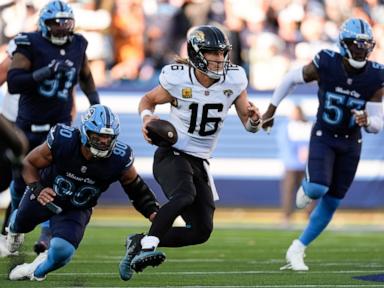
Most NFL fans still treat Jacksonville like an afterthought. That's a massive mistake right now.
The Jacksonville Jaguars sit right on the edge of making franchise history, chasing down the longest 30-point scoring streak the organization has ever seen. For a team that spent much of the last two decades struggling just to find a pulse on offense, putting up 30 or more points week after week isn't just a fun trivia note. It's a complete identity shift.
You don't stumble into a streak like this in the modern NFL. Defenses are too fast, defensive coordinators are too creative, and red-zone windows shrink to nothing once November hits. When an offense consistently clears the 30-point mark, something fundamental has clicked between the play-caller, the quarterback, and the guys winning their one-on-one matchups on the perimeter.
The History Behind Jacksonville's Scoring Streaks
To appreciate where this offense stands, you have to look at how rare explosive, sustained scoring has been in Duval County since the franchise launched in 1995.
Even during the golden years of the late 1990s under Tom Coughlin, the Jaguars weren't built to win track meets every Sunday. Mark Brunell had Jimmy Smith, Keenan McCardell, and Fred Taylor—a legitimate triumvirate of offensive firepower—yet those teams often leaned on physical defense and clock control once they grabbed a two-score lead. They'd grind you down rather than run up the scoreboard for four straight quarters.
Then came the dark ages. For years, hitting 30 points once a month felt like a minor miracle in Jacksonville. Fans watched endless cycles of conservative play-calling, stagnant passing concepts, and drives that stalled out the second the ball crossed the opponent's 40-yard line. Getting three consecutive games with 30-plus points wasn't even on the radar during the Blake Bortles or Blaine Gabbert eras, save for the occasional garbage-time explosion or a bizarre outlier shootout.
That's why standing on the doorstep of the longest 30-point streak in team history carries so much weight. It separates this current group from every era that came before it, including the 1999 squad that went 14-2 and reached the AFC Championship Game.
What Actually Fuels a 30-Point NFL Offense
People love attributing scoring binges to one guy. Usually, the quarterback gets all the credit when the scoreboard lights up and all the blame when the punt team works overtime.
Reality is messier.
Sustaining a 30-point pace requires three specific things happening simultaneously, and failing at even one of them kills a streak dead:
- Early-down efficiency that keeps the playbook open. If you're constantly facing third-and-8, you aren't scoring 30 points against NFL defenses. You have to win on first down, whether that's a five-yard interior run or a quick rhythmic throw into the flat.
- Red-zone conversion rates above 65 percent. Settling for field goals is the fastest way to ruin a historic scoring run. Four trips inside the 20-yard line need to yield at least three touchdowns, not four chip-shot kicks.
- Explosive plays that flip field position in a single snap. Long, 14-play drives are great for eating clock, but eventually someone holds, drops a pass, or misses a block. You need shots downfield that turn a drive near midfield into six points instantly.
When Jacksonville's offense is humming, they aren't relying on fluke defensive touchdowns or lucky special teams bounces to pad the total. They're methodically dismantling coverage shells. They force safeties to creep up toward the line of scrimmage to respect the run, and the moment those safeties bite, the ball goes right over their heads.
Why Opposing Defenses Struggle to Slow Them Down
Watch the tape from recent weeks and you'll notice a clear pattern. Defensive coordinators keep trying to take away Jacksonville's primary read, assuming the offense will panic and force throws into coverage.
It hasn't worked.
Instead of forcing low-percentage deep balls into double teams, the passing game has stayed remarkably disciplined. Take what the defense gives you. Check the ball down to the running back when the linebackers bail out. Hit the tight end sitting in the soft spot of a zone coverage.
It sounds basic, almost boring, until you realize how exhausting it is for a defense to defend. Every four-yard gain on first down creates a second-and-six. Every second-and-six turns into a fresh set of downs. Before the defensive front even realizes what happened, they've been on the field for nine plays, their pass rushers are sucking wind, and the Jaguars are knocking on the door of the end zone again.
The Hidden Value of Tempo and Pre-Snap Motion
Another piece most casual viewers miss is how much work happens before the ball is even snapped.
Pre-snap motion has become a staple across the league, thanks largely to the coaching trees of Kyle Shanahan and Sean McVay, but execution varies wildly from team to team. In Jacksonville, motion isn't just window dressing to look modern on broadcast television. It's a diagnostic tool.
By shifting receivers across the formation right before the snap, the quarterback gets an immediate tell on whether the defense is playing man or zone. If a cornerback sprints across the field to follow his man, the offense knows exactly where the leverage vulnerabilities are. If nobody moves, the protection scheme adjusts instantly to pick up potential zone blitzes.
That split-second advantage saves the offensive line from getting beaten cleanly off the edge. Clean pockets lead to accurate throws, and accurate throws keep drives alive long enough to push the point total past 30.
Common Misconceptions About High-Scoring Streaks
Whenever an NFL team goes on a tear like this, the hot-take machines immediately fire up with predictable narratives. Most of them miss the mark completely.
First, critics love to claim that high scoring is purely a byproduct of bad opponents. Look closer at how NFL parity actually works. Even the worst defenses in the league are packed with former first-round picks and All-Americans. Nobody accidentally gives up 30 points three or four weeks in a row unless the offense across from them is executing at an elite level.
Second, people assume an explosive offense means a team is reckless with the football. Actually, the exact opposite is true. You cannot sustain a 30-point streak if you're turning the ball over twice a game. Every interception or lost fumble steals a possession—and in an average NFL game, each team only gets around 10 or 11 possessions total. Losing two of them makes hitting 30 points nearly mathematically impossible without a defensive score.
Third, there's a weird lingering bias that warm-weather teams play "soft" football when they put up big numbers. Tell that to the offensive linemen driving 310-pound defensive tackles off the ball in the fourth quarter to ice a game. Physicality doesn't always look like a 13-10 slugfest in the mud. Sometimes physicality looks like imposing your will for 60 minutes until the other team quits tackling.
How This Changes the AFC Playoff Picture
Points aren't just for fantasy football managers and highlight reels. In the AFC, where you have to go through elite quarterbacks just to survive Wild Card weekend, offensive firepower is the only currency that matters in January.
You aren't beating the conference's heavyweights 17-14 in the postseason. You need an offense capable of trading blows when the game turns into a fourth-quarter shootout. By proving they can clear 30 points consistently, the Jaguars are sending a pretty clear message to the rest of the conference: good luck keeping up if your offense has an off afternoon.
More importantly, a prolific offense completely transforms how Jacksonville's defense can play. Edge rushers love pinning their ears back when the opponent is down by two touchdowns in the third quarter. When an offense spots its defense a 14-point cushion early, opposing play-callers have to abandon their run game, making their passing attacks predictable and turning pass-rush rotations loose.
What to Watch When Jacksonville Takes the Field Next
If you're tuning in to see whether the Jaguars lock down the longest 30-point streak in franchise history, ignore the box score for the first quarter and watch three specific indicators instead.
Look at third-down distance. If Jacksonville averages less than five yards to go on third down through the first half, the streak is in great shape. Once a team gets stuck in third-and-long territory, drives stall and punters get busy.
Pay attention to red-zone play-calling on first-and-goal. Teams that settle for predictable runs up the middle inside the five-yard line usually end up kicking field goals. Watch for creative misdirection, quick rub routes, and quarterback movement that forces defenders to hesitate for half a second.
Finally, keep an eye on turnover margin early in the game. One short field created by the defense—or one avoided mistake by the offense—usually makes the difference between stalling out at 24 points and cruising past 30 before the two-minute warning even hits.
Watch the opening two drives closely next Sunday. You'll know within the first ten minutes of game clock whether Jacksonville is going to rewrite its own record book.