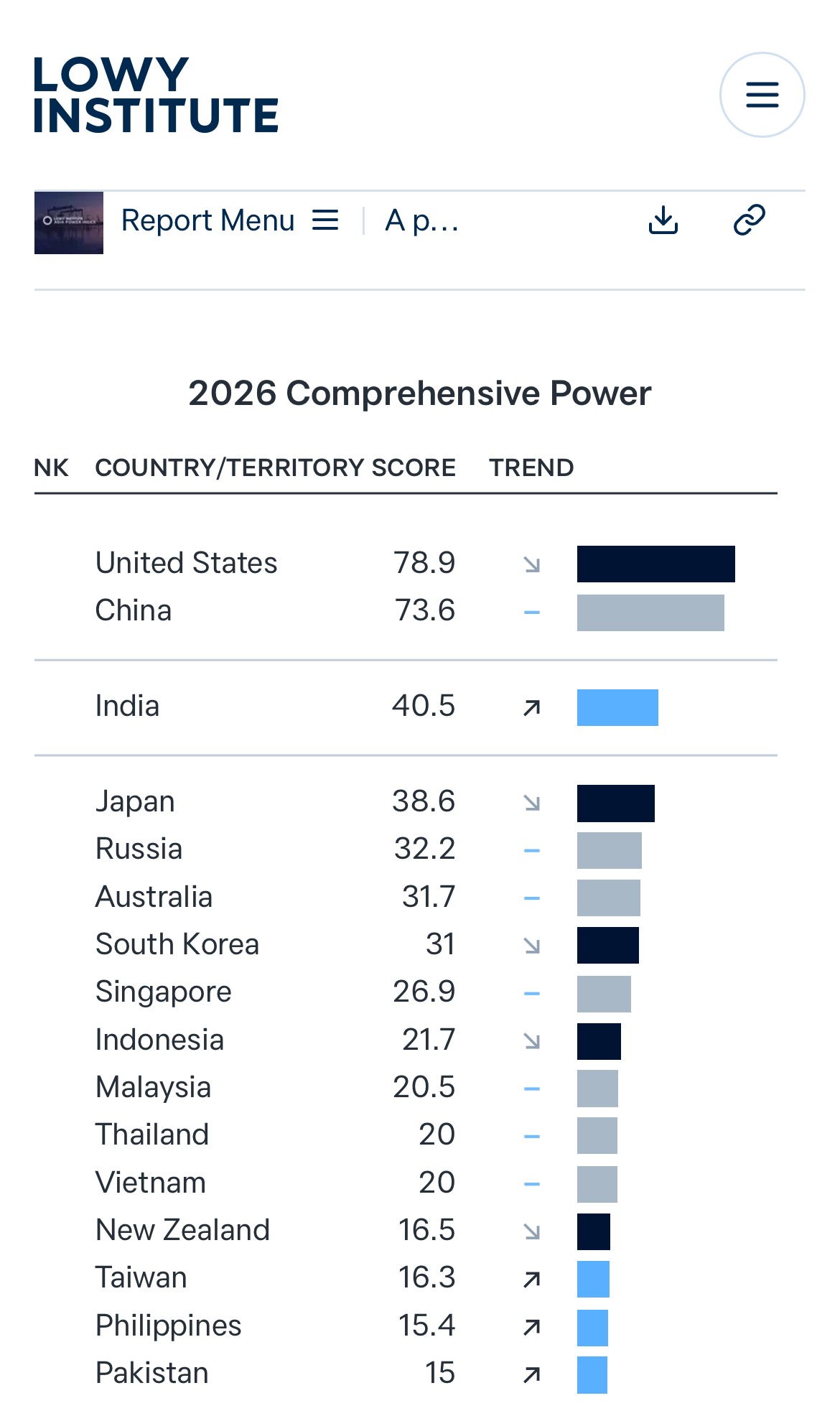
India's expanding diplomatic and economic footprint across the Indo-Pacific has drawn intense scrutiny from foreign policy analysts, driven largely by annual assessments like the Lowy Institute Asia Power Index. While headlines often compress these sprawling datasets into simple leadership scoreboards comparing Prime Minister Narendra Modi and Chinese President Xi Jinping, the underlying metrics reveal a far more complicated geopolitical reality. India is undeniably gaining diplomatic ground and structural heft in Asia, yet its trajectory is defined by sharp asymmetries between its vast demographic potential, its growing diplomatic reach, and the persistent domestic constraints that limit its ability to project hard economic and military power beyond its immediate neighborhood.
To understand what is actually happening in New Delhi and across the region, one has to look past the horse-race framing of individual leader ratings. Leadership effectiveness in international indices is not a popularity contest; it is a composite measurement of how efficiently a head of government converts national resources into regional sway. When analysts at institutions like the Sydney-based Lowy Institute evaluate regional power, they weigh eight distinct measures, ranging from military capability and economic relationships to cultural influence and diplomatic networks. In recent iterations of the Asia Power Index, India's overall score has ticked upward, cementing its position as a major regional player behind the United States and China, while its leadership metrics reflect both the centralization of foreign policy in the Prime Minister's Office and New Delhi's high-visibility multilateral diplomacy.
How Regional Power Indices Measure Leadership
The raw numbers tell a specific story. In the Asia Power Index methodology, "diplomatic influence" and "leadership" are separated from raw economic weight. A country can possess a massive economy yet punch below its weight diplomatically if its leadership appears erratic, inward-looking, or alienated from regional norms. Conversely, a nation with moderate per-capita wealth can achieve outsized diplomatic visibility through sustained summitry, strategic messaging, and institutional engagement.
That distinction explains why India scores markedly higher on diplomatic influence than it does on economic relationships or defense networks. Under Narendra Modi, Indian foreign policy has abandoned the cautious, low-profile posture that characterized earlier decades in favor of relentless high-level engagement. New Delhi's hosting of the G20 summit, its vocal advocacy for the Global South, and its active participation in overlapping minilateral groupings—such as the Quadrilateral Security Dialogue alongside the United States, Japan, and Australia—have given the Indian government a seat at virtually every major table in the Indo-Pacific.
Evaluators assessing regional leadership look closely at diplomatic frequency, crisis management, and the coherence of foreign policy execution. Xi Jinping consistently registers high marks in these frameworks not because regional neighbors uniformly welcome Beijing's assertiveness, but because the Chinese state apparatus projects unified, well-funded, and long-term strategic intent across trade, infrastructure, and security. Modi's placement directly behind Xi in expert surveys reflects a recognition among regional diplomats and strategists that New Delhi now operates with a similar degree of centralized direction and sustained geopolitical ambition, even if its material resources remain a fraction of Beijing's.
The Centralization of Indian Foreign Policy
Decades of coalition governments in New Delhi once meant that Indian foreign policy moved at the speed of domestic consensus. Regional states bordering neighboring countries could veto bilateral water treaties or trade agreements, stalling national initiatives for years. The consolidation of parliamentary authority since 2014 altered that internal calculus.
Foreign policy decisions are now tightly coordinated between the Prime Minister's Office and the Ministry of External Affairs, led by seasoned career diplomat S. Jaishankar. This alignment allows New Delhi to move rapidly on defense procurement, maritime patrol agreements, and bilateral credit lines without getting bogged down in inter-ministerial turf wars. When regional crises erupt—such as the economic collapse in Sri Lanka in 2022, when India extended roughly $4 billion in emergency financial and humanitarian assistance before the International Monetary Fund finalized its bailout—New Delhi demonstrated an ability to deploy state resources decisively.
The Structural Drivers of India's Asian Footprint
Numbers on a spreadsheet do not build ports or sign defense pacts. India's rising profile in Asia rests on three concrete structural shifts that have unfolded over the past decade, each reinforcing New Delhi's utility to smaller Asian states looking to hedge their strategic bets.
First is the global supply chain recalibration. As multinational corporations seek to reduce their single-country manufacturing exposure to China, India has positioned itself as a primary alternative assembly hub. Production-Linked Incentive schemes targeting electronics, pharmaceuticals, and semiconductors have drawn substantial capital commitments from global technology firms. While India's share of global manufacturing exports still trails that of China and several Southeast Asian nations combined, the directional momentum has altered how trade ministries in Tokyo, Seoul, and Singapore view the Indian market.
Second is the weaponization of economic interdependence across the region. Many Indo-Pacific nations find themselves economically reliant on Beijing while growing increasingly anxious about Chinese maritime claims in the South China Sea and along contested borders. New Delhi offers these capitals a rare commodity: a large, non-Western democratic partner that does not demand ideological alignment or force countries to choose between Washington and Beijing. This doctrine of multi-alignment resonates deeply in capitals from Jakarta to Hanoi, where governments prioritize strategic autonomy above formal alliances.
Third is India's emergence as a credible defense exporter and maritime security provider. Historically one of the world's largest arms importers, India has begun selling indigenous military hardware—most notably the BrahMos supersonic cruise missile system to the Philippines—to Southeast Asian states seeking to bolster their coastal deterrence. Alongside expanded naval exercises in the Andaman Sea and the Malacca Strait, these arms transfers signal that India is willing to move beyond rhetorical solidarity toward tangible security cooperation.
Where the Narrative Hits Hard Economic Limits
A clear-eyed assessment requires looking at the ledger entries where India continues to lag. Geopolitical analysts frequently warn of an "expectations gap" surrounding India's rise—a tendency among Western commentators to treat India's future potential as current reality.
The most glaring vulnerability lies in regional trade integration. Despite its diplomatic activism, India remains notably absent from the region's two largest multilateral trade architectures: the Regional Comprehensive Economic Partnership (RCEP) and the Comprehensive and Progressive Agreement for Trans-Pacific Partnership (CPTPP). New Delhi walked away from RCEP negotiations in 2019 due to fears that tariff reductions would allow a flood of cheap Chinese manufactured goods and agricultural imports from Australia and New Zealand to devastate domestic producers.
That decision protected vulnerable domestic industries in the short term, yet it carried a steep strategic price. By standing outside RCEP, India excluded itself from the rules-setting process governing Asian supply chains and regional commerce. While China deepens its institutional trade ties across Southeast Asia, India relies on slower, piecemeal bilateral free trade agreements that do not offer the same seamless integration for multinational manufacturers.
The Asymmetry Between Beijing and New Delhi
Comparing India and China solely through diplomatic rankings obscures the vast material gulf separating the two economies. China's nominal gross domestic product remains roughly five times larger than India's. When Beijing launches an infrastructure initiative in Southeast Asia or the Pacific Islands, it backs its diplomacy with state-owned policy banks capable of disbursing tens of billions of dollars in rapid, if often debt-heavy, financing.
India simply cannot match that financial firepower. New Delhi's development assistance relies heavily on concessional lines of credit administered through the Export-Import Bank of India, and project delivery has historically suffered from bureaucratic delays and cost overruns. In countries like Nepal, Bangladesh, and the Maldives, local political factions routinely play New Delhi and Beijing off against one another, using Chinese infrastructure pledges to extract better terms from India while remaining acutely aware that India cannot bankroll mega-projects on the scale of China's Belt and Road Initiative.
| Strategic Dimension | China's Regional Posture | India's Regional Posture |
|---|---|---|
| Trade Architecture | Core member of RCEP; dominant bilateral trade partner for nearly every Asian economy. | Outside RCEP and CPTPP; relies on bilateral trade deals and selective tariff protections. |
| Infrastructure Financing | Massive state-backed lending through policy banks; rapid execution with high debt exposure. | Smaller concessional credit lines; focus on targeted community projects and digital infrastructure. |
| Security Partnerships | Formal alliances limited, but expansive military footprint and coast guard presence in disputed waters. | Growing network of bilateral defense pacts, joint naval exercises, and selective arms exports. |
| Diplomatic Framing | Promotes alternative global governance norms and bilateral economic dependency. | Champions multi-alignment, Global South advocacy, and flexible minilateral coalitions. |
The Domestic Bottlenecks Behind Foreign Ambition
Foreign policy is ultimately an extension of domestic capacity, and India's ability to sustain its upward trajectory in Asia depends entirely on resolving stubborn internal structural challenges.
Job creation remains the most pressing test. India possesses the world's largest youth population, a demographic profile often touted as an automatic economic dividend. Yet a demographic bulge only becomes an asset if the economy generates enough formal, productive employment to absorb millions of new workers entering the labor force each year. Agricultural employment still accounts for an outsized share of India's workforce, while labor-intensive manufacturing—the traditional engine that lifted East Asian economies from poverty to middle-income status—has struggled to scale rapidly enough due to rigid land acquisition laws, uneven infrastructure quality, and logistical costs.
Education and skill development compound this challenge. While India produces world-class engineers, software architects, and corporate executives, the broader public education system struggles with uneven learning outcomes. Transitioning from a service-led growth model to a broad-based industrial powerhouse requires a workforce trained in precision manufacturing, supply chain logistics, and technical trades.
Furthermore, domestic political polarization and debates over democratic institutions occasionally complicate New Delhi's diplomatic messaging abroad. Western governments largely overlook domestic controversies in India because they view New Delhi as an indispensable counterweight to Beijing in the Indo-Pacific. However, friction with neighbors over domestic policies—such as citizenship legislation or border management—can quickly spill over into bilateral relations with Bangladesh, Nepal, and Sri Lanka, undermining the goodwill cultivated through economic aid and summit diplomacy.
Digital Public Infrastructure as a Diplomatic Tool
Where India has found an innovative, low-cost way to compete with larger powers is through the export of its Digital Public Infrastructure (DPI). Rather than trying to outspend China on physical ports and railways, New Delhi has begun offering developing nations open-source digital frameworks modeled on its domestic Aadhaar biometric identity system and the Unified Payments Interface (UPI).
This strategy is calculated and pragmatic. Physical infrastructure requires massive capital outlays and years of construction, leaving projects vulnerable to political shifts in host countries. Digital payment rails and identity verification architectures require minimal capital investment, deploy rapidly, and embed Indian technical standards into the daily financial plumbing of partner nations. Countries across Southeast Asia, the Middle East, and Africa have signed agreements to adopt or interoperate with India's digital payment networks, giving New Delhi a quiet, durable form of institutional influence that bypasses traditional balance-of-power constraints.
The Reality of Regional Hedging
The rise of India in Asian power rankings does not signal an imminent displacement of China, nor does it mean that Indo-Pacific nations are lining up behind a single leader. Smaller and middle-sized states across Asia operate in a multipolar environment defined by constant hedging. Governments in Hanoi, Manila, Jakarta, and Singapore welcome a stronger, more engaged India precisely because it complicates Beijing's strategic calculations and expands their own diplomatic room for maneuver.
At the same time, those same governments watch New Delhi closely for signs of follow-through. Diplomatic summits, high-profile state visits, and favorable leadership scores create momentum, yet regional influence is ultimately measured in ports completed on schedule, trade deficits narrowed, and security guarantees honored under pressure. India has successfully claimed its seat at the center of Asian geopolitics, and its real test lies in translating that diplomatic visibility into the hard economic integration the region demands.