Two in the morning in the high desert smells like creosote, diesel exhaust, and hot iron.
If you stand fifty yards back from the Union Pacific tracks stretching out of Los Angeles toward the Arizona border, you can hear a freight train coming twenty minutes before you see its headlamp. It starts as a low, teeth-rattling hum in the gravel beneath your boots. Then comes the rhythmic clack-clack of steel wheels hitting expansion joints. Finally, a wall of multi-colored shipping containers cuts through the pitch black, moving at sixty miles an hour across the scrubland.
It looks unstoppable. It looks like the backbone of American commerce—heavy, industrial, and completely impervious to anything short of a natural disaster.
Until the train stops.
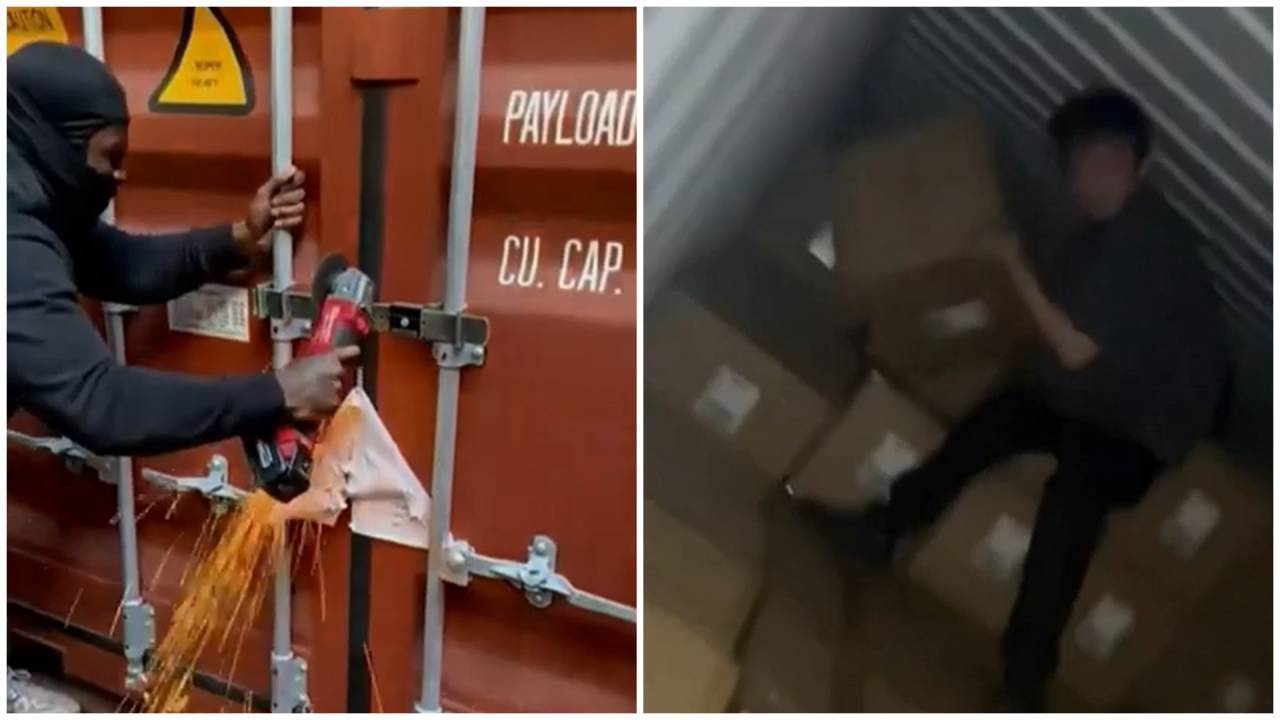
Imagine—as a hypothetical composite drawn from federal court affidavits—a crew of five men crouching behind a stand of Joshua trees near Kingman, Arizona. They aren’t wearing masks straight out of a Western, and they aren’t carrying six-shooters. They are wearing dark hoodies, high-visibility vests stolen from a rail yard, and tactical gloves. One of them holds a pair of heavy-duty bolt cutters. Another holds a burner phone lighting up with real-time GPS coordinates.
When the two-mile-long train slows to a crawl to let an oncoming engine pass on a siding, the men move.
Within ninety seconds, a high-security steel seal is snapped. The heavy corrugated doors of a specific 53-foot container swing open. Inside, stacked floor to ceiling in neat brown cardboard boxes, are thousands of pairs of unreleased Nike sneakers—Air Jordans, Dunks, and limited-edition collaborations destined for retail shelves across the country.
By the time the train’s air brakes hiss and the locomotive lurches forward again, five hundred boxes have vanished into the bed of a waiting U-Haul truck.
This isn't a Hollywood script. According to federal indictments unsealed by the Department of Justice, this exact choreography played out at least thirty-six times across the American Southwest. Fourteen people now stand accused of orchestrating a sprawling, $22.5 million cargo theft racket that turned the desert rail corridors of California and Arizona into a modern-day Wild West.
We tend to think of supply chains as invisible, frictionless tubes. You click a button on your phone; a box appears on your porch forty-eight hours later. We rarely stop to consider the physical vulnerability of the miles in between. Yet when an organized crew can bleed a single footwear giant of more than twenty million dollars in transit, it forces us to confront a jarring reality about how modern commerce actually moves—and how easily it can be hijacked.
The Anatomy of a Modern Train Robbery
To understand how fourteen people pulled off thirty-six separate heists without triggering an immediate nationwide dragnet, you have to understand the blind spots of the American rail system.
I spent three years working logistics dispatch out of the Inland Empire in Southern California—the sprawling warehouse basin forty miles east of Los Angeles where roughly forty percent of all containerized imports enter the United States. Anyone who has worked those docks knows the dirty secret of intermodal freight: once a container leaves the port gates and locks onto a railcar, it enters a digital dead zone.
Unlike an eighteen-wheeler on Interstate 10, which has a driver sitting in the cab checking mirrors and stopping at weigh stations, a freight train can stretch over two miles long. The engineer and conductor sit in the lead locomotive, entirely blind to what is happening a mile and a half behind them. Between the engine and the caboose—which doesn't even exist on modern trains, replaced by a blinking red telemetry box—there are zero eyes on the cargo.
The accused crew didn't just get lucky picking which containers to crack open. Out of five hundred identical steel boxes rolling through the desert, they knew precisely which ones held Nike footwear.
How? Federal prosecutors point to a combination of insider leaks, physical reconnaissance at rail yards, and sophisticated tracking. In the logistics world, manifest data passes through dozens of hands—port clerks, drayage drivers, rail yard spotters, and third-party brokers. If a single link in that chain decides to sell a container number for a few thousand dollars, a two-mile train stops being a mystery and becomes a menu.
Even more audacious was how the crew forced the trains to stop in the middle of nowhere.
Railroad air brakes work on continuous pressure. If that pressure suddenly drops, the entire train locks up automatically—a fail-safe designed to prevent runaway cars. Investigators revealed that thieves along the BNSF and Union Pacific lines frequently sever the air hoses between railcars. To the engineer up front, it registers as a mechanical fault. The train grinds to a halt in a pitch-black stretch of desert miles from the nearest highway patrol cruiser. While the conductor walks a mile back with a flashlight looking for the broken hose, the crew at the rear is already loading boxes into rented box trucks.
It is brutally simple. Low tech meeting high value.
Why Sneakers Are the New Gold Bullion
If you are going to risk decades in federal prison to rob a moving train, you don't steal television sets or refrigerators. TVs are heavy, fragile, and lose half their value the moment they fall off a truck.
You steal sneakers.
Specifically, you steal Nike.
To grasp the economics of this heist, think of limited-edition sneakers not as clothing, but as bearer bonds. A pair of Travis Scott Air Jordan 1s or unreleased Nike Dunks might have a retail price of $150 to $200. The moment they hit the secondary resale market—platforms like StockX, GOAT, or private Discord groups—that same pair can command $800, $1,200, or more.
Better yet, sneakers are completely untraceable. There are no VIN numbers stamped into the rubber soles. There are no IMEI serial chips that Nike can remotely brick the way Apple locks down stolen iPhones from an Apple Store riot. Once a cardboard carton of size 10 Jordans leaves the manifest, it dissolves into a global, multi-billion-dollar gray market where buyers rarely ask where the inventory originated.
Consider what happens next in the lifecycle of a stolen box.
According to court filings, the fourteen defendants didn't stand on street corners hawking shoes out of car trunks. They operated like a legitimate distribution enterprise. Stolen goods were routed to stash houses and commercial storage units in Southern California. From there, the merchandise was sorted by SKU, size, and style, then funneled to third-party resellers, boutique consignment shops, and online storefronts across the country—sometimes before Nike had even officially announced the shoe's release date.
When you see a sneaker influencer unboxing a pair of shoes three weeks early, bragging about their "plug," there is a non-zero chance you are looking at the downstream ripple of a cut air hose in the Mojave Desert.
The Invisible Tax on Everyone Else
It is tempting to look at a $22.5 million loss to a mega-corporation like Nike—a company that pulls in over $50 billion in annual revenue—and shrug. They have insurance, people say. Nobody got hurt.
That reaction misses the quiet, corrosive reality of organized retail and cargo crime.
First, there is the human toll on the tracks. Railroad crews are routinely outmanned and outgunned in isolated areas where cell service is spotty and police backup is forty minutes away. I remember talking to a veteran Union Pacific conductor in Barstow a few years back who told me he stopped walking the length of his train at night when the air pressure dropped. "If I see shadows between the cars," he told me, "I lock the cab door and wait for the sheriff. No box of shoes is worth catching a bullet in the dark."
Second, there is the economic drag that lands squarely on ordinary consumers.
Corporations do not absorb $22.5 million losses out of the goodness of their executive bonus pools. Every snapped bolt, every delayed shipment, every fortified rail yard, and every private security detail hired to patrol the desert gets baked into the cost of doing business. According to the National Retail Federation and supply chain security firm CargoNet, cargo theft across North America surged dramatically over the past two years, with losses reaching hundreds of millions of dollars annually.
When a freight corridor becomes a high-risk zone, insurance premiums skyrocket. Rail operators impose security surcharges. Retailers raise prices by five dollars here, ten dollars there, to offset "shrink." You pay for those thirty-six train robberies every time you buy a pair of running shoes for your kid at the mall.
History Rhyming on Steel Rails
There is a strange, circular irony to watching federal prosecutors file conspiracy and interstate theft charges over train robberies in 2026.
More than a century ago, men like Butch Cassidy and the Sundance Kid made headlines by dynamiting express cars along these exact same Western rail corridors. Back then, the prize was payroll gold and bank notes. The railroads responded by forming the Pinkerton detective agencies, arming guards with shotguns, and building armored cars. Eventually, paved highways and commercial aviation made train robbery seem like a dusty relic of a bygone era.
Yet the fundamental geometry of freight never changed.
America still relies on a sprawling, open-air network of 140,000 miles of track to move goods from coastal ports to inland cities. For decades, that network operated on an unspoken social contract—an assumption that the sheer scale, speed, and isolation of freight rail made it too difficult to rob at scale.
The fourteen suspects in the Nike racket proved that assumption wrong. By combining modern digital tracking with old-fashioned crowbars, they turned the vastness of the American West from a shield into a liability.
The Reckoning on the Tracks
Law enforcement eventually caught up to the crew through the very thing that enabled them: digital footprints.
When you move tens of thousands of pairs of shoes across state lines, you leave a trail. Burner phones ping cell towers near remote desert sidings at the exact minute a train logs an emergency brake application. Rental trucks show up on highway license plate readers heading back toward Los Angeles heavy on their rear axles. Bank accounts swell with unexplained cash deposits and wire transfers from out-of-state sneaker boutiques.
Federal agents—working alongside Union Pacific and BNSF railroad police—spent months stitching those fragments together. They tracked the shipments, surveilled the stash houses, and built a timeline spanning thirty-six separate strikes. When the indictments finally dropped, charging fourteen individuals with conspiracy, theft from interstate shipment, and money laundering, it marked one of the largest cargo theft takedowns in recent history.
But ask anyone who works the rails, and they will tell you that locking up one crew doesn't fix the tracks.
Walk down to the freight lines outside Los Angeles today, and you will see the scars of this quiet war. You will see razor wire coiled atop concrete walls along the Alameda Corridor. You will see high-security steel cable locks—thick as a thumb—securing container doors that used to rely on flimsy tin seals. You will see drones buzzing over rail yards at dusk, scanning the tops of boxcars with thermal cameras.
The romantic myth of the open rail is gone, replaced by a hard, expensive reality.
Every night, as the sun drops behind the San Gabriel Mountains and the desert cools, another two-mile-long train pulls out of the ports, engines roaring against the grade. Inside its steel containers sit the clothes we wear, the phones we hold, and the shoes on our feet. And somewhere out there in the dark, between the creosote bushes and the humming steel rails, the battle to keep them moving has only just begun.