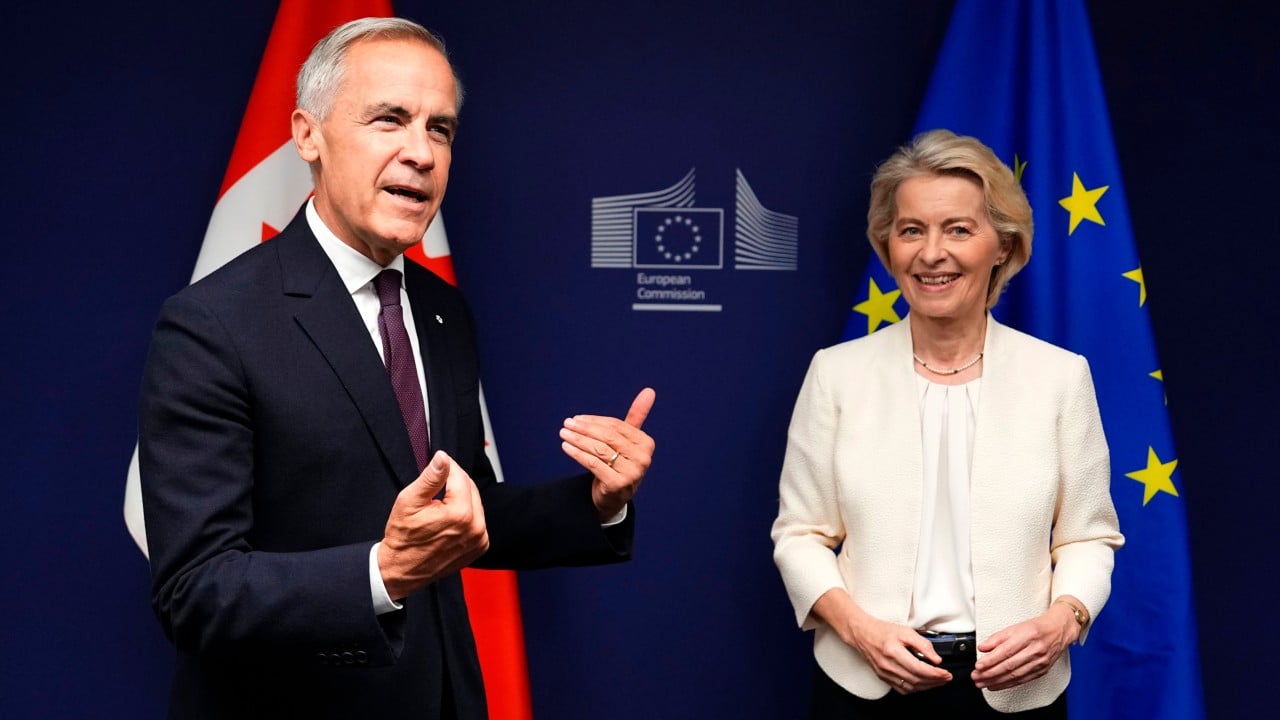
Brussels and Ottawa are getting cozy, and London is watching from the cheap seats.
If you've been paying attention to European politics lately, you've probably noticed a shift in how the European Union approaches its non-EU allies. While the UK spent the better part of a decade untangling itself from continental supply chains, Canada quietly positioned itself as Brussels' favorite reliable partner. Now, as Greater Manchester Mayor Andy Burnham and other senior British figures warn about the lingering economic drag of Brexit, the contrast between Ottawa's access and London's isolation couldn't be sharper.
Let's be honest about what's actually happening here. The UK didn't just leave a political union. It walked away from the world's largest single market without a clear blueprint for what comes next, assuming its historical weight would guarantee preferential treatment forever. That didn't happen. Instead, countries like Canada—which never had to go through a messy divorce with Brussels—are reaping the rewards of patient, predictable diplomacy.
The Reality Of EU Canada Relations Versus Post Brexit Britain
When the Comprehensive Economic and Trade Agreement (CETA) provisionally entered into force back in 2017, plenty of British commentators dismissed it as a watered-down template. During the height of the Brexit negotiations, "Canada-style deal" became a political buzzword in Westminster. Politicians threw the phrase around like it was an easy off-the-shelf solution that offered all the perks of free trade with none of the regulatory obligations.
They missed the point entirely.
Canada spent seven years negotiating CETA to eliminate 98% of tariffs between itself and the EU. Since then, Ottawa and Brussels haven't stood still. They've built joint frameworks on critical raw materials, digital trade standards, green energy transitions, and security cooperation. When European Commission officials look across the Atlantic, they see a G7 partner that shares their regulatory philosophy and actually wants to deepen ties.
Compare that to the UK's Trade and Cooperation Agreement (TCA). Signed in late 2020, the TCA prevented catastrophic tariffs, sure. Yet it erected massive non-tariff barriers that continue to choke British exporters every single day. Rules-of-origin paperwork, sanitary and phytosanitary checks on food, and the loss of passporting rights for financial services have turned routine cross-Channel business into an administrative headache.
Here is what the numbers actually show:
- According to the UK's own Office for Budget Responsibility (OBR), Brexit is projected to reduce long-run UK productivity by around 4% compared to remaining in the EU.
- Goods exports from the UK to the EU have struggled to recover their pre-pandemic, pre-TCA momentum, particularly for smaller firms that can't afford dedicated customs compliance teams.
- Meanwhile, bilateral merchandise trade between Canada and the EU has grown steadily since CETA took effect, surpassing 150 billion Canadian dollars in recent annual counts.
Brussels isn't punishing Britain out of spite. The EU is simply prioritizing partners who bring stability to the table. Canada wants in. Britain spent years trying to get out. Naturally, the doors open faster for the guest who actually wants to be at the party.
Why Andy Burnham And Regional Leaders Are Sounding The Alarm
You don't hear the sharpest critiques of Britain's post-Brexit isolation coming from Westminster frontbenchers. Both major parties in London have spent years treating the "B-word" like radioactive waste, terrified of alienating leave-voting constituencies in the Midlands and the North.
That's where figures like Andy Burnham step in.
As Mayor of Greater Manchester, Burnham sits at the sharp end of the UK's economic reality. When foreign direct investment stalls, or when regional manufacturers complain about supply chain friction with European suppliers, mayors don't have the luxury of hiding behind ideological slogans. They see the empty industrial units and the delayed infrastructure projects up close.
Burnham has repeatedly argued that Britain's current arrangement with the EU isn't working for the regions that were promised a post-Brexit renaissance. Greater Manchester relies heavily on advanced manufacturing, digital tech, and life sciences—sectors that thrive on frictionless cross-border collaboration and talent mobility. Right now, British researchers and businesses face steeper hurdles accessing European networks than their counterparts in countries that never even belonged to the bloc.
It's a bizarre reversal of fortune. For forty years, Britain shaped EU single market rules from the inside. Today, UK manufacturers still have to follow most of those exact same European product standards if they want to sell into the continent, except London no longer gets a seat in the room when those rules are written. Ottawa, through its structured regulatory cooperation forums with Brussels, arguably enjoys a more constructive consultative relationship on emerging tech and green standards than London does.
What Westminster Got Wrong About Leverage
If you sit down with trade negotiators who worked on both sides of the Channel, one theme comes up repeatedly. The UK government fundamentally misunderstood how power works in modern trade blocs.
In 2016 and 2017, the prevailing orthodoxy in Downing Street was that German carmakers and French winemakers would force Brussels to cave to British demands. The thinking went that Europe needed the UK market too much to let trade friction get in the way.
That theory collided with reality almost immediately.
For the EU, protecting the integrity of the single market always outweighed any single bilateral trade relationship. Allowing a departing member to cherry-pick market access without accepting the accompanying obligations would have destroyed the entire European project. Brussels held firm, and London blinked repeatedly, signing a bare-bones deal just days before the transition period expired at the end of 2020.
Canada never made that mistake. Ottawa approached Brussels with a clear understanding of what the EU values—regulatory alignment, multilateralism, and long-term predictability. Because Canada wasn't trying to dismantle existing European institutions, Brussels was willing to get creative. They included mutual recognition agreements for professional qualifications, streamlined conformity assessments, and deep cooperation on clean technology supply chains.
When global supply chains fractured over the past few years, the EU immediately looked to Canada to secure lithium, cobalt, and other critical minerals needed for electric vehicles and renewable energy. Britain, despite having world-class financial and engineering hubs, found itself scrambling to negotiate side deals just to prevent punitive tariffs on electric vehicle batteries traded across the Channel.
The Hidden Cost Of Being A Rule Taker
People love talking about sovereignty in the abstract, yet sovereignty looks very different on a factory floor in Bolton or a logistics hub in Kent.
Right now, Britain is experiencing what economists call "passive divergence." Even when the UK government doesn't actively rewrite laws, the EU keeps updating its own rulebook—on artificial intelligence, carbon border taxes, chemical safety, and data protection. Every time Brussels passes a new regulation, British businesses face an ugly choice. They can either pay to comply with two separate regulatory regimes, or they can quietly adopt the EU standard anyway just to keep their biggest export market open.
Look at the EU's Carbon Border Adjustment Mechanism (CBAM). As Europe phases in tariffs on carbon-intensive imports like steel, cement, and aluminum, British exporters risk getting caught in the crossfire unless the UK links its emissions trading scheme directly with Brussels. Canada, through its ongoing high-level climate and trade dialogues with the European Commission, is actively shaping how transatlantic carbon pricing interacts. Britain is mostly reacting after the fact.
The same pattern shows up in security and defense. Europe's geopolitical landscape changed overnight following Russia's full-scale invasion of Ukraine. You might think Britain's military weight would automatically restore its central role in European decision-making. And while the UK has been a vital bilateral partner on Ukraine, its exclusion from formal EU defense procurement frameworks and industrial strategy talks remains a glaring blind spot. Meanwhile, Brussels is actively exploring deeper security and defense partnerships with non-EU allies—including Canada—that plug directly into European industrial funding.
Can Britain Actually Close The Gap
So where does this leave the UK? Rejoining the EU single market or customs union remains politically off-limits for the current Westminster leadership, regardless of what regional mayors like Burnham say in public. Nobody in Downing Street wants to reopen the constitutional trench warfare of the late 2010s.
Still, standing still means falling further behind. While Brussels deepens its ties with Ottawa, Tokyo, and other global partners, London has to get realistic about what incremental progress actually looks like.
If you're tracking whether Britain is genuinely fixing its European problem or just offering warm rhetoric, watch three specific areas over the coming months:
- Veterinary and sanitary agreements. A formal SPS agreement would wipe out the vast majority of border checks on food and agricultural products moving between Great Britain, Northern Ireland, and the EU. Without it, British food exporters remain stuck in red tape.
- Youth mobility schemes. Brussels has pushed for a reciprocal youth mobility agreement allowing young Europeans and Britons to live, study, and work across borders for limited periods. London has resisted, terrified of anything that looks like free movement, even though Canada, Australia, and New Zealand already enjoy similar bilateral arrangements with the UK.
- Mutual recognition of professional qualifications. Right now, British architects, engineers, and consultants face fragmented national rules across 27 EU member states. Fixing this doesn't require rejoining the single market, just serious technical diplomacy.
Until London treats Brussels as a permanent strategic partner rather than a domestic political talking point, the dynamic won't change. Canada figured out years ago that cooperating closely with the European Union doesn't diminish national independence—it multiplies economic reach. Until Britain learns that same lesson, Andy Burnham won't be the last British leader complaining about watching Europe move on without them.