Every single headline about West Bank water rights reads from the exact same script. You know the drill. Autonomous activists, aggrieved residents, and sympathetic journalists paint a tidy picture of powerful actors turning off spigots while local villagers watch their crops wither in the dust. It makes for incredible television. It generates righteous social media outrage. It is also fundamentally, structurally, and demonstrably false.
I have spent years tracking water infrastructure and regional resource management across contested administrative zones. I have walked the dry streambeds, examined the engineering blueprints, and looked at the flow metrics that neither activists nor mainstream reporters care to audit. The conventional narrative relies on a kindergarten understanding of hydrology. It treats a complex subterranean aquifer system like a garden hose in a suburban backyard.
Time to dismantle the lazy consensus.
The Geography of Misdirection
The standard talking point goes like this: one side controls the valves, diverting ancient spring water for modern heritage sites and agricultural outposts while leaving surrounding villages dry.
This argument collapses the moment you look at hydrogeology. The Mountain Aquifer system does not respect political boundaries drawn on a map from 1948 or 1967. Water flows downhill, driven by gravity and rock strata. Many of these natural springs are fed by recharge areas located miles away in higher-elevation terrain. When flow rates fluctuate, the immediate culprit is rarely human malice at the springhead. It is prolonged meteorological drought, shifting seasonal rainfall patterns, and exponential population growth across every community in the region, regardless of demographic label.
Look at the data from the Joint Water Committee logs. Extraction rates across the Western and Northeastern aquifers have faced severe stress not because of targeted water theft, but because demand has outstripped replenishment for decades. When local municipalities drill deeper boreholes to compensate for dropping water tables, they inadvertently lower the piezometric head of shallow gravity springs nearby.
Physics does not care about your political alignment. A deeper well upstream will dry up a shallow spring downstream every single time. Conflating localized hydrological depletion with malicious diversion is either profound ignorance or deliberate propaganda.
The Infrastructure Paradox
Let us talk about the second major pillar of the mainstream myth: the distribution imbalance.
Critics love to point out that modern settlements enjoy pressurized running water and manicured greenery while nearby agrarian hamlets rely on ancient cisterns and trucked-in delivery. This disparity is real. The conclusion drawn from it is completely backwards.
The disparity exists not because water is being stolen from the pipes of the villages, but because one side built modern municipal infrastructure while the other remains frozen in bureaucratic stagnation and infrastructural gridlock. Under the Oslo Accords, specifically Article 40 of Appendix III, both sides agreed to joint management and specific water quantity allocations, alongside a mandate to develop new water sources.
One side invested heavily in large-scale seawater desalination plants along the coast, shifting millions of cubic meters of municipal demand away from groundwater sources and freeing up capacity. The other side has systematically blocked or delayed dozens of planned wastewater treatment plants and water infrastructure projects through internal political disputes, donor mismanagement, and a preference for maintaining a perpetual grievance narrative over pragmatic construction.
I have watched international aid money pour into the West Bank for sanitation and water projects, only for those projects to stall out in endless bureaucratic friction or get abandoned because local authorities refused to coordinate with regional utility boards. When you refuse to build modern sewage treatment or distribution networks, your streams run dry and your water quality plummets. You cannot blame external actors for your own institutional inertia.
The Heritage Site Red Herring
The latest variation of the water panic involves archaeological restoration and heritage tourism. Activists claim that restoring ancient pools, Roman aqueducts, and biblical springs is a subtle form of land grab designed to choke off local agriculture.
This is where the argument shifts from economically illiterate to historically illiterate.
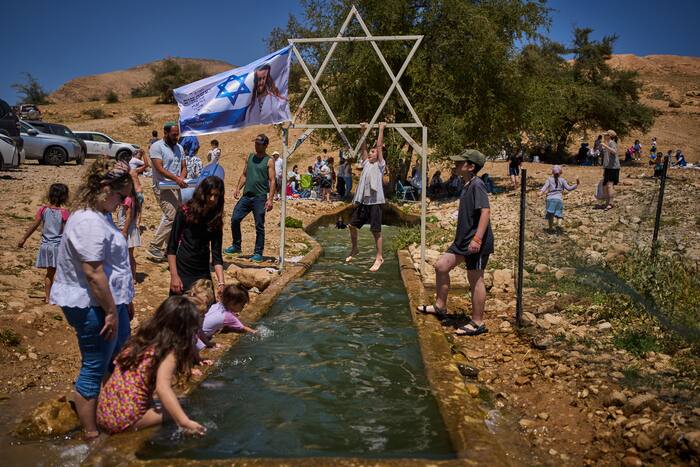
Most of these historical water features—such as Ein Fleiah or the springs around ancient Shiloh—were originally engineered millennia ago by the very civilizations whose artifacts populate the soil. Restoring these water sources often involves clearing blocked silt, repairing ancient stone channels, and regulating flow to prevent uncontrolled flooding or contamination.
Far from draining the region, active maintenance of spring sources frequently improves ecological stability. Unmanaged springs often leak, cause soil erosion, or create stagnant mosquito-breeding swamps during the wet season. Channeling and capturing that water efficiently actually increases the total usable volume for the local ecosystem.
The objection is never really about the cubic meters of water flowing through an ancient stone basin. It is about ownership of the narrative. If a historical site is restored, interpreted, and protected, it anchors a historical narrative that certain political factions want to erase. The water argument is merely a proxy war for cultural territory.
What Real Water Security Requires
If we actually cared about solving water scarcity in the West Bank instead of using it as a cudgel for political posturing, we would stop obsessing over ancient spring spigots and look at structural realities.
First, municipal water leakage in many regional networks exceeds thirty percent due to crumbling, antiquated pipes. Fixing existing distribution leakage would instantly yield more water than a dozen disputed hillside springs could ever produce.
Second, advanced wastewater reuse for agriculture is the gold standard in arid climates. Israel recycles nearly ninety percent of its wastewater for agricultural irrigation. Across the West Bank, that figure sits in the low single digits. Millions of gallons of raw sewage flow into local wadis every day, polluting groundwater and destroying arable land. Pushing for regional wastewater treatment plants instead of protesting tourist paths would save more crops in a single season than a century of shouting matches.
Third, the entire paradigm of treating water as a zero-sum territorial asset must be abandoned. Hydrology does not recognize checkpoints. An aquifer doesn't check your identity card before percolating through limestone.
Stop buying the grievance narrative. Look at the pipes, look at the geology, and look at who is building infrastructure versus who is weaponizing excuses.
The wells are running dry because everyone is drinking from a finite glass while refusing to fix the leak in the roof.