On November 15, 2026, the Trump administration closed the cloud computing loophole that allowed Chinese technology companies to rent remote access to restricted American artificial intelligence chips in third-party countries. Issued by the Commerce Department’s Bureau of Industry and Security (BIS), the new interim final rule treats remote compute access across foreign data centers—including facilities in Singapore, Malaysia, Thailand, Indonesia, and Brazil—as a regulated export. Any facility providing more than 12,000,000 aggregate Total Processing Performance (TPP) to entities headquartered in China or Macau must now secure a federal license within 90 days or cut off service.
For three years, Washington operated under a glaring structural contradiction. Federal export controls banned shipping advanced Nvidia and AMD processors directly to Chinese soil, yet did almost nothing to stop Chinese engineers from logging into those exact same chips over fiber-optic cables in Kuala Lumpur or Singapore. The hardware stayed put. The weights, training runs, and model outputs flowed freely back across the border. If you liked this post, you might want to look at: this related article.
Closing that gap was overdue. The manner in which the White House executed it, however, exposes deep fractures inside Washington’s national security apparatus and hands global data center operators a compliance nightmare that nobody in the industry is ready to police.
How the Cloud Loophole Survived Three Years of Sanctions
When the Biden administration first imposed sweeping semiconductor restrictions in October 2022, regulators wrote rules built for a 20th-century manufacturing economy. Export controls tracked physical crates crossing physical borders. If a server rack containing Nvidia H100 or Blackwell processors landed in a warehouse in Shenzhen, customs agents and BIS investigators had a clear violation. For another perspective on this event, check out the recent update from TechCrunch.
Cloud infrastructure broke that enforcement model entirely. Training a frontier AI model does not require owning the silicon; it only requires renting compute—raw processing cycles measured in floating-point operations—for weeks or months at a time.
A shadow market formed almost overnight across Southeast Asia and the Middle East. Regional cloud providers, often backed by opaque holding companies, bought tens of thousands of high-end American GPUs legally. Those operators then leased bare-metal server capacity via encrypted remote connections to AI labs in Beijing, Shanghai, and Hangzhou. The chips never entered China. On paper, the transactions looked like ordinary enterprise cloud hosting.
Meanwhile, physical diversion flourished alongside remote rental. Congressional disclosures from the House Foreign Affairs Committee revealed that roughly 900,000 advanced AI chips from Nvidia and AMD were approved for sale to Chinese-linked buyers between December 2025 and May 2026 alone. Federal prosecutors had already charged individuals tied to Super Micro Computer in March 2026 over an alleged $2.5 billion scheme to route Nvidia-equipped servers through intermediary shell firms.
The Biden administration tried to address the cloud gap in January 2025 with its global AI Diffusion Rule, a tiered licensing system that capped chip allocations by country. The Trump administration shelved that framework upon taking office, arguing its blanket quotas strangled American hardware exports and alienated allied buyers. For more than a year, the replacement was regulatory silence—a vacuum that turned Southeast Asian data centers into offshore training grounds for Chinese frontier models.
Inside the November 15 Rule That Changed the Math
The new BIS interim final rule formally rescinds the shelved Biden-era diffusion tiers and replaces them with a surgical, threshold-based trap. Rather than capping entire nations, regulators targeted linked data centers and compute aggregation.
Three mechanisms give this rule real teeth:
- The 12 Million TPP Ceiling: BIS measures chip power using Total Processing Performance. Under the new standard, providing remote access exceeding 12,000,000 aggregate TPP to an entity headquartered in Macau or a Country Group D:5 nation (which includes China) triggers a mandatory license. That threshold is less than half of what the prior rule allowed as a low-volume exemption. In practical hardware terms, a relatively modest cluster of high-end accelerators crosses the line immediately.
- Linked Infrastructure Counting: Operators can no longer evade caps by splitting a massive training run across five separate facilities. If separate data centers share workloads or resources as a unified whole, BIS aggregates their combined TPP into a single calculation.
- Strict Operator Liability: Hardware possession now carries direct legal exposure. Even if a data center operator in Thailand or Brazil had zero role in importing the servers, switching a customer workload from a permitted commercial use to a prohibited Chinese training run counts legally as an unauthorized "in-country transfer". American-headquartered hyperscalers operating overseas facilities receive no exemption.
To appreciate how narrow the margin for error has become, consider a hypothetical example. Suppose a regional cloud provider in Johor, Malaysia, operates three mid-sized server halls connected by high-speed fiber. If a subsidiary registered in Singapore—whose parent company traces back to Beijing—rents idle GPU capacity across all three halls to fine-tune a foundation model, the operator has just committed a federal export violation unless it holds a BIS license. Ignorance of the parent company's ownership structure will not hold up in court.
The Geopolitical Collision Behind the Timing
Export rules rarely drop by accident on a Sunday afternoon two days before a presidential flight to Asia. President Trump signed off on the measure right before departing for summit talks with Chinese President Xi Jinping.
Behind closed doors, the rule was drafted not by Commerce Department trade officials, but at the direct insistence of the Treasury Department and the National Security Council. That bureaucratic turf war tells the real story. For months, hawks inside the administration argued that Commerce was dragging its feet while Chinese AI labs narrowed the capability gap to roughly six to twelve months behind American frontier systems.
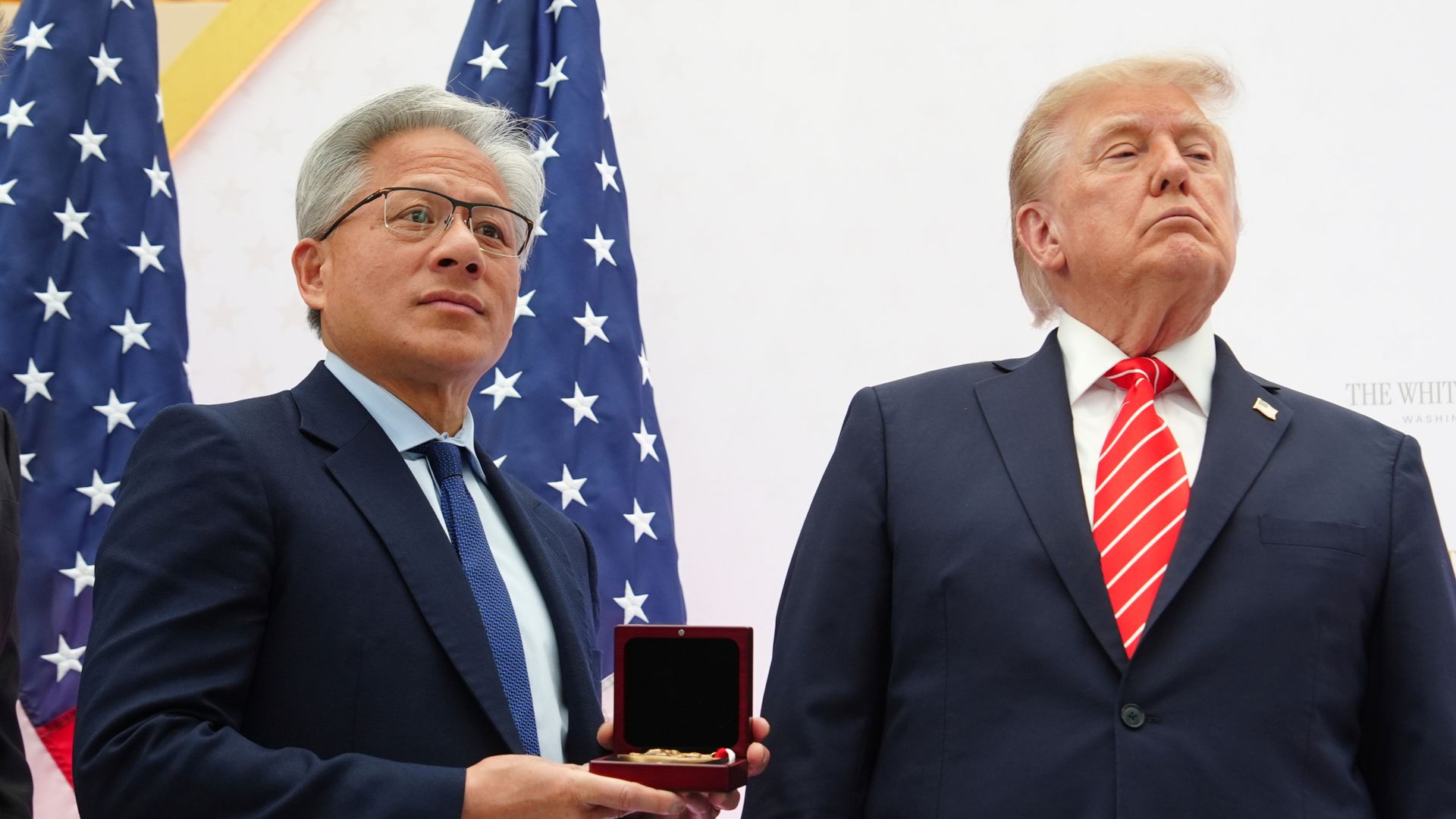
Then came the Nvidia crisis. Days before the rule dropped, Nvidia CEO Jensen Huang stepped down amid mounting scrutiny over personal conduct and intense federal scrutiny of the company's overseas distribution channels, including Justice Department inquiries into major Singapore-based buyers like Megaspeed. With Capitol Hill demanding hearings and Nvidia's market valuation swinging violently, the White House needed immediate proof that it was not handing Beijing the keys to superintelligence ahead of bilateral negotiations.
Trump himself acknowledged the internal split on the White House lawn before boarding Air Force One, noting the tension between advisers who warned against insulting Beijing right before a summit and hawks who demanded aggressive action. The hawks won the text of the regulation. Whether they win its enforcement remains an open question.
Why Enforcement Could Still Collapse in Practice
Closing a legal loophole on paper is easy. Policing teraflops inside foreign server farms is another matter entirely.
The new regulation relies heavily on expanded Know Your Customer (KYC) mandates. If a foreign data center refuses or fails to provide enough documentation to verify who is using its compute, American chip exporters are legally presumed to have knowledge of a violation. BIS also added a sweeping "is informed" clause allowing officials to notify individual firms privately that specific customers require licenses.
Yet three massive blind spots threaten to undermine the entire framework:
1. The Domestic Loophole Remains Wide Open
As national security analysts have pointed out, the November 15 rule targets foreign data centers. It does not stop Chinese-affiliated entities from renting cloud capacity inside data centers located on United States soil. Because domestic cloud rentals do not cross an international border, BIS export jurisdiction does not automatically apply. Unless Congress passes legislation closing domestic cloud access, Chinese developers could simply shift their remote training runs from servers in Singapore to servers in Northern Virginia.
2. Financial Sanctions Have Teeth; Chip Rules Do Not
When the U.S. Treasury sanctions a bank in Dubai or Zurich, compliance officers enforce the ban instantly because losing access to the U.S. dollar clearing system means instant corporate death. Semiconductor export controls have no equivalent kill switch. Once an Nvidia Blackwell rack is bolted into a private data center in Southeast Asia, Washington cannot remotely audit every virtual machine spinning up inside that facility. Software telemetry and hardware-level location verification have been debated in Congress under proposals like the Chip Security Act, but physical chips currently lack tamper-proof geofencing.
3. Shell Companies Move Faster Than Federal Auditors
A determined AI lab in China does not rent servers under its own corporate banner. It routes payments through three layers of shell corporations registered in Cayman, Hong Kong, and Singapore, using local proxy engineers to manage SSH keys and model checkpoints. Data center operators in Malaysia or Thailand, facing intense pressure to monetize multi-billion-dollar infrastructure investments, have minimal financial incentive to play detective when a paying customer presents clean incorporation papers.
What Cloud Operators and Chipmakers Must Do Now
The 90-day grace period built into the November 15 rule is ticking. Data centers currently supplying heavy compute to Chinese-linked firms face a binary choice before February 2027: file a formal BIS license application—which carries a near-certain presumption of denial for frontier training—or terminate those contracts.
For American semiconductor suppliers and server builders, passive compliance is dead. Selling hardware to an intermediary distributor without auditing the downstream end-user's workload logs now creates direct legal liability. Companies that suspect prior shipments violated existing end-use rules have been explicitly instructed by BIS to submit voluntary self-disclosures before federal investigators knock on their doors.
Washington finally admitted that compute, not cargo, is the real battleground of the AI race. Until regulators build technical verification directly into the silicon and close the domestic server gap on U.S. soil, Beijing will keep looking for the next fiber-optic backdoor.