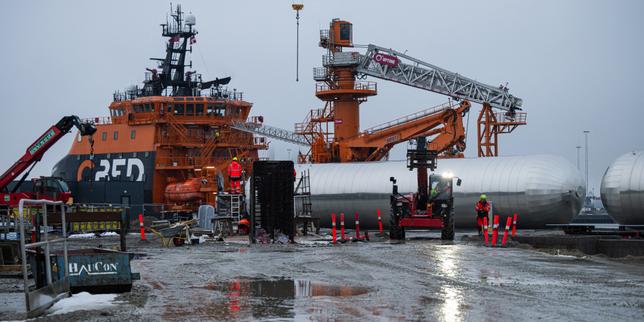
Saltwater does not care about our ambitions. It rolls across the North Sea in heavy, grey swells, indifferent to the steel rigs piercing its surface or the political summits happening thousands of miles away. Down there, in the dark, silence reigns.
For decades, we treated the sky like an open sewer. We pumped the ancient breath of ferns and swamps—trapped for millions of years beneath the earth—straight into the air we share. We watched the numbers tick upward on climate charts, felt the summers grow sharper and more hostile, and wondered when the bill would finally come due.
Now, off the coast of Denmark, a massive metal artery is trying to pump it all back down.
Category: technology
Step onto the deck of the enterprise vessels hovering over the depleted oil fields of the Danish sector. The wind whips salt against your cheeks. The roar of the generators is a constant, low vibration in your chest. Here, engineers are no longer just talking about reducing emissions. They are performing a kind of geological salvage operation, trying to stuff the smoke back into the chimney of the earth.
This is the story of Project Greensand, and the quiet, heavy-stakes gamble happening a mile beneath the seabed.
The Weight of an Invisible Enemy
Carbon dioxide is a ghost. You cannot see it. You cannot smell it. It fills the room, wraps around the planet, and traps the heat of the sun with terrifying efficiency. We have spent generations learning how to pull carbon out of the ground, burn it to power our lives, and let the invisible residue vanish into the atmosphere.
Stopping that release entirely is the dream. But reality is messier. Heavy industry, cement production, steel manufacturing—these processes create emissions simply by existing. You cannot easily replace the chemical reactions that make steel with pure optimism.
So, what do you do with the exhaust you cannot prevent?
You catch it. You squeeze it until it turns into a liquid, cold and pressurized. And then, you send it on a very long, very deep one-way trip.
Imagine standing in a control room where the air smells faintly of coffee and stale sweat. Screens flicker with green and red lines of data. Pressure gauges hold steady. Outside the reinforced glass, tankers and injection platforms sit like industrial spiders on the water. They are handling a substance that nobody wanted, packed tight into specialized containers, preparing to force it down through exhausted sandstone reservoirs that once held crude oil.
It feels wrong. Pumping waste back into the planet feels like sweeping dirt under a rug on a planetary scale.
Yet, the geologists and engineers running these projects insist the math is sound. The oil and gas stayed trapped down there for twenty million years under immense natural pressure. Why shouldn't a carefully chosen, monitored rock formation hold compressed gas for a few centuries?
The Engineering of Return
To understand what Denmark is doing, you have to look past the political speeches and look at the physics.
Carbon capture and storage, or CCS, is often talked about as a silver bullet by politicians who want to avoid hard lifestyle choices. It is dismissed by cynics as a greenwashing fantasy designed to keep fossil fuel extraction alive. Both groups miss the messy, grinding reality of the engineering.
First, you have to capture the gas at the smokestack before it escapes. That requires massive chemical absorption towers—complex facilities where exhaust gases bubble through solvents that trap the carbon. It is loud, energy-intensive, and expensive.
Next comes the transport. You compress the gas until it behaves like a dense liquid. It travels through pipelines or gets loaded onto specially designed ships—vessels that look ordinary from the outside, but house cryogenic tanks chilled to sub-zero temperatures.
Finally, you reach the wellhead.
This is where the nerves kick in. When the injection pumps start pushing the liquid carbon down the well, every pressure sensor is watched like a newborn's monitor. The fluid travels down thousands of meters of steel casing, past layers of impermeable shale, until it reaches the targeted sandstone layer.
Sandstone looks solid to the naked eye, but under a microscope, it is a sponge. It is riddled with microscopic pores filled with ancient water. As the liquid carbon enters these spaces, it displaces the brine. Over time, something remarkable happens. The carbon dissolves into the remaining water, reacting chemically with the surrounding minerals. It turns into stone. It mineralizes. It locks itself away into the very structure of the earth.
At least, that is the theory. And in the North Sea, they are betting everything that nature will keep its promise.
The Human Equation
We tend to view technology as an abstraction. We talk about megatons of carbon, gigawatts of power, and injection rates as if these are numbers on a spreadsheet, detached from human hands.
Meet the technicians working twelve-hour shifts on the North Sea platforms. They are roughnecks turned environmental custodians. Many of them spent their early careers drilling for the very oil that created the crisis we are now trying to clean up. There is a quiet irony in that transition. They spent decades cracking the earth open to extract fuel, and now they are spending their days patching the vault shut.
They don't talk much about climate policy while they check the valves. They talk about pipe corrosion, seal integrity, and weather windows. A storm in the North Sea can turn a routine maintenance check into a vertical rollercoaster. They strap themselves into harnesses, feeling the howl of the wind and the freezing bite of sea spray, knowing that a single faulty valve could compromise a multi-million-dollar injection cycle.
Their labor is unglamorous. It does not make for inspiring campaign ads. But without them, the grand climate targets signed in European capitals are just ink on parchment.
The Dangerous Allure of Easy Answers
We must confront the discomfort of this solution.
Storing carbon underground does not solve our addiction to consumption. It treats the symptom, not the cause. It is a lifeboat, not a destination. Critics are right to warn that relying too heavily on storage technologies could give polluters an excuse to keep burning fossil fuels indefinitely, treating the earth's crust as an infinite garbage can.
If we pump carbon down while continuing to pull more oil up, we are running on a treadmill that only gets faster.
The Danish initiative is not a license to carry on as usual. It is an emergency brake for the industries that simply cannot decarbonize overnight. It buys time. And time is the one commodity we are running out of faster than oil.
Consider the alternative. If we do nothing—if we refuse to utilize storage because the technology is imperfect, because it is expensive, because it feels like cheating—we are left with an atmosphere choking on its own history. We are choosing ideological purity over atmospheric survival.
The engineers on the North Sea rigs aren't philosophers. They are pragmatists. They look at the volume of carbon pouring out of our industrial centers, look at the empty reservoirs beneath their feet, and decide to connect the two.
The Horizon
Back on the coast, the Danish coastline stretches flat and green against the grey water. Families walk their dogs along the dunes, breathing air that feels crisp and clean, far removed from the smokestacks of heavy manufacturing and the high-pressure noise of the offshore platforms.
They do not think about the sandstone formations a thousand meters beneath the seabed. They shouldn't have to. That invisible labor belongs to the quiet machinery of survival.
As the sun dips below the horizon, painting the North Sea in bruised shades of purple and amber, the injection pumps keep turning. Deep in the dark, drop by drop, a civilization tries to put the genie back in the bottle. It is a desperate, brilliant, deeply human endeavor—flawed, messy, and entirely necessary.
The waves keep rolling in, washing over the steel anchors, indifferent to our panic, waiting to see if we can fix the damage before the tide comes in.


