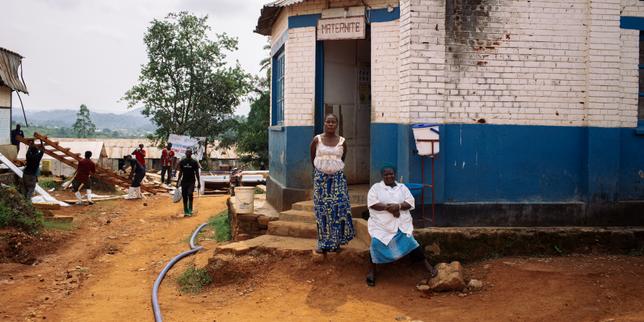
The heat in the eastern Democratic Republic of Congo does not just sit on your skin; it presses into your lungs. In the makeshift clinics of North Kivu, the air carries a heavy, metallic weight. It is the smell of bleach, sweat, and terror. For months, the Ebola virus has ripped through these hills, but its most devastating path is one that rarely makes the global headlines. It tracks the quietest rooms. It targets the women carrying the future.
Consider a woman named Alphonsine. She is a composite of the dozens of mothers, midwives, and daughters who have walked through these isolation ward doors, but her reality is entirely accurate to the clinical data coming out of the zone. She is seven months pregnant. Under normal circumstances, her community would be preparing a celebration. Instead, her body has become a battlefield. Her fever is spiking. Her joints feel as though they are filled with broken glass.
When Ebola enters a community, it does not strike randomly. It exploits human kindness. It attacks the caregivers, the traditional birth attendants, and the mothers who wipe the brows of their feverish children. Because women bear the weight of caregiving in this region, they find themselves on the front lines of an invisible war. When those women are pregnant, the virus transforms from a severe threat into a near-certain catastrophe.
The medical reality is brutal. Historically, the mortality rate for pregnant women infected with Ebola has hovered near 90 percent. The virus has a terrifying affinity for the placenta. It concentrates there, creating a highly infectious reservoir that shields itself from the mother’s fading immune system. For an unborn child, the prognosis is even darker. The transmission rate from an infected mother to her fetus is almost absolute. It is a dual death sentence carried out in the dark.
But the numbers do not capture the quiet horror of the isolation ward.
Step inside the red zone. The rustle of yellow biohazard suits is constant. It sounds like dried leaves dragging across concrete. To a patient inside, the doctors and nurses are faceless ghosts, their eyes hidden behind fogged goggles, their voices muffled by thick masks. There is no human touch. Every interaction is mediated by layers of thick rubber.
For a pregnant patient, the isolation is magnified by a devastating biological law. Even if a mother miraculously survives the virus, her womb often remains infected. The amniotic fluid can remain a toxic well long after her blood clears. This means that a surviving mother cannot hold her newborn. She cannot comfort a child that might be dying from the very illness she just defeated. The psychological toll is a heavy, suffocating fog that no medication can clear.
The systemic failure compounds the biological tragedy. In the eastern DRC, decades of conflict have left the healthcare infrastructure fractured. Roads are frequently cut off by armed groups. Distrust runs deep. When health workers arrive in terrifying protective gear, demanding that patients leave their families, many choose to hide. They deliver their babies at home, in secret, assisted by traditional midwives who have no access to gloves, masks, or clean water.
One home delivery can ignite an entire village outbreak. The fluids associated with childbirth carry the highest viral loads imaginable. A single act of communal love—helping a neighbor bring a new life into the world—becomes the catalyst for a dozen funerals.
We often view epidemics through the lens of cold logistics. We talk about vaccine distribution, contact tracing, and treatment protocols. These are essential, of course. The development of new therapeutics and the deployment of the Ervebo vaccine have changed the trajectory of recent outbreaks. They offer a shield where there used to be only a shroud.
The real problem lies elsewhere. A vaccine is useless if it stays in a temperature-controlled freezer in Goma because the roads to the rural clinics are too dangerous to travel. A therapeutic drug cannot save a woman who arrives at the treatment center only after she has been bleeding for three days in her village, terrified that the doctors will harvest her organs—a rumor that spreads faster than the virus itself.
To truly understand the stakes, look at the healthcare workers who refuse to run. Many of them are local women, nurses who knew the risks long before the international agencies arrived. They operate in a state of perpetual vigilance. Every drop of blood is a potential hazard. Every cough could mean a week of agonizing uncertainty. They watch their colleagues fall ill, yet they return to the wards the next morning. Their expertise is not just clinical; it is deeply cultural. They are the ones who know how to speak to a terrified husband, how to explain the necessity of a safe burial without stripping a family of their dignity.
The fight against Ebola in the DRC is not a data point on a global health chart. It is a sequence of agonizing, deeply personal choices made every single day in the mud-walled clinics of North Kivu. It is a pregnant teenager deciding whether to walk toward the faceless figures in yellow suits or stay hidden in her bedroom. It is a nurse deciding to touch a dying patient’s shoulder with a gloved hand, offering the only piece of humanity left in a world stripped of it.
Outside the clinic, the sun begins to dip below the jagged green horizon of the Nyiragongo hills. The air cools slightly, but the tension never dissipates. Inside, a monitor beeps rhythmically, a fragile counterweight to the silence of the surrounding jungle. A woman holds her breath, waiting for a test result that will determine whether her future will be counted in decades, or in hours.