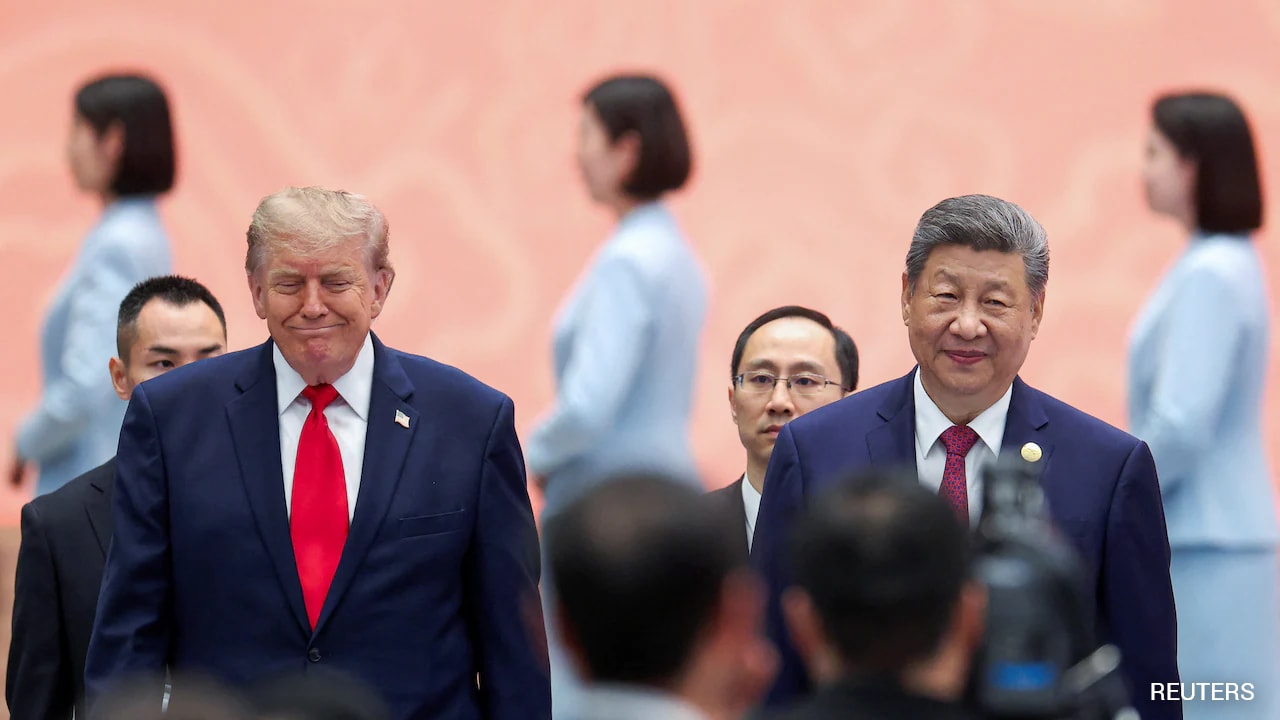
Every foreign policy pundit in Washington is currently clutching their pearls over a single sentence. When Donald Trump casually remarked that the United States spies on China—and does it better—right before high-stakes talks with Xi Jinping, the mainstream media immediately defaulted to its favorite script. They called it reckless. They called it unpresidential. They framed it as a diplomatic hand grenade tossed into a delicate negotiation room.
That consensus is lazy, historically illiterate, and completely backward.
The outrage relies on a Victorian fantasy of statecraft where diplomats pretend espionage doesn't exist while intelligence agencies quietly run multi-billion-dollar budgets behind closed doors. Treating Trump’s admission as a diplomatic blunder misses the entire point of modern coercive diplomacy. Saying the quiet part out loud wasn't a slip of the tongue. It was a calculated flex designed to shatter Beijing’s information advantage before anyone even sat down at the table.
The Myth of Polite Espionage
Mainstream coverage of intelligence operations suffers from a terminal case of theater-kid syndrome. Commentators act as though international relations operate like a polite dinner party where mentioning the silverware gets you kicked out.
In reality, espionage is the baseline currency of superpower competition. Every major intelligence apparatus—from the CIA and NSA to China’s Ministry of State Security (MSS)—operates under the absolute certainty that the other side is inside their networks, reading their cables, and recruiting their assets. Nobody in Zhongnanhai gasped when Trump said the US spies on China. Xi Jinping has spent the last decade orchestrating the most aggressive cyber-espionage and human intelligence campaign in modern history, from the Office of Personnel Management breach to the Salt Typhoon telecom infiltrations.
When traditional Washington insiders insist on "plausible deniability," they aren't protecting national security. They are protecting an outdated etiquette that benefits the aggressor. For years, Beijing has operated in the gray zone—stealing terabytes of intellectual property, mapping critical US infrastructure, and infiltrating defense contractors—while relying on Washington’s obsession with diplomatic decorum to keep the confrontation compartmentalized.
By openly declaring superiority in espionage right before bilateral talks, Trump stripped away the polite fiction. He forced the reality of the shadow war onto the main stage. You cannot compartmentalize cyber theft and intelligence warfare when the American president explicitly links them to the negotiating table.
Why "We Do It Better" Is a Psychological Trap
Look closer at the phrasing. Trump didn't just admit to spying; he framed it as a competitive metric. "We do it better."
To a conventional diplomat, bragging about intelligence capabilities is heresy because it risks burning sources and methods. To a strategist who understands authoritarian psychology, it is poison injected directly into the opponent's decision-making loop.
Authoritarian regimes like the Chinese Communist Party run on paranoia and information control. Xi Jinping’s entire governance model relies on vertical loyalty, strict compartmentalization, and the belief that the Party sees everything while outsiders see nothing. Over the past few years, Beijing has systematically blinded Western intelligence—dismantling CIA networks in the early 2010s, locking down corporate data flows, and passing sweeping anti-espionage laws that turned basic due diligence into a criminal offense.
When the US president publicly boasts that American intelligence still penetrates Beijing's walls better than the MSS penetrates Washington's, it triggers an immediate internal crisis in Beijing.
Imagine a scenario where you are a senior intelligence official in Beijing the morning after that statement airs. You don't know if the American president is bluffing, or if he just read a morning brief pulled directly from a compromised Politburo server. You are forced to spend months launching internal counterintelligence purges, auditing secure communications, and second-guessing the loyalty of your own inner circle.
Look at the real-world precedent. The abrupt, unexplained removals of China’s Foreign Minister Qin Gang and Defense Minister Li Shangfu—alongside sweeping purges across the People's Liberation Army Rocket Force—demonstrated just how deeply rumors of Western intelligence penetration can paralyze Beijing's upper echelons. Even without releasing a single classified document, the mere assertion of intelligence dominance forces an authoritarian system to turn inward and eat itself.
The False Premise of "De-Escalation First"
If you search for analysis on US-China summitry, you will inevitably run into the same tired questions: Will blunt rhetoric derail trade talks? Does acknowledging espionage hurt diplomatic trust?
Both questions are built on a broken premise. They assume that "trust" is a prerequisite for a deal with Beijing, and that smooth rhetoric produces substantive concessions.
Decades of diplomatic wreckage prove the exact opposite. Every administration since Richard Nixon has tried the "trust-building" approach—muting criticism, downplaying intelligence friction, and offering symbolic gestures to create a warm atmosphere for talks. Beijing pocketed the goodwill every single time, signed vague communiqués, and accelerated its military buildup and industrial espionage the moment the cameras turned off.
Trust does not exist between hegemonic rivals. Only leverage does.
In high-stakes negotiations with a Leninist state, warmth is interpreted as weakness, and restraint is read as fear. When a leader signals that they know what the other side is doing, possess superior capabilities, and are entirely unafraid of public friction, the dynamic shifts. Beijing doesn't respect diplomats who follow the rules of Foggy Bottom; Beijing respects power that threatens its core survival mechanisms.
The Real Risks Nobody Is Talking About
Taking a contrarian stance doesn't mean ignoring genuine operational hazards. While the mainstream media is hyperventilating over diplomatic etiquette, they are completely missing the actual dangers of weaponizing intelligence rhetoric in public.
There are two legitimate downsides to this approach, and neither has anything to do with hurting Xi Jinping’s feelings:
- The Burned-Asset Reflex: When political leaders boast about intelligence superiority, intelligence agencies face immediate pressure to prove it—or risk having sensitive human sources exposed by frantic counterintelligence sweeps. Following the 2010–2012 collapse of the CIA’s human network in China, rebuilding assets inside a hyper-surveilled police state took over a decade. Loose talk from the top can inadvertently narrow the haystack for Beijing’s counter-espionage units, turning a strategic bluff into a tactical bloodbath for officers on the ground.
- Escalation Dominance Traps: Publicly claiming you "do it better" sets a benchmark that demands validation. If a major Chinese cyber operation—like a crippling attack on US power grids or water systems—becomes public three months later, the administration looks impotent. Deterrence only works if the capability behind the rhetoric holds up under stress.
These are serious operational trade-offs. They require tight coordination between the White House and the Intelligence Community to ensure that public signaling doesn't compromise technical collection platforms or human networks.
Stop Reading Diplomacy Like a Press Release
The fundamental flaw in modern political commentary is treating international diplomacy as a public relations exercise. Pundits evaluate leaders based on how well they adhere to a script written by career bureaucrats who have never negotiated a hostile takeover or stared down an adversary who wants to replace the global order.
Diplomacy between superpowers isn't a polite conversation. It is a continuous, multi-domain collision where economics, military posture, cyber warfare, and intelligence operations bleed into one another. Pretending that espionage sits in a separate box from trade or security talks is self-imposed blindness.
When you walk into a room with an adversary who has spent twenty years robbing your treasury, mapping your infrastructure, and subverting your supply chains, you don't open with an apology or a platitude about mutual respect. You put your hand on the table, look them in the eye, and let them know you can see their cards.
Stop asking whether Trump’s comments violated diplomatic norms. Start asking why those norms kept failing the country that invented them.