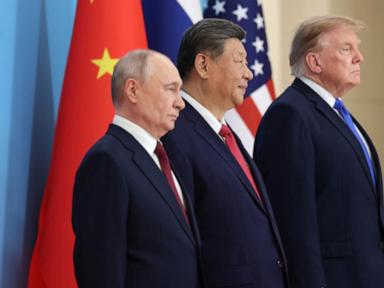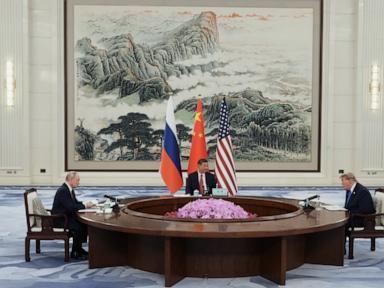
Trilateral nuclear negotiations between the United States, China, and Russia fail to produce binding treaties because a three-body deterrence equation cannot be solved with bilateral arithmetic. When Donald Trump, Xi Jinping, and Vladimir Putin convene to discuss nuclear risks and emerge without concrete agreements, conventional diplomatic reporting treats the outcome as a failure of political will. That diagnosis misses the structural reality. A meeting that produces no treaty is not an empty diplomatic exercise; it is the predictable equilibrium of three asymmetric nuclear arsenals operating under incompatible strategic doctrines, divergent force postures, and irreconcilable verification constraints.
To evaluate the strategic utility of high-level trilateral nuclear talks, analysts must separate theatrical diplomacy from structural arms control. The absence of a formal communique or warhead cap reflects four interlocking mechanisms: the breakdown of bilateral parity math, the asymmetry of conventional-nuclear entanglement, the verification paradox in non-deployed stockpiles, and the distinct domestic risk-tolerance curves of Washington, Beijing, and Moscow.
The Three-Body Deterrence Problem
Cold War arms control functioned because it was a two-player zero-sum game. Under bilateral frameworks such as the Strategic Arms Reduction Treaties, Washington and Moscow could measure stability through rough numerical parity. If Party A deployed 1,550 strategic warheads, Party B required an equivalent figure to maintain an assured second-strike capability.
Introducing China into this equation destroys linear parity. The tripolar nuclear balance creates what strategic theorists call the Two-Against-One Contingency.
- The American Dilemma: Washington must size its nuclear force to deter both Moscow and Beijing simultaneously. If the United States reduces its deployed arsenal to match Russia, it risks falling behind the combined warhead count of a potential Sino-Russian alignment. Conversely, if Washington builds up to deter both rivals concurrently, Moscow and Beijing interpret the expansion as a bid for first-strike supremacy, triggering an offensive arms race.
- The Chinese Dilemma: Beijing maintains a smaller, rapidly modernizing nuclear force designed around assured retaliation rather than numerical parity. Entering a binding cap freezes China in a position of permanent quantitative inferiority relative to both the United States and Russia. For Beijing, transparency equals vulnerability; revealing exact silo locations and warhead counts degrades the survivability of a smaller deterrent.
- The Russian Dilemma: Moscow relies heavily on nuclear weapons to offset conventional military attrition and NATO technological advantages. Russia refuses to enter trilateral caps unless the nuclear arsenals of France and the United Kingdom are included in the Western ledger, a demand Washington rejects because British and French forces operate under independent national command structures.
Because each state optimizes against a different threat matrix, no single numerical ceiling satisfies all three capitals simultaneously.
Structural Asymmetries Across the Three Arsenals
Standard media coverage treats "nuclear risks" as a uniform category. In operational planning, risk is segmented across delivery systems, alert statuses, and warhead classes. The deadlock between Trump, Xi, and Putin stems directly from mismatched force structures.
Strategic vs. Non-Strategic Warheads
The United States and Russia historically regulated strategic delivery vehicles—intercontinental ballistic missiles, submarine-launched ballistic missiles, and heavy bombers. However, Russia maintains a massive advantage in non-strategic, or tactical, nuclear weapons designed for battlefield use. Washington insists that any future framework must capture all warhead types. Moscow refuses to negotiate away its tactical stockpile without corresponding limits on American missile defense systems and long-range conventional precision weapons.
The Breakout Velocity Gap
China is currently executing the fastest nuclear expansion in modern history, constructing hundreds of new missile silos and expanding its road-mobile launcher fleet. For Beijing, agreeing to a freeze during an active buildup halts its trajectory before it achieves what it views as a secure minimum deterrent against American missile defenses. The United States seeks to cap China's growth trajectory now; China seeks to reach its target plateau before discussing limits.
Command, Control, and Early Warning
Strategic stability depends on decision time. Both Washington and Moscow operate space-based infrared early-warning satellites and over-the-horizon radars capable of detecting a launch within seconds. China has historically lacked a comprehensive space-based early-warning architecture, relying instead on a strict "no first use" declaratory policy and de-mated warheads stored separately from missiles. As Beijing transitions toward a launch-on-warning posture with Russian technical assistance, the risk of miscalculation during a crisis increases. Yet formalizing crisis-communication protocols requires disclosing technical parameters of command networks that all three militaries treat as classified vulnerabilities.
Why Diplomatic Stalemates Still Alter Risk Profiles
Dismissing a summit with no treaty as a failure ignores how executive-level engagements function as risk-management mechanisms. When formal treaties expire or collapse—such as the demise of the Intermediate-Range Nuclear Forces Treaty and the suspension of New START inspections—intelligence agencies lose ground-truth visibility into adversary deployments.
In the absence of on-site inspections, military planners default to worst-case threat assessments. If a satellite detects a new construction site in western China or a modified submarine hull in a Russian shipyard, defense analysts must assume maximum payload capacity and highest readiness levels. Those assumptions drive budget requests for counter-deployments, accelerating the security dilemma.
Direct dialogue among Trump, Xi, and Putin serves three tactical functions even when no documents are signed:
- Intent Signaling: Leaders establish personal red lines regarding the integration of artificial intelligence into nuclear command-and-control systems. Keeping human decision-makers in the loop is a shared interest that requires no formal verification regime to establish as a baseline norm.
- Crisis Channel Validation: High-level meetings force national security bureaucracies to test and update direct communication hotlines between strategic commands, reducing the friction of diplomatic routing during an acute regional crisis in Eastern Europe or the Indo-Pacific.
- Escalation Management: By separating nuclear risk reduction from active proxy conflicts and trade disputes, the three leaders create a diplomatic firewall. This prevents conventional friction in the South China Sea or Ukraine from automatically spilling over into strategic nuclear signaling.
The Verification Bottleneck
Even if Trump, Xi, and Putin agreed in principle to limit warhead production, executing the agreement faces a severe technical bottleneck: non-intrusive verification.
Traditional arms control verified delivery systems—counting bombers on a tarmac or missile tubes on a submarine via spy satellites. Modern nuclear competition centers on warheads in storage, hypersonic glide vehicles, and dual-capable missiles that can carry either conventional or nuclear payloads.
- The Dual-Capable Ambiguity: Systems like China's DF-26 intermediate-range missile or Russia's Iskander can be armed with conventional explosives or nuclear warheads. If a satellite tracks a dual-capable brigade deploying during a regional conflict, the opposing military cannot determine whether it faces a conventional strike or a nuclear threshold breach. Verifying warhead types requires physical portal monitoring and radiation-detection equipment at production facilities—measures Beijing views as legalized espionage.
- Hypersonic Trajectories: Unlike ballistic missiles, which follow predictable parabolic arcs, hypersonic glide vehicles maneuver at lower altitudes. This compresses radar detection windows and obscures the intended target until the final minutes of flight, eroding crisis stability regardless of total warhead counts.
No diplomatic summit can resolve a verification problem that current sensor technology and national security doctrines cannot accommodate.
Separating Known Facts from Strategic Hypotheses
Evaluating the trajectory of trilateral nuclear diplomacy requires strict discipline regarding what is observable versus what is inferred.
Known Facts:
- The bilateral architecture that governed strategic stability between Washington and Moscow for five decades has largely dissolved, leaving no active inspection regimes verifying warhead limits.
- China is actively expanding its fissile material production capacity, plutonium breeder reactors, and intercontinental delivery systems.
- All three nations are investing heavily in multi-domain capabilities—including cyber warfare, anti-satellite weapons, and missile defense—that directly threaten the survivability of nuclear command-and-control networks.
- High-level trilateral engagement establishes top-down political authorization for lower-level military-to-military risk-reduction talks, which otherwise stall in bureaucratic paralysis.
Educated Hypotheses:
- The Asymmetric Freeze Hypothesis: China will not agree to numerical parity limits until its deployed strategic warhead count reaches a threshold perceived by the Central Military Commission as sufficient to survive an American first strike and penetrate US homeland missile defenses.
- The Linkage Hypothesis: Moscow will continue to hold nuclear risk-reduction talks hostage to broader European security demands, using strategic instability as diplomatic currency to extract concessions on sanctions and conventional force deployments.
- The Algorithmic Risk Hypothesis: The immediate danger of accidental nuclear escalation stems less from warhead numbers and more from the compression of decision timelines caused by hypersonic weapons, cyber intrusions into early-warning networks, and automated target-recognition systems.
Limitations of Summit-Driven Arms Control
Relying on leader-level summits to manage tripolar nuclear risk carries inherent structural flaws. Executive diplomacy is episodic, whereas weapons modernization is continuous. A single meeting cannot override decades of institutional momentum within defense ministries and nuclear weapons laboratories.
Furthermore, personal agreements between leaders lack legal durability. Without Senate ratification in the United States or formal institutional codification in Beijing and Moscow, executive understandings evaporate with leadership transitions or sudden geopolitical shocks. Summit diplomacy can lower the diplomatic temperature temporarily, but it cannot substitute for legally binding, verifiable constraints on force posture.
The Strategic Play for Tripolar Stability
Given that formal trilateral warhead treaties are structurally unviable in the near term, policy planners and defense strategists must abandon the pursuit of comprehensive numerical caps. Continuing to demand Cold War-style parity agreements guarantees diplomatic deadlock while leaving operational risks unaddressed.
Instead, Washington, Beijing, and Moscow should pivot immediately to behavioral arms control—targeting specific operational practices rather than total arsenal sizes:
- Codify Nuclear-Conventional Separation: Establish mutual transparency protocols prohibiting the co-mingling of nuclear and conventional warheads at the same storage facilities and launch bases, reducing the risk of misinterpreting a conventional mobilization as a nuclear alert.
- Ban Cyber and Kinetic Interference with Early Warning: Execute a trilateral executive declaration designating space-based early-warning satellites and nuclear command-and-control nodes as off-limits to cyberattacks and anti-satellite weapons during both peacetime and conventional conflicts.
- Mandate Pre-Launch Notifications: Expand existing bilateral ballistic missile launch notification agreements into a unified trilateral data-exchange center that covers hypersonic glide vehicle tests and space-launch vehicles.
- Institute AI Firewalls: Formalize a binding operational standard requiring explicit human authorization for all nuclear launch sequences, barring autonomous or semi-autonomous artificial intelligence systems from nuclear release authority.
Focusing diplomatic capital on behavioral guardrails bypasses the unsolvable math of three-way warhead parity while directly neutralizing the triggers most likely to cause an unintended nuclear exchange.