The coffee in the press room always tastes like burnt pennies.
If you have ever stood behind a velvet rope in a convention center in Geneva, or Osaka, or Hanoi, waiting for three armored motorcades to converge on a single concrete bunker, you know the specific vibration that settles into the soles of your shoes. It is not the hum of history being made. It is the low, anxious thrum of eight billion people holding their breath while three aging men decide whether the grocery bills in Ohio, the semiconductor factories in Hsinchu, or the wheat fields outside Odesa will survive the weekend.
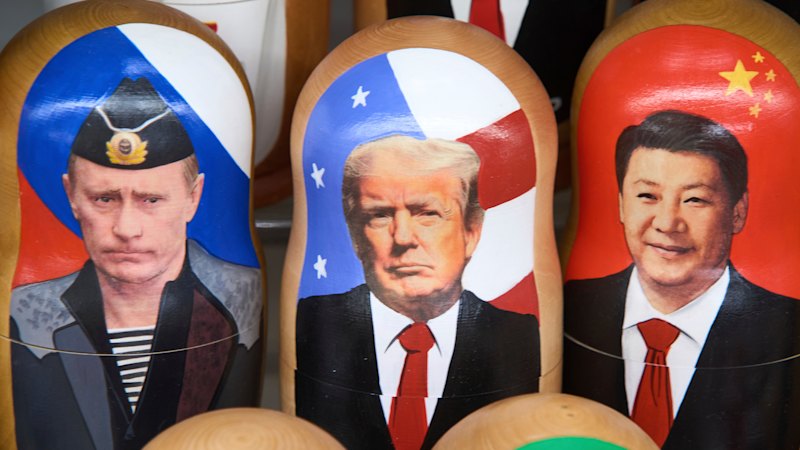
Pundits love the circus. They love the choreography of the handshake, the calculated tardiness, the whispered speculation about a photobomb on a red carpet or a secret twenty-minute chat behind a closed mahogany door. They treat a summit between Donald Trump, Xi Jinping, and Vladimir Putin like the season finale of a prestige television drama.
They miss the point entirely.
When these three men occupy the same square mile of airspace, the spectacle is just a distraction. The real story is happening in the margins, in the pauses between translated sentences, and in the quiet, terrifyingly fragile calculations that govern how the rest of us live.
The Architecture of the Unscripted Moment
To understand what happens when Washington, Beijing, and Moscow sit at the same table, consider a hypothetical scenario. Picture a mid-level logistics manager named Elena working out of a port facility in Rotterdam. Elena does not care about geopolitical theory. She cares about whether the container ship carrying lithium-ion batteries from Shenzhen will clear customs before Friday, and whether the diesel powering her cranes will spike by forty percent because of a pipeline dispute three thousand miles east.
Elena’s entire livelihood rests on predictability. Global trade is essentially a massive, intricate clockwork mechanism built on the assumption that rules written yesterday will still apply tomorrow morning.
Now, place Donald Trump, Xi Jinping, and Vladimir Putin in a room together.
Each man brings a completely different operating system to that table, and none of those systems are built for Elena’s predictability.
Trump views diplomacy through the lens of the high-stakes real estate closing. To him, alliances are not sacred covenants; they are balance sheets requiring constant renegotiation. He thrives on disruption because disruption forces the person across the table to reveal what they actually value. When he leans in for a prolonged handshake or breaks protocol to walk over to another leader’s cluster, he is testing the structural integrity of the room. He wants to see who flinches.
Xi Jinping is the exact opposite. The General Secretary operates like an architect who thinks in thirty-year blueprints. Every gesture is calibrated by committees months in advance. The angle of his lapel, the exact phrasing of his opening remarks, the deliberate stillness of his posture—none of it is accidental. For Xi, a summit is not a place to improvise a deal. It is a ceremony meant to ratify an outcome his diplomats have already extracted behind closed doors. Surprise is the enemy of stability, and stability is the oxygen of the Chinese state.
And then there is Vladimir Putin.
Putin enters every room as an intelligence officer who assumes the walls are wired and everyone is lying. Having spent decades navigating the wreckage of the Soviet collapse, he understands leverage not as economic might—Russia’s economy is roughly the size of Italy’s or Texas’s—but as the capacity to impose pain and exploit hesitation. He does not need to hold the winning hand if he can convince the other players that he is willing to flip the table over.
Put those three temperaments in a single room, and the air changes.
What Happens When the Cameras Leave
The public gets the grip-and-grin. We see the stiff smiles on the risers, the flags arranged in alphabetical order, the brief, carefully manicured photo opportunities where reporters shout questions over the click of motorized shutters.
That is theater. The actual summit begins when the doors close and the pool reporters are herded back down the corridor.
In those private bilateral and trilateral pull-asides, the dynamic shifts from public posturing to raw transactional math. Based on decades of diplomatic records and the accounts of former national security advisors who have sat on those stiff leather chairs, these private sessions rarely resemble the grand strategic debates taught in political science classrooms. They are blunt. They are personal. And they are overwhelmingly focused on immediate pain points.
When Trump sits across from Xi, the conversation inevitably gravitates toward the ledger. Tariffs, agricultural purchases, intellectual property, and the delicate, razor-thin status quo across the Taiwan Strait. Trump wants a tangible win he can hold up at a rally—a number big enough to fit on a headline. Xi wants breathing room. Facing demographic headwinds, a sluggish domestic property market, and intense pressure on China’s high-tech manufacturing sector, Beijing cannot afford a total decoupling from the American consumer. Yet Xi cannot appear weak before his own party apparatus. So they trade in ambiguity, offering just enough concession to keep the tariffs from freezing global supply chains, while leaving the fundamental rivalry untouched.
Shift the chairs so Trump is facing Putin, and the temperature drops ten degrees.
Here, the currency is not trade; it is security architecture. Moscow’s primary objective in any encounter with an American president is validation as a co-equal superpower—the right to carve out a sphere of influence in Eastern Europe and Eurasia without Western interference. Putin speaks in historical grievances, reciting borders from centuries past to justify tanks on modern highways. Trump, skeptical of multilateral institutions like NATO and openly frustrated by the financial burden of foreign entanglements, listens through a filter of cost-benefit analysis. What is America paying, and what is America getting back? That question alone makes European capitals break into a cold sweat every time Trump and Putin speak without a full slate of note-takers present.
And what about the third side of the triangle? When Xi and Putin meet, the cameras capture bear hugs and declarations of a friendship with "no limits."
Do not mistake the warmth for equality.
Since the invasion of Ukraine severed Russia from European energy markets and Western financial systems, Moscow has become the junior partner in a lopsided marriage. China buys Russian crude at a steep discount, supplies the dual-use microchips and machine tools keeping Russian factories running, and quietly expands its economic footprint across Central Asia—a region Moscow once considered its exclusive backyard. Xi needs Russia as a geopolitical distraction that keeps Washington’s eyes and munitions tied down in Europe rather than focused on the Pacific. Putin needs China to survive. It is a marriage of convenience built on shared resentment of American dominance, not mutual trust.
The Invisible Stakes in the Corridor
It is easy to get lost in the personalities, to treat a summit as a clash of egos. We are wired to look for human drama—the awkward body language, the unscheduled walk-by, the viral clip of one leader photobombing another’s arrival. Those moments happen because summits are chaotic environments where security details collide and schedules slip by forty minutes at a time.
But while commentators dissect whether a pat on the shoulder was a sign of dominance or camaraderie, the real consequences are quietly being drafted in annexes down the hall.
Think of international diplomacy like a suspension bridge. The cables holding it up are thousands of small, boring agreements: maritime collision protocols, nuclear arms verification treaties, trade arbitration panels, and hotlines between military commanders so a misread radar blip does not trigger a nuclear exchange.
Over the past decade, those cables have been fraying. Major arms control frameworks like the Intermediate-Range Nuclear Forces Treaty have collapsed. Trade disputes have hardened into permanent national security restrictions. Communication channels between militaries have gone dark for months at a time.
When Trump, Xi, and Putin gather, they are standing on that bridge while the wind picks up.
Consider what happens next if a single miscalculation occurs in that room. Suppose Trump leaves a bilateral meeting believing he has secured a verbal freeze on missile deployments, while Putin leaves believing he just extracted tacit approval to redraw a border. Or imagine Xi interpreting an offhand remark about trade reciprocity as a signal that Washington will not intervene in a regional maritime blockade.
In normal times, teams of career diplomats spend months after a summit clarifying every comma and footnote to ensure both sides left with the exact same understanding. Under strongman leadership, however, the apparatus is often bypassed. Leaders trust their own instincts over the briefing books prepared by their intelligence agencies. When three men who pride themselves on personal authority rely on verbal understandings across three different languages, the margin for catastrophic misunderstanding shrinks to zero.
I remember watching a seasoned European diplomat stare at a television monitor during a summit press conference years ago. The leaders on screen were laughing at a joke one of them had made about the press corps. Everyone in the media bullpen chuckled along. The diplomat did not smile. He rubbed his temples and muttered that when leaders start joking with each other without an agenda, it usually means they have given up trying to solve the actual problem and are just trying to survive the photo op.
That honesty stays with you. Watching the mechanics of global power up close strips away the illusion that someone, somewhere, has a master plan. Often, they are improvising on a tightrope without a net.
The Myth of the Grand Bargain
Whenever these three figures converge, a specific rumor inevitably circulates through financial markets and diplomatic cables: the fear—or hope—of a "Grand Bargain."
The theory goes like this. Behind closed doors, without the interference of parliaments, congresses, or noisy allies, the three most powerful men on earth will simply divide the world into neat, manageable spheres. America gets the Western Hemisphere and control of its trade borders. China gets economic primacy in East Asia and the South China Sea. Russia gets its buffer zone in Eastern Europe. Everyone shakes hands, the markets rally, and the threat of global conflict evaporates.
It is a seductive fantasy. It is also completely detached from reality.
Spheres of influence do not stay in their boxes. They bleed into one another. You cannot hand Beijing dominance over the Pacific trade routes without starving the American economy of the semiconductors that power everything from hospital ventilators to fighter jets. You cannot grant Moscow a veto over European security without triggering an immediate nuclear arms race among smaller nations that suddenly realize their alliances will not protect them. And neither Xi nor Putin will ever genuinely accept a stable global order underpinned by the U.S. dollar, because their own domestic legitimacy relies on portraying themselves as the bulwark against Western hegemony.
There will be no Grand Bargain.
Instead, what emerges from these high-wire encounters is something far messier and far more human: a temporary truce bought with ambiguity. A joint statement scrubbed of any language that might offend anyone, accompanied by a handful of small, reversible gestures—a prisoner swap here, a resumption of soybean purchases there, an agreement to hold another meeting in six months.
Back at the Port
Return for a moment to Elena, our logistics manager in Rotterdam.
When the summit ends and the motorcades race back toward the airport tarmac, Elena will check her phone over breakfast. She will see the photos of the three men standing side by side, flags fluttering behind them, hands clasped in stiff, practiced formality. She will read a headline about a secret forty-minute conversation or an unexpected moment of levity on the red carpet.
Then she will open her shipping manifest.
If the summit went well—meaning nobody walked out early and no new sanctions were announced on the tarmac—her container ship from Shenzhen will dock on schedule. Her diesel prices will hold steady. Her life will continue uninterrupted, cushioned by the invisible friction of a truce that resolved nothing, yet prevented everything from breaking at once.
We look at leaders like Trump, Xi, and Putin and see titans moving armies and markets with a stroke of a pen. Yet when you strip away the flags, the armored limousines, and the breathless commentary, you are left with three mortal men sitting in uncomfortable chairs, trying to project absolute strength while acutely aware of the vulnerabilities waiting for them back home.
The real power in that room does not belong to the man who talks the loudest, or the one who holds his smile the longest for the cameras. It lives in the heavy, breathless silence after the translators finish speaking, right before someone decides whether to push the chips forward or walk away from the table.