The air inside a diesel-electric submarine never truly feels clean. It smells of scorched machine oil, stale coffee, and the faint, metallic tang of recycled oxygen. For hours, you forget that a few inches of steel are the only thing keeping millions of gallons of freezing seawater from collapsing your ribs.
Imagine standing in that cramped, dimly lit control room. You are looking at a radar screen that shows nothing but empty, black water, knowing you are blind to what lies beneath the polar ice caps.
This is the reality for the sailors of the Royal Canadian Navy. For decades, Canada has possessed the longest coastline in the world, stretching across three oceans. Yet, its underwater defenses have been treated as an afterthought. The current fleet of four Victoria-class submarines, purchased second-hand from the United Kingdom in the late 1990s, has spent far more time sitting in drydock undergoing agonizingly slow repairs than patrolling the deep. They are old. They are tired.
Now, the Canadian government is forced to confront a terrifyingly expensive reality. The ice in the Far North is melting, opening up new, unprotected shipping lanes. Russian and Chinese vessels are moving through the deep arctic trenches with increasing frequency. To guard its sovereignty, Ottawa has put a staggering US$39 billion on the table for the Canadian Patrol Submarine Project.
It is one of the largest naval defense contracts in modern history.
Two industrial titans, located on opposite sides of the globe, are currently locked in a fierce, quiet war to win it. In one corner stands Germany, the traditional heavyweight of European naval engineering. In the other stands South Korea, the hyper-efficient, fast-rising challenger of the Pacific.
The choice Canada makes will not just decide the fate of its navy. It will redraw the lines of global military manufacturing for the next fifty years.
The Ghost of Kiel
To understand the German bid, you have to travel to the Baltic coast, to the shipyards of Kiel. This is a place where engineering is treated like a secular religion. ThyssenKrupp Marine Systems has spent generations perfecting the art of the conventional submarine.
The German philosophy is built on absolute precision. Their design for Canada relies on a concept called Air-Independent Propulsion, or AIP. Think of it as a massive, hyper-advanced hydrogen fuel cell. While older diesel submarines must surface regularly to breathe—running their engines to recharge batteries and exposing themselves to enemy radar—an AIP system allows a submarine to glide through the water in near-total silence for weeks at a time.
For a Canadian commander patrolling the Atlantic, this silence is life. German submarines are built like mechanical watches. Every valve, every pipe, every weld is designed to minimize acoustic vibration. They do not clank; they hum.
But Germany’s pitch to Canada goes beyond hardware. It relies heavily on historical comfort. Germany is a NATO ally. Its systems are built to tie directly into the Western military apparatus. For decades, Canadian and German officers have shared intelligence, sat in the same briefing rooms, and trained in the same cold Atlantic waters.
Choosing Germany feels safe. It is the status quo, wrapped in immaculate steel.
Yet, the real problem lies elsewhere. The German shipyard model is brilliant, but it is slow. Europe’s defense sector is notorious for bureaucratic delays and backlogged production lines. Canada needs these boats soon, before its current fleet completely rusts away. And in the world of heavy industry, patience is a luxury Ottawa simply does not have.
The Iron Foundries of Geoje
Ten thousand miles away, on the southern coast of South Korea, the atmosphere could not be more different.
In the massive shipyards of Geoje, owned by giants like Hanwha Ocean and HD Hyundai, the scale of production is dizzying. Gantry cranes as tall as skyscrapers blot out the sun. The air is thick with the smell of molten iron and the roar of automated welding lines.
South Korea does not build ships; it manufactures them with the relentless speed of a semiconductor factory.
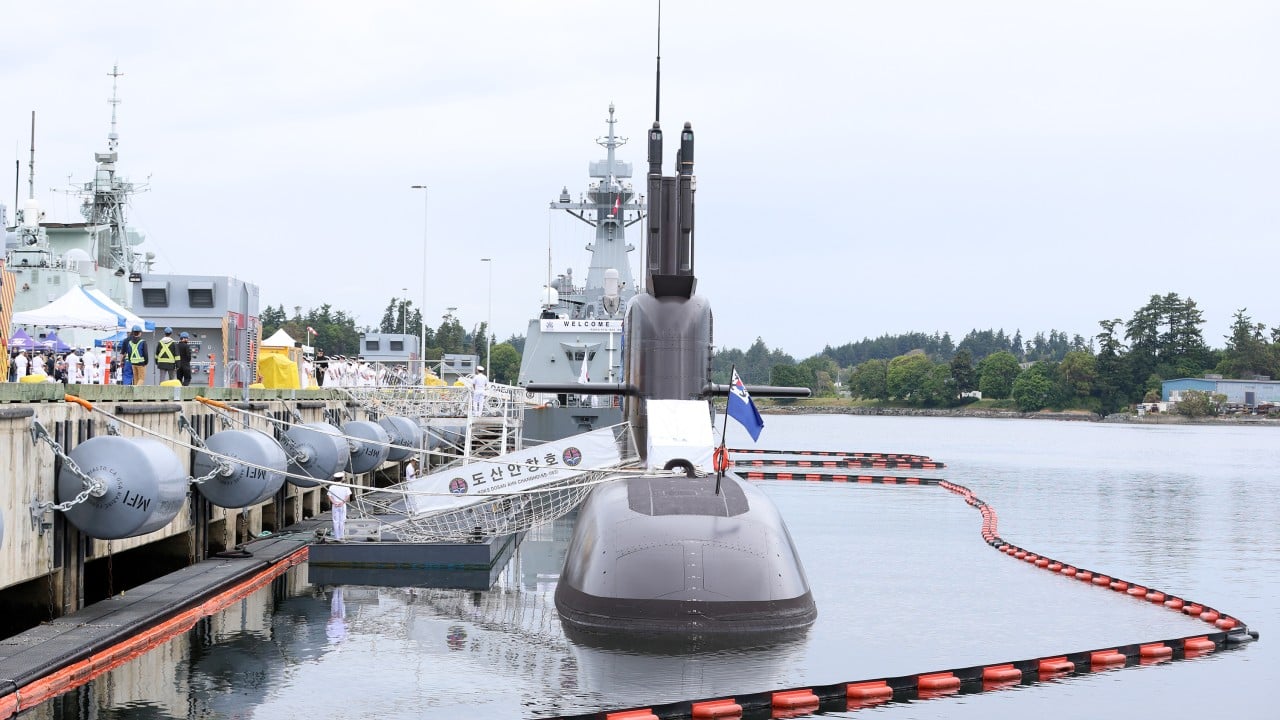
The South Koreans are offering Canada the KSS-III, a massive, 3,000-ton diesel-electric beast. Unlike the Germans, who favor hydrogen fuel cells, the South Koreans have bet heavily on lithium-ion battery technology. It is a massive gamble, but the math is compelling. These batteries charge incredibly fast and allow the submarine to sprint at high speeds underwater for far longer than traditional designs.
Consider what happens next if Canada chooses Seoul. South Korea’s biggest selling point isn't just the technology; it is the timeline. Because South Korea lives under the constant, existential threat of a nuclear-armed neighbor to the north, its defense industry operates on a permanent war footing. They do not tolerate delays. They build ships on time, on budget, and at a volume that leaves European shipyards staring in disbelief.
For Canadian politicians sweating over a US$39 billion taxpayer-funded bill, that efficiency is intoxicating.
But the South Korean bid carries an unspoken weight. South Korea is not a NATO member. Integrating a Pacific-designed submarine into a North American defense network requires a massive leap of faith. The combat systems, the torpedo tubes, the communication arrays—everything would have to be stripped down and rebuilt to talk to American and British systems.
The True Cost of Silence
It is easy to get lost in the technical jargon of lithium-ion versus fuel cells, or the astronomical numbers on a balance sheet. But the true stakes of this US$39 billion duel are intensely human.
Think of a twenty-two-year-old sonar technician, sitting in the dark beneath the waves of the Beaufort Sea. Her ears are strained, listening through headphones to the ambient clicks of shrimp and the grinding of pack ice. She is looking for a signature—the faint, rhythmic thrum of an uninvited foreign submarine cruising through Canadian waters.
If the ship beneath her fails, there is no rescue team coming. The Arctic is vast, lonely, and unforgiving.
For years, Canada’s political class viewed submarines as an expensive luxury, an archaic remnant of the Cold War. That illusion has shattered. The oceans are no longer a barrier; they are a highway for global ambition. Whoever wins this contract will hold the keys to Canada’s northern frontier.
If Germany wins, it reinforces the old Atlantic alliance, proving that traditional NATO ties still govern the geopolitical chessboard. If South Korea wins, it marks a seismic shift, signaling that the center of gravity for military manufacturing has permanently moved to the Pacific.
The bureaucrats in Ottawa continue to pore over blueprints, cost estimates, and diplomatic cables. They weigh the quiet precision of Kiel against the industrial muscle of Geoje. They debate, they stall, and they calculate.
Meanwhile, far out at sea, the old Victoria-class submarines continue to creak against the pressure of the dark, cold water, waiting for a replacement that cannot arrive soon enough.