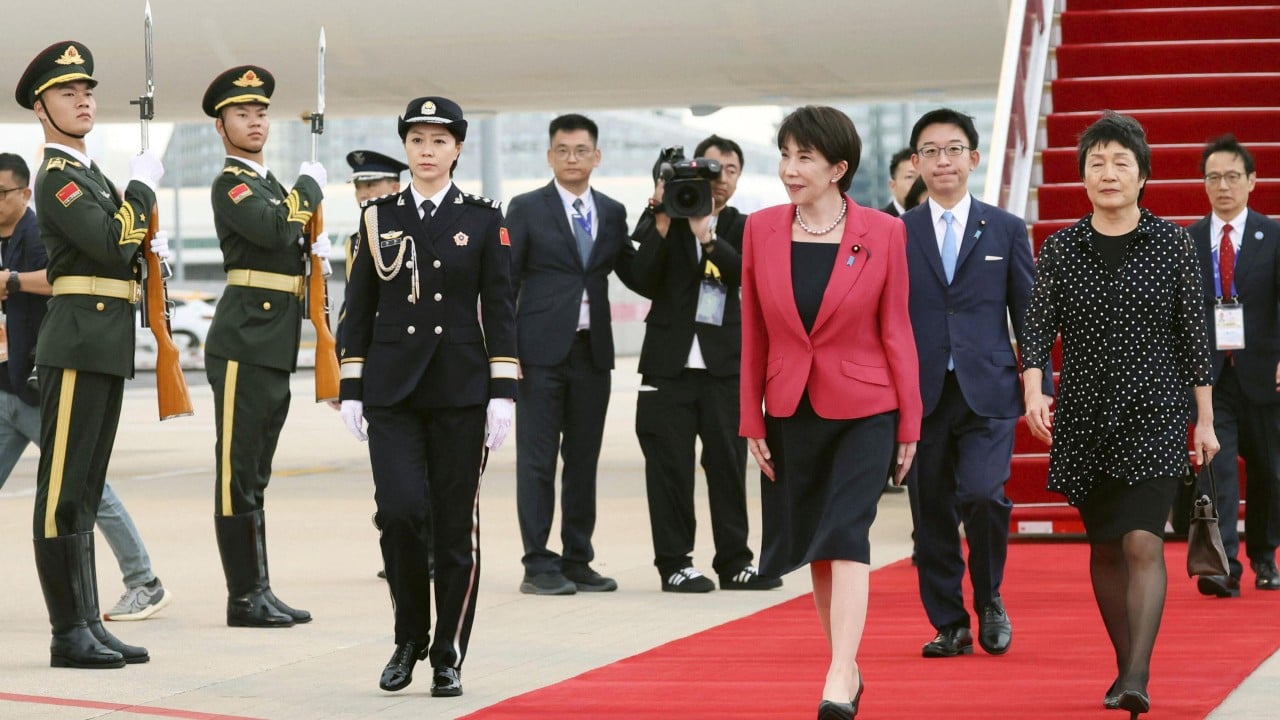
Mainstream foreign policy pundits are obsessed with airport tarmac choreography. They count the flower girls, measure the length of the red carpet, and tally the decibels of the brass bands. When South Korean President Lee Jae-myung touched down in Shenzhen to a welcoming committee of traditional dancers while Japanese Prime Minister Sanae Takaichi slipped into the exact same city with zero fanfare, the lazy consensus formed instantly. The talking heads declared a diplomatic snub. They framed Takaichi’s low-key arrival as a sign of Japanese weakness, a humiliating contrast to Seoul’s warm reception, and proof that Tokyo is losing influence in East Asia.
That analysis is completely backward. It mistakes theatrical flattery for actual power.
If you have spent any time watching how Beijing operates behind closed doors, you know that protocol spectacle is a distraction tool. China rolls out the dancers when it wants to butter up a leader it thinks it can bend, flatter, or split away from a rival coalition. When Beijing skips the theatrics and goes straight to cold, stripped-down logistics, it means the person stepping off the plane holds real structural cards that cannot be charmed away with a folk dance. Takaichi did not get a quiet arrival because Tokyo is weak. She got a quiet arrival because Beijing knows performative hospitality will not buy a single millimeter of policy concession from her administration.
The Tarmac Fallacy in East Asian Diplomacy
Foreign correspondents love visual metaphors because visual metaphors write themselves. A vibrant dance troupe greeting Lee Jae-myung next to a sterile, business-only tarmac for Sanae Takaichi makes for an effortless split-screen narrative. The implied story is simple: Beijing favors Seoul and punishes Tokyo.
This reading fails basic diplomatic literacy. In East Asian statecraft, and specifically within the Chinese Communist Party’s protocol playbook, hospitality is an inverse indicator of leverage.
Consider the historical pattern. Beijing routinely stages elaborate, culturally rich welcomes for leaders of smaller nations, swing states, or Western politicians whose domestic constituencies respond to optical prestige. The pageantry serves a specific function: it creates a psychological debt of gratitude before the bilateral meetings even begin. It signals to the visiting leader’s domestic press that their head of state is respected on the world stage, lowering the visitor's guard when trade imbalances, territorial claims, or security alignments hit the table.
I have watched corporate executives and trade negotiators fall for this exact trap in Guangdong for twenty years. The moment a visiting delegation starts bragging about the banquet spread or the caliber of the welcoming committee, you know they are about to sign a terrible term sheet. When the host skips the banquet and meets you in a windowless conference room with bottled water and a calculator, you have their undivided, anxious attention.
Shenzhen is not Beijing. It is not a museum of imperial pageantry; it is the engine room of China’s hardware, telecommunications, and advanced manufacturing economy. Arriving in Shenzhen without dancers is not an insult. It is an admission that the conversation is strictly transactional and fiercely competitive.
Decoding the Shenzhen Contrast
To understand why Lee Jae-myung and Sanae Takaichi received opposite treatments at the same airport, look at what Beijing wants from each country right now.
Why Seoul Got the Dancers
South Korea sits in a precarious economic and security vise. Its semiconductor giants, battery makers, and automakers remain deeply entangled with Chinese supply chains and consumer markets, even as Washington demands stricter export controls and alliance solidarity. Lee Jae-myung’s political brand emphasizes pragmatic balancing—a willingness to keep lines open with Beijing and Pyongyang rather than locking Seoul exclusively into a hardline Washington-Tokyo axis.
For Beijing, Lee is an opportunity. By giving him a warm, high-visibility welcome in China’s premier tech hub, Chinese strategists are executing a classic wedge strategy. They are sending a visual message directly to South Korean voters and conglomerates: Work with us, and you get respect, market access, and stability. The dancers were not a reward for past compliance; they were an upfront investment in future hedging. Beijing wants Seoul to hesitate the next time Washington asks for unified export restrictions on advanced chips or joint naval drills in the East China Sea.
Why Tokyo Got the Cold Shoulder
Sanae Takaichi represents the exact opposite equation. A staunch conservative, a protege of the late Shinzo Abe, and an unapologetic hawk on national defense and economic security, Takaichi does not leave room for diplomatic ambiguity. Beijing knows exactly where she stands on Taiwan, on the Senkaku Islands, on semiconductor equipment bans, and on Japan’s rapid military buildup.
You cannot charm Sanae Takaichi with a folk performance. Attempting to do so would look ridiculous to both the Chinese public and the Japanese electorate.
Furthermore, a muted arrival actually serves Takaichi’s domestic political interests just as much as it serves Beijing’s. Had Chinese state media broadcast images of Takaichi smiling through an elaborate welcoming ceremony in Shenzhen, her conservative base in Tokyo would have erupted, accusing her of going soft on Beijing. Conversely, Beijing could not offer high-level ceremonial warmth to a Japanese leader whose platform explicitly frames Chinese military expansion as an existential threat without triggering nationalist backlash on Weibo.
What looks to Western commentators like a unilateral Chinese snub is, in reality, a mutually convenient strip-down of diplomatic theater. Both sides cleared the stage of unnecessary props because neither side needed an illusion of friendship.
What the Pundits Missed About Supply Chain Leverage
The media fixation on airport optics completely obscured the real story happening on the ground in Shenzhen. Why were both leaders in Shenzhen in the first place? Because Shenzhen is the epicenter of the technology war that defines modern geopolitics.
If you want to understand the balance of power between Tokyo and Beijing, stop looking at protocol officers and start looking at cleanrooms.
China’s entire industrial strategy—from electric vehicles and robotics to artificial intelligence and aerospace—depends on escaping the semiconductor chokehold. Shenzhen is home to Huawei, BYD, DJI, and thousands of component manufacturers racing to build domestic alternatives to Western and Japanese technology.
Here is the uncomfortable reality that Beijing’s leadership faces every single morning: you cannot build advanced semiconductors without Japan.
While American firms like Nvidia and Applied Materials dominate chip design and certain fabrication steps, Japanese corporations hold near-monopolies over the critical materials and specialized machinery required to make chips work at all. Companies like Tokyo Electron, Shin-Etsu Chemical, JSR, and Lasertec control the photoresists, silicon wafers, extreme ultraviolet inspection tools, and precision chemicals that keep global foundries running. When Tokyo tightened export controls on twenty-three types of advanced chipmaking equipment, it did not just inconvenience Chinese fabs; it hit a structural nerve that billions of dollars in state subsidies cannot quickly bypass.
| Diplomatic Metric | Lee Jae-myung Arrival | Sanae Takaichi Arrival | Strategic Reality |
|---|---|---|---|
| Visual Optics | Dancers, high-visibility warmth | Low-key, minimal protocol | Optics measure seduction, not respect |
| Beijing's Goal | Encourage hedging against US-Japan bloc | Manage friction, protect trade channels | Wedge strategy vs. containment management |
| Domestic Audience | Signals pragmatic economic relief | Protects hawkish credibility at home | Both leaders got the visuals they needed |
| Core Leverage | Market access dependency | Upstream tech & defense chokepoints | Tokyo holds asymmetric supply chain power |
When Sanae Takaichi lands in Shenzhen without a parade, she brings that upstream leverage in her briefcase. Beijing does not need to flatter her because Beijing needs to negotiate guardrails with her. The central question in those closed-door rooms is not how to make Sino-Japanese relations warm and fuzzy. It is whether Tokyo will tighten the screws further on dual-use technologies, chemical precursors, and precision machine tools—and what economic retaliation Beijing can realistically threaten without blowing up its own export economy.
Dismantling the "Isolation" Myth
Another lazy trope circulating in the aftermath of the Shenzhen arrivals is that Japan is isolating itself in Asia by taking a hard line while neighbors like South Korea seek accommodation. This argument ignores the entire geopolitical architecture of the Indo-Pacific over the past decade.
Let us test this premise against actual strategic developments:
- The Philippines and Southeast Asia: Manila has dramatically expanded defense cooperation with Tokyo, signing reciprocal access agreements and accepting Japanese radar and patrol vessels to counter Chinese coast guard aggression in the South China Sea. Vietnam and Indonesia have steadily upgraded their strategic partnerships with Japan, viewing Tokyo as a reliable infrastructure financier and security counterweight that does not carry the ideological baggage of Washington.
- Australia and India: Through the Quad and bilateral security pacts, Canberra and New Delhi have integrated their defense planning with Tokyo at levels unthinkable fifteen years ago. Japan is no longer a passive checkbook diplomat; it is an active security exporter.
- Taiwan: Informal legislative, intelligence, and semiconductor supply chain ties between Tokyo and Taipei have never been deeper. TSMC’s massive foundry investments in Kumamoto Prefecture physically anchor Taiwan’s survival to Japan’s industrial heartland.
Takaichi is not walking into Shenzhen alone. She is walking in backed by a dense network of regional security partnerships, a doubling of Japanese defense spending, and counterstrike missile capabilities that fundamentally alter military calculus in the East China Sea.
The Real Meaning of Protocol Minimalism
In diplomacy, as in high-stakes corporate mergers, noise is inversely proportional to substance. When two parties have nothing real to negotiate, they hold a press conference, sign a non-binding memorandum of understanding on cultural exchange, and hire a dance troupe. When two parties are staring across a table over existential security boundaries and trillion-dollar supply chains, they skip the speeches and get straight to the agenda.
Think about a scenario where a major pharmaceutical buyer visits a sole-source chemical supplier during a supply shortage. Does the buyer expect a marching band in the lobby? No. Both sides walk straight to the boardroom, close the doors, and argue over pricing, allocation, and exclusivity clauses. The absence of hospitality is proof that the stakes are too high for small talk.
By contrast, look at what happens when a leader does get the royal treatment in China. Often, high-wattage hospitality masks an inability to secure concrete policy wins. Beijing uses ceremony to give the visiting leader a domestic PR victory precisely because Beijing refuses to budge on the underlying trade deficit, market access barriers, or territorial disputes. The dancers are a consolation prize.
The Downside of Takaichi’s Hard-Edge Approach
To be clear, stripping away diplomatic theater carries real risks. A purely transactional, low-optics relationship leaves very little cushion when an unexpected crisis hits.
When bilateral ties are maintained solely through cold deterrence and economic leverage, there is no reservoir of public goodwill on either side to absorb a shock. If a Chinese coast guard vessel collides with a Japanese fishing boat near the Senkaku Islands, or if a Japanese executive is detained in China on vague national security charges, neither Takaichi nor Chinese leadership has the political room to offer a face-saving off-ramp. Both leaders are locked into rigid domestic postures.
Furthermore, overplaying upstream supply chain leverage has an expiration date. Every export control Tokyo enforces accelerates Beijing’s domestic substitution drive. While China cannot replicate high-end Japanese photoresists or precision optics overnight, throwing unlimited state capital at engineering problems eventually yields results in legacy and mid-tier nodes. If Tokyo pushes economic decoupling too fast without coordinating every step with Washington and European allies, Japanese chemical and equipment firms risk losing permanent market share in China while watching competitors find loopholes to fill the void.
Cold realism requires constant calibration. If you rely exclusively on deterrence without functioning crisis-communication channels, a minor tactical miscalculation at sea can spiral into an economic blockade that devastates both nations.
How to Actually Read Diplomatic Signals
Stop letting cable news producers and surface-level wire reports dictate how you interpret international summits. The next time two world leaders visit the same country and receive wildly different airport receptions, run the event through a three-part filter before drawing conclusions:
- Follow the chokepoints, not the cameras. Ask what each visiting nation controls that the host cannot easily replace. If a country holds critical intellectual property, energy reserves, or geographic chokepoints, its leader does not need a red carpet to command respect.
- Look at the venue, not the welcome. A meeting in a political capital emphasizes ideology and status. A meeting in a commercial, industrial, or military hub like Shenzhen emphasizes concrete capability and hard bargaining.
- Check the domestic constraints of both sides. When two rival powers meet without fanfare, it usually means both leaders have agreed to protect each other from domestic backlash so they can actually talk business behind closed doors.
The commentators mocking Sanae Takaichi’s quiet arrival in Shenzhen are grading a heavyweight title fight based on who had the flashier walkout music. Lee Jae-myung got the dancers because Beijing wants to pull Seoul away from its allies. Takaichi got a quiet tarmac because Beijing knows she cannot be bought, flattered, or distracted from the structural realities of East Asian power. In high-stakes geopolitics, the most dangerous person in the room is never the one getting applauded at the door—it is the one who skips the party and goes straight to the negotiating table.