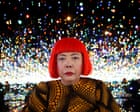
Yayoi Kusama did not merely produce aesthetic objects; she scaled a singular neurological pathology into an unassailable global commercial asset. Her death at age ninety-seven in Tokyo closes a seven-decade production cycle that challenges traditional art market metrics. Standard cultural obituaries reduce her trajectory to a narrative of triumph over mental illness and mid-century sexism. This framing ignores the rigorous structural mechanisms that governed her career. Her output operated on precise economic and psychological principles: repetition as a branding mechanism, psychological compulsion converted into infinite scalability, and spatial disorientation engineered for the digital consumer economy.
The Neurological Engine and the Pathology of Scale
The foundational driver of Kusama’s work was self-obliteration, a psychological mechanism born from childhood hallucinations where fields of dots and patterns engulfed her physical environment. In clinical terms, this constant visual feedback loop generated a relentless production drive.
Most artists treat motifs as stylistic choices. For Kusama, the polka dot and the Infinity Net were compulsory data outputs of a biological condition. This distinction created a unique production barrier to entry. Competitors in the 1950s New York avant-garde scene shifted styles based on market trends or critical theory—moving from abstract expressionism to minimalism to pop art. Kusama maintained strict visual continuity because her output was tethered to a medical imperative.
This strict adherence solved a core market problem: instantaneous visual recognition. Before branding strategies became standard in contemporary art, Kusama’s output possessed an absolute visual monopoly on a single geometric primitive. A dot, rendered in isolation, belongs to geometry. Multiplied infinitely across surfaces, sculptures, and textiles, it became proprietary intellectual property.
The New York Arbitrage and Systemic Rejection
To understand the trajectory of her career, one must analyze the geographic and cultural arbitrage she attempted in 1957 by relocating from Matsumoto to New York. The contemporary art market of that era operated as a closed network controlled by male-dominated hierarchies, prioritizing the physical gesture of action painting.
Kusama entered this ecosystem with zero structural capital: she lacked fluency in English, institutional backing, and inherited wealth. Her early response was an aggressive scaling of volume. When she produced her "Infinity Nets"—vast canvases covered in meticulous, repeating arcs of paint—she was executing a high-density labor strategy that American painters could not easily replicate.
Despite technical innovation, her work suffered from systemic appropriation by male peers. Historical analyses frequently cite Claes Oldenburg and Andy Warhol adopting strategies of soft sculpture and mass-production installation after observing Kusama's studio practices. The structural failure in her early career was not a lack of market demand for her visual style, but an inability to capture distribution rents. Without commercial gallery protection or institutional gatekeepers, her labor was extracted by contemporaries who possessed better network positioning. This structural exclusion forced her return to Tokyo in 1973, where she voluntarily entered a psychiatric hospital, a facility she maintained as her permanent operational base for the remainder of her life while continuing production.
The Infinity Room as an Engagement Engine
The modern resurrection of Kusama’s career in the late 1990s and 2000s was driven by a pivot in consumer behavior. Traditional fine art relied on passive contemplation: a viewer standing at a fixed distance from a flat surface. Kusama’s "Infinity Mirror Rooms" inverted this model by turning the viewer into an active component of the installation.
These rooms function through precise architectural variables:
- Controlled spatial limits utilizing mirrored surfaces to simulate infinite depth.
- High-density LED lighting arrays that multiply point sources into billions of optical reflections.
- Severe capacity bottlenecks, restricting entry to single digits of visitors per minute.
This architectural design created an artificial scarcity of experience. By the time social media platforms prioritized visual self-representation, Kusama’s installations were structurally optimized for digital distribution. The visitor did not just look at the art; the visitor became the medium. Museums recorded record attendance numbers not because of traditional art historical education, but because the installations provided high-yield social capital assets for the consumer.
The Commercial Synthesis and Brand Architecture
In her later decades, Kusama’s studio achieved complete vertical integration of her aesthetic. Critics who dismiss her commercial collaborations—such as her multi-year partnership with Louis Vuitton—fail to recognize that mass-market licensing was the logical endpoint of an art form explicitly built on mass-repetition.
Most fine artists protect their market value by restricting volume. Kusama inverted this economic rule. By flooding the commercial sphere with polka-dot pumpkins, branded accessories, and accessible consumer goods, she increased the top-of-funnel awareness for her gallery-tier installations. The high-end paintings and museum-scale rooms served as the research and development arm, while commercial licensing monetized the broader cultural footprint.
The studio operates with strict quality control over its output, ensuring that even as production scales into millions of consumer units, the core visual vocabulary remains strictly tied to the originator's neurosis. This decoupling of physical creation from the master's hand allowed her output to remain continuous even as her physical mobility declined in her final years.
The passing of Yayoi Kusama removes the last active practitioner of post-war avant-garde who successfully bridged the gap between clinical psychological compulsion and globalized mass-media economics. Future artists attempting to replicate her trajectory must bypass traditional gallery gatekeepers entirely, leveraging digital infrastructure in the exact manner Kusama leveraged physical mirrors: by trapping the viewer inside an inescapable loop of infinite reflection.