Allocating over one billion dollars to renovate the Louvre is not an aesthetic vanity project; it is a capital expenditure designed to resolve a severe thermodynamic and spatial bottleneck in cultural asset management. When a single physical asset—Leonardo da Vinci’s Mona Lisa—generates disproportionate demand within a legacy architectural footprint, the resulting friction degrades visitor utility, accelerates physical wear on the surrounding infrastructure, and caps revenue velocity.
To understand the logic behind the French government's massive capital injection into the Louvre, one must strip away standard tourism journalism and evaluate the institution as a high-throughput operational system experiencing acute capacity failure. The renovation addresses three interconnected operational crises: spatial congestion at the point of primary demand, the degradation of secondary asset visibility, and the thermodynamic strain on a 18th-century museum infrastructure built for a fraction of its current load.
The Anatomy of a Cultural Bottleneck
In operations management, a bottleneck occurs when the capacity of a single node in a system is lower than the demand placed upon it, restricting the throughput of the entire network. At the Louvre, that node is the Salle des États, the gallery housing the Mona Lisa.
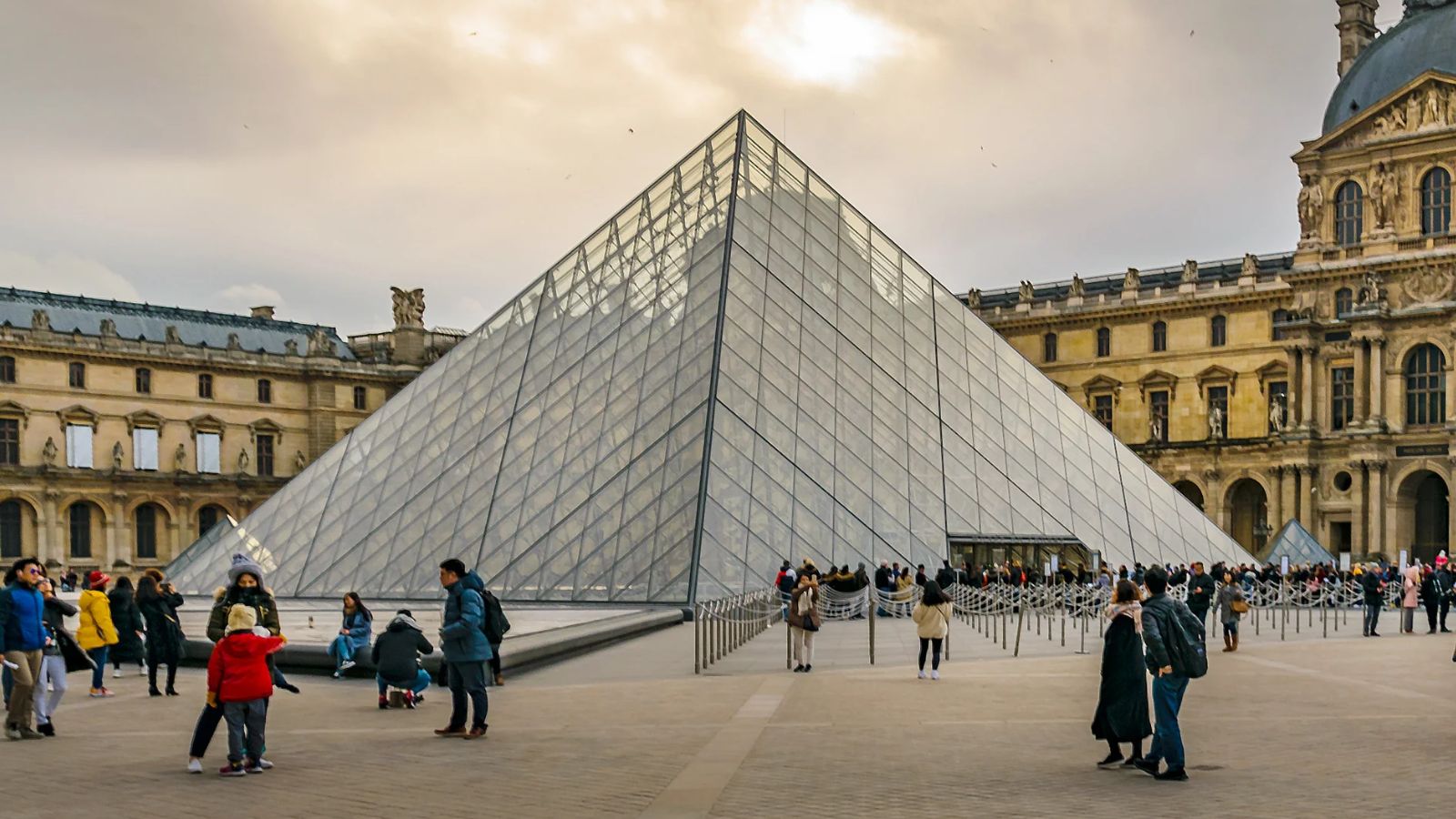
The Louvre was originally designed as a royal palace and converted into a public museum in 1793. In 1989, the I.M. Pei glass pyramid renovation re-engineered the museum's intake capacity, optimizing the subterranean entrance for roughly four million visitors annually. Today, attendance routinely exceeds double that baseline. When you force nine million annual visitors through a spatial topology engineered for four million, the system does not fail uniformly. Instead, failure concentrates at the point of highest inelastic demand.
- The Gravity Well Effect: Roughly 80 percent of Louvre visitors cite the Mona Lisa as their primary motivation for entry. This creates an immediate vector of movement from the Pyramid entrance directly toward the Denon wing.
- Dwell-Time Compression: Because the Salle des États cannot physically expand, the museum manages throughput by compressing dwell time. Visitors are funneled into a narrow viewing queue, granted seconds to capture a digital photograph, and pushed out.
- Negative Spillover: The congestion in the Denon wing does not remain isolated. The human traffic jams spill into adjacent galleries housing works by Veronese, Titian, and Raphael. These secondary assets suffer from visual occlusion and degraded viewing environments, effectively reducing the functional square footage of the museum's active collection.
By dedicating an expanded, isolated underground or dedicated architectural space specifically for the Mona Lisa, the renovation decouples the primary demand driver from the rest of the museum's circulatory system. In queueing theory, this is the equivalent of creating an express lane for high-volume, single-item transactions so they no longer block multi-item shoppers in the main aisles.
Deconstructing the $1.2 Billion Capital Allocation
A renovation budget exceeding one billion dollars (roughly one billion euros, depending on currency fluctuations and multi-year inflation adjustments) requires a rigorous breakdown of cost functions. Without granular line-item public ledgers, we can evaluate the expenditure through the standard capital cost drivers of heritage infrastructure retrofits.
1. Subterranean Excavation and Structural Underpinning
The Louvre sits directly adjacent to the Seine River in central Paris. Expanding square footage within a protected historic monument—where vertical expansion is legally impossible and horizontal expansion is blocked by the urban grid—forces architects underground. Excavating beneath a historic palace in a high water-table zone requires complex civil engineering, including slurry walls, micropiling, and continuous dewatering systems to prevent foundation settlement in the above-ground wings. Subterranean excavation in dense historic urban cores routinely consumes 40 to 50 percent of total project capital before a single gallery wall is framed.
2. Thermodynamic and Microclimatic Retrofitting
Art conservation is fundamentally an exercise in environmental control. Paintings on wood panels—specifically the poplar panel of the Mona Lisa—are hygroscopic. They absorb and release moisture in response to ambient humidity, causing expansion and contraction that cracks paint layers.
Every human body entering a gallery emits roughly 100 watts of thermal energy alongside significant moisture through respiration and perspiration. When thousands of visitors pack into a single gallery, the HVAC system must constantly fight sharp spikes in temperature and relative humidity. Upgrading an 18th-century stone structure with modern, redundant, whisper-quiet climate control systems that maintain strict tolerances (typically 20°C ± 1°C and 50% ± 3% relative humidity) requires threading massive ductwork through thick masonry walls without compromising structural integrity or aesthetic preservation.
3. Security and Access Control Architecture
High-profile cultural assets face asymmetric security threats, ranging from climate activists throwing liquids at protective glazing to sophisticated theft attempts. Relocating the Mona Lisa allows engineers to build a bespoke security perimeter from the concrete up. This includes ballistic-grade glass enclosures, independent air-filtration systems to neutralize airborne contaminants, rapid-isolation blast doors, and biometric or high-throughput ticketing gates that separate Mona Lisa ticket holders from general admission visitors.
Revenue Mechanics and Price Discrimination
A capital outlay of this magnitude cannot be sustained solely through municipal subsidies, particularly when European state budgets face tightening fiscal constraints. The renovation enables the Louvre to implement advanced revenue management strategies—specifically, segmented pricing and dynamic capacity allocation.
Currently, a standard general admission ticket grants access to the entire museum, including the Mona Lisa. This flat-rate model leaves substantial consumer surplus on the table while failing to regulate demand. By creating a dedicated architectural space with its own controlled ingress and egress, the Louvre gains the structural capability to introduce tiered ticketing.
- Unbundled Access: The institution can sell a lower-cost general admission ticket that grants access to the broader collection (Mesopotamian antiquities, French sculpture, Dutch masters) while excluding the Mona Lisa chamber.
- Premium Surge Pricing: Access to the Mona Lisa space can be priced dynamically based on seasonal demand, time of day, or bundled as a premium add-on. Because demand for the painting is largely price-inelastic among international tourists—who have already spent thousands on flights and hotels—a €10 to €20 surcharge yields massive margin expansion with negligible drop-off in volume.
- Time-Slot Granularity: Dedicated entry points allow for strict, algorithmic time-slotting. If the new space can comfortably hold 400 people at a time with an average dwell time of 12 minutes, the system's maximum theoretical throughput is 2,000 visitors per hour. Ticketing software can sell exact inventory up to that ceiling, eliminating the physical queues that currently snake through the courtyard.
The Circulatory Redesign: Rebalancing the Museum Portfolio
From a portfolio management perspective, the Louvre suffers from extreme asset concentration. It houses roughly 35,000 works on display out of a total collection exceeding 500,000 objects, yet the vast majority of visitor attention is captured by fewer than ten pieces (the Mona Lisa, the Venus de Milo, the Winged Victory of Samothrace, and The Raft of the Medusa).
The existing circulatory layout forces visitors to traverse long, linear corridors to reach these anchor assets, creating a phenomenon known in retail architecture as the "boomerang effect"—customers walk straight to the back corner for milk, grab it, and walk straight out, ignoring the high-margin goods in the center aisles.
Relocating the Mona Lisa and establishing a new secondary entrance (such as the proposed eastern entrance near the Perrault Colonnade) fundamentally alters the museum's pedestrian traffic modeling:
- Load Balancing: Splitting intake between the central Pyramid and an eastern entrance distributes foot traffic across two distinct axes. This reduces the load on the subterranean escalators and coat checks beneath the Pyramid, which currently operate beyond their mechanical design limits.
- Curatorial Decompression: Removing the Mona Lisa from the Salle des États restores that gallery to its intended function: showcasing 16th-century Venetian painting. Without the 30-deep crowd blocking the center of the room, visitors can properly view Veronese’s monumental The Wedding at Cana, which hangs directly opposite the Mona Lisa and is currently treated as an afterthought by crowds facing the other direction.
- Extended Dwell Time in Secondary Wings: When visitors are not exhausted by fighting through a claustrophobic crowd during their first thirty minutes in the building, their cognitive fatigue is delayed. Visitors with lower cognitive fatigue spend more time in secondary wings—such as the Richelieu wing's Islamic art galleries or the Egyptian antiquities—increasing overall satisfaction scores and driving higher per-capita spending in secondary cafes and bookshops.
Operational Risks and Execution Vulnerabilities
No infrastructure overhaul of this scale is without severe execution risks. Mega-projects in dense, historic European capitals consistently experience cost overruns and schedule slippage due to unforeseen physical and regulatory variables.
Archaeological Interruption
In Paris, digging beneath a former royal fortress inevitably uncovers medieval foundations, ancient fortifications, or artifacts. Under French heritage law, any significant subterranean discovery triggers mandatory, state-supervised preventative archaeology. Teams must halt heavy excavation while archaeologists document and extract the finds. This introduces an unquantifiable time variable into the critical path of the construction schedule, driving up daily carrying costs for contractors and equipment.
Operational Continuity Friction
Unlike a greenfield stadium or a new airport terminal, the Louvre cannot easily shut down for five years to complete the retrofit. Closing the museum entirely would forfeit hundreds of millions of euros in annual ticket revenue and inflict severe secondary economic damage on the Parisian hospitality sector. Therefore, engineers must execute the renovation in phases while keeping the museum operational. Phased construction requires erecting temporary acoustic barriers, dust-containment walls, and rerouted visitor pathways. This inevitably creates temporary bottlenecks that may temporarily worsen the visitor experience before the final system comes online.
The Induced Demand Paradox
In urban planning, the theory of induced demand states that expanding road capacity often fails to relieve congestion because the improved infrastructure attracts previously deterred drivers, quickly filling the new lanes to capacity. A similar risk applies to cultural mega-renovations. Publicizing a billion-dollar expansion and a larger, more accessible Mona Lisa gallery acts as a global marketing campaign. If global tourism continues to grow—driven by expanding middle classes in Asia and Latin America—the newly expanded space could reach maximum design capacity within five years of opening, resetting the congestion cycle at a higher baseline volume.
The Strategic Imperative for Cultural Mega-Institutions
The Louvre’s $1.2 billion investment establishes the operational blueprint for how legacy cultural institutions must adapt to the realities of mass global tourism. Relying on 20th-century spatial layouts and flat-rate ticketing models to manage 21st-century visitor volume guarantees systemic degradation—both of the physical artifacts and the human experience.
To prevent the induced demand paradox from neutralizing this capital expenditure, the Louvre's leadership must pair the physical architecture with strict algorithmic governance from day one. The institution must immediately transition to a decoupled, dynamic ticketing architecture that separates general collection access from Mona Lisa chamber entry, enforcing hard hourly capacity caps without exception. Physical space can only absorb so much human volume; long-term equilibrium requires using price and digital reservation gates to regulate the flow before the visitor ever steps onto the museum grounds.


