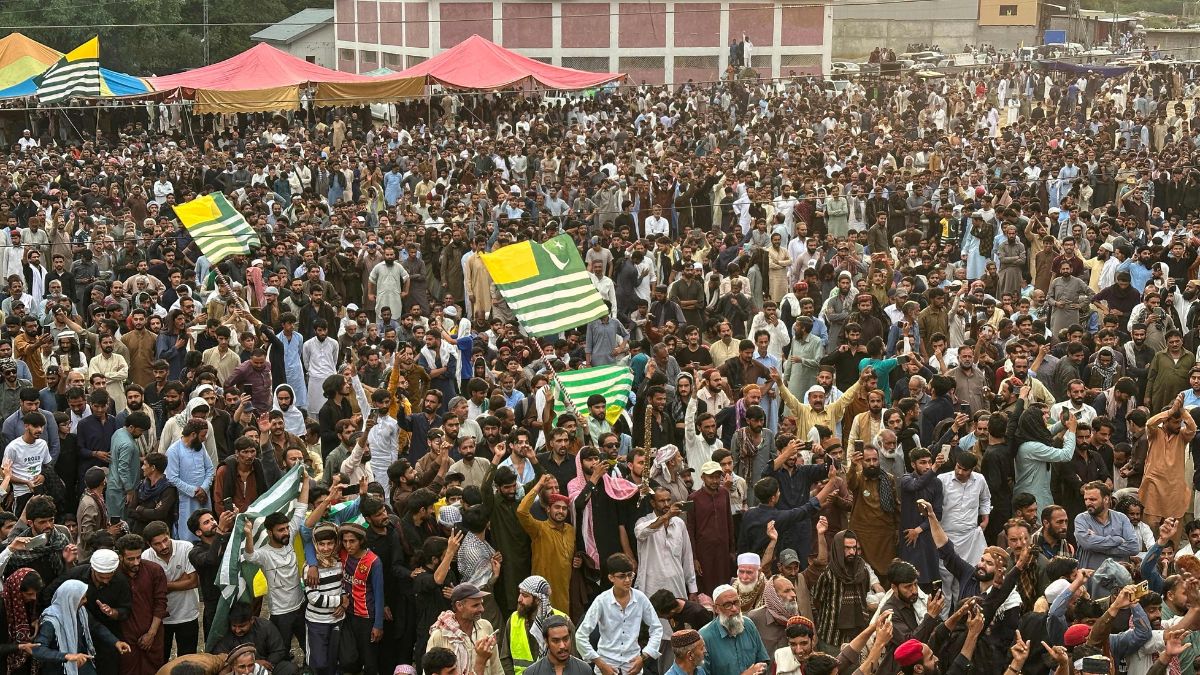
The modern nation-state maintains its territorial integrity through a specific equilibrium: the extraction of resources from peripheral territories must be balanced by the provision of security, economic stability, and institutional legitimacy. When this equilibrium collapses, the state enters a phase of structural disintegration. Pakistan is currently demonstrating the mechanical failure of this equilibrium across two distinct geographical vectors: Balochistan and Pakistan-administered Kashmir (historically referenced as Pakistan-occupied Kashmir, or PoK).
Media narratives frequently mischaracterize these parallel unrests as localized, disconnected instances of civil dissatisfaction. In reality, they represent a systemic failure of the central state’s fiscal and coercive models. The core vulnerability is not merely political; it is an unsustainable debt-to-extraction ratio combined with a diminishing return on state-sponsored coercion.
The Tri-Centric Extraction Framework
To analyze why peripheral regions are simultaneously rejecting federal authority, the state-to-periphery relationship must be broken down into three operational pillars:
- Resource Asymmetry (The Extraction Vector): The central government drains primary resources—natural gas and mineral wealth from Balochistan; hydroelectric power from Kashmir—while returning negligible capital or infrastructure investments to the source populations.
- Institutional Exclusion (The Governance Vector): Local administrations are structurally bypassed. In Kashmir, federal control has long been maintained through reserved legislative seats assigned to individuals outside the territory, rendering the local assembly structurally subservient to Islamabad.
- Coercive Over-Reliance (The Stabilization Vector): Lacking fiscal space to deploy economic incentives, the state substitutes economic integration with paramilitary governance. This shifts the costs of state survival from economic development to defensive kinetic operations.
This framework explains the structural shifts observed in recent civil movements. The Joint Awami Action Committee (JAAC) in Kashmir and the Baloch Yakjehti Committee (BYC) in Balochistan are not traditional political parties seeking electoral concessions. They are structural reactions to a bankrupt center that can no longer fund the basic inputs of civic life, such as subsidized flour or accessible electricity, yet continues to extract energy and strategic geography.
The Fiscal and Kinetic Bottlenecks
The structural failure of Pakistan's federal model is accelerated by two distinct bottlenecks.
The Fiscal Stragulation Function
The federal government operates under intense macroeconomic distress, characterized by severe foreign exchange constraints and strict external debt obligations. Historically, Islamabad managed peripheral unrest via targeted fiscal subsidies—keeping the prices of basic commodities artificially low in sensitive border regions to preempt civil friction.
The current macroeconomic reality has eliminated this policy option. Forced to reduce public expenditures to meet fiscal deficit targets, the state removed energy and food subsidies. In Kashmir, this created an immediate inflationary shock. The population found itself paying inflated tariffs for electricity generated by hydroelectric projects located within their own rivers, alongside escalating costs for staple goods like wheat flour.
When the state can no longer afford to bribe the periphery into compliance, the implicit social contract dissolves. The resulting civil resistance is driven by survival metrics rather than abstract ideology.
The Diminishing Returns of Kinetic Coercion
The second bottleneck is structural and military. When fiscal incentives fail, a state must rely on its coercive apparatus—the military, the Frontier Corps, and paramilitary Rangers. However, the enforcement capacity of this apparatus is subject to a strict function of diminishing returns.
[State Fiscal Crisis]
       │
       ▼
[Removal of Peripheral Subsidies]
       │
       ▼
[Mass Civil Mobilization (JAAC / BYC)]
       │
       ▼
[Paramilitary Kinetic Crackdown]
       │
       ▼
[Diminishing Returns: Increased Local Resistance & Strategic Overextension]
In Balochistan, the state's reliance on kinetic measures—enforced disappearances, kinetic crackdowns on peaceful assemblies led by figures like Mahrang Baloch, and systemic political marginalization—has transformed a low-level regional militancy into a broader civil resistance. The Baloch Liberation Army (BLA) leverages this local alienation to execute high-profile strikes against state infrastructure and foreign assets, notably Chinese personnel linked to the China-Pakistan Economic Corridor (CPEC).
Simultaneously deploying these heavy-handed tactics against civilian populations in Kashmir creates an unsustainable operational footprint. Utilizing paramilitary forces to suppress protests over utility bills and food access strips away the state's remaining institutional legitimacy. Instead of dampening dissent, kinetic crackdowns serve as a force multiplier for local mobilization.
Divergent Vectors: Balochistan vs. Kashmir
While the structural causes are identical, the operational execution of these movements varies significantly based on regional geography and local organizational capacity.
- The Balochistan Vector: Characterized by high-intensity asymmetric warfare and an entrenched separatist insurgency. The terrain allows insurgent groups to execute guerrilla operations against security forces and infrastructure, while civilian movements like the BYC challenge state narratives through mass urban sit-ins. The core objective here is often complete political separation or comprehensive resource sovereignty.
- The Kashmir Vector: Predominantly civic and urban, structured around civil disobedience, market shutdowns, and mass rallies organized by the JAAC. The movement focuses on direct economic grievances—demanding uniform education, electricity tariffs matched to production costs, and the elimination of reserved administrative seats for outsiders. However, the systematic use of state violence against these civilian demonstrations is rapidly shifting the discourse from economic grievance to a fundamental rejection of Pakistani constitutional authority.
Strategic Outlook
The structural analysis indicates that Pakistan cannot maintain its current peripheral configuration under its existing fiscal model. The state lacks the financial capital to restore the subsidies required for civic stability, and its military apparatus is overextended across multiple internal security fronts, from Khyber Pakhtunkhwa to the southern coastline.
The most probable strategic outcome is not immediate territorial fracturing, but a protracted state of internal gridlock. The central government will likely oscillate between brief, unenforceable legislative concessions—such as temporary fund injections for regional electricity infrastructure—and abrupt security crackdowns when protests threaten federal supply lines or foreign investments.
This cyclical approach offers no structural solution. Each cycle of state violence deepens local alienation, lowers the threshold for future mass mobilization, and erodes the state's capacity to govern these regions through anything short of active military occupation.
For a detailed visual overview of the ground realities and human cost associated with these escalating regional dynamics, the investigative broadcast PoK Unrest Analysis outlines the direct friction between local civilian populations and deployed state security forces.


