The Quiet That Feels Like Erasure
Silence.
That is the first thing people notice when they step out of an old rally car and into a modern electric commuter, a dead, padded hush where the road disappears behind four layers of glass, thick foam, and a chorus of synthesized chimes reminding you to keep your hands centered.
I have spent years sitting in bucket seats that smelled like cold vinyl, cast iron, and wet wool after a morning on back-country asphalt. When you drive something built with intention, your spine reads the camber of the road before your eyes even register a pebble. You feel the rear axle settle. You hear the tiny metallic tick of cooling exhaust steel when you park in the damp grass. Over the last decade, watching everyday cars swell into heavy, screen-dominated pods has made driving feel less like a conversation with a machine and more like negotiating with a spreadsheet on wheels.
Consider Claire—a hypothetical character modeled after dozens of drivers I have met at rainy autocross events and Sunday coffee runs. A decade ago, Claire spent her weekends reading pace notes on narrow, leaf-strewn stages, her knuckles white and her pulse hammering every time the tail stepped out. Today, she commutes forty minutes each way in a compact electric crossover that parks itself, lectures her about lane drift, and weighs nearly as much as a vintage pickup. She loves the instant shove when merging onto the highway. Yet most mornings she arrives at work feeling curiously numb, as if she rode inside a journey rather than taking part in it.
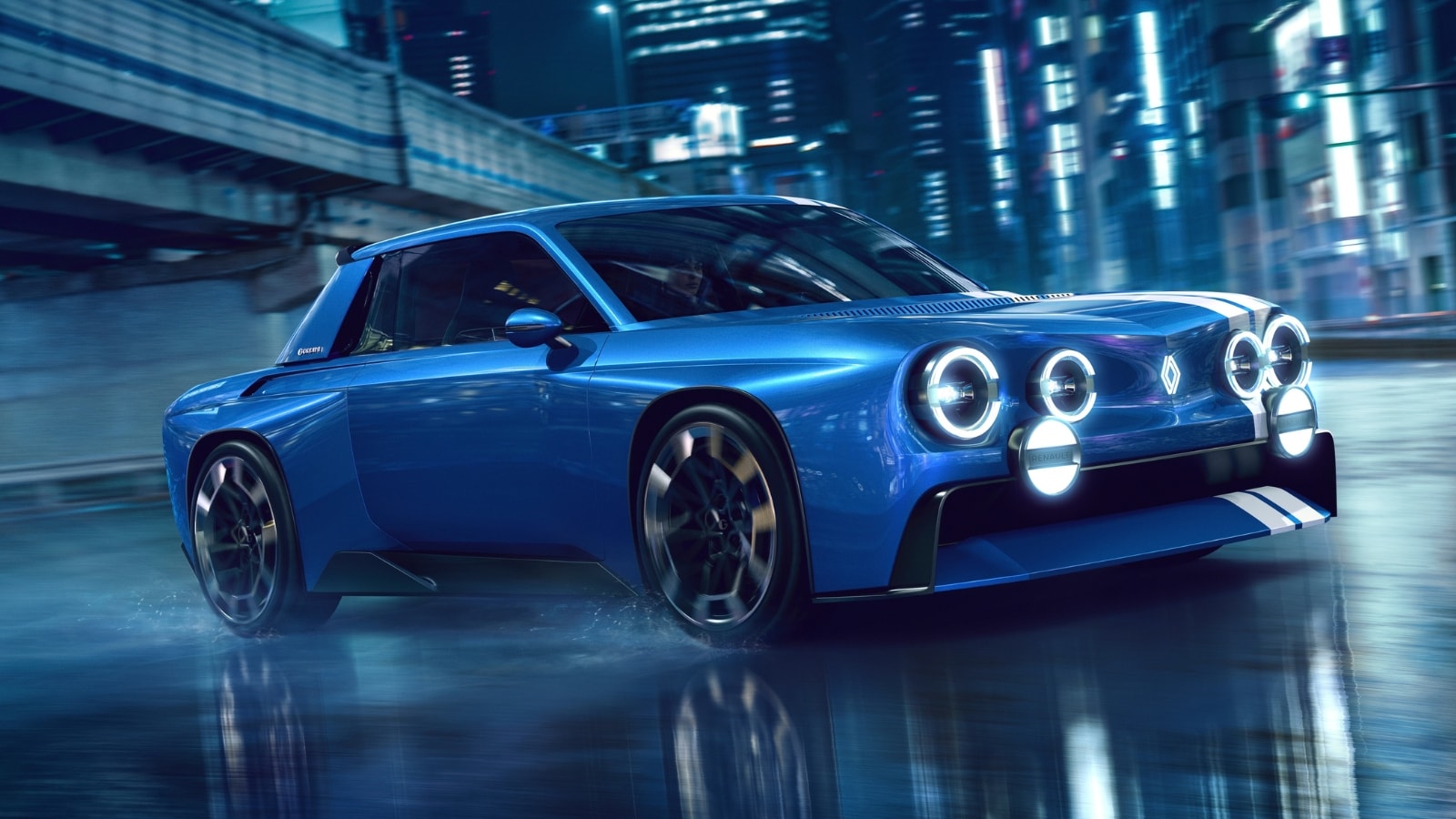
When word spreads that Renault is looking back to a 1964 rally icon and reimagining it as an electric coupe with cafe racer styling, Claire’s reaction is immediate and complicated. Hope flickers first. Skepticism follows right behind it. Because a 1964 rally car and a modern electric coupe sit at opposite poles of automotive history—one born of lightweight grit, carburetor fumes, and desperate privateer ingenuity; the other shaped by battery packs, aerodynamics, and software updates.
Ghosts of 1964 and the Cafe Racer Rulebook
To understand why a 1964 rally touchstone matters at all, you have to look at what rallying meant in the mid-1960s. In 1964, rallying was not yet the hyper-funded, aerospace-budgeted motorsport it later became. Smaller, nimble sedans and coupes—cars like the homologated Renault 8 Gordini that earned fierce devotion on tight European roads—could embarrass far more powerful machinery when the pavement turned broken, slick, and narrow. On a twisting mountain road, a light car that changes direction cleanly beats a heavy bruiser every single time.
Layer onto that memory the spirit of the cafe racer. Born among riders who wanted faster, sharper machines without waiting for factories to build exotic specials, cafe racer culture follows a ruthless, romantic law: strip away everything that does not serve speed, balance, or character. Cut the excess fenders. Lose the heavy touring trim. Lower the stance. Make the machine look like it is straining forward even while resting on its kickstand.
Here is a metaphor to hold onto: imagine a modern luxury electric SUV as a medieval knight encased in seventy pounds of ceremonial plate armor, carrying a broadsword so heavy it tires the wrist after ten swings. Now picture a cafe racer as a bare-knuckle sprinter in thin cotton and canvas—nothing extra, no wasted movement, every ounce accounted for.
Pairing a 1964 rally bloodline with a cafe racer attitude on an electric coupe is a daring mashup because it asks two rival traditions to share the same garage. Rallying is about mud, gravel, sudden compression, and survival on unpredictable stages. Cafe racers are about stripped-down rebellion, clean lines, and intimate connection between human and machine. Put them together inside a two-door electric coupe, and the promise is clear: a low, compact silhouette with the punch of electric torque and the stripped-back attitude of an outlaw special.
When Heritage Risks Becoming a Costume
I would be lying if I pretended this combination guarantees magic.
I have seen enough "heritage" revivals over the years to know how easily nostalgia curdles into costume jewelry. Slap vintage stripes on a heavy chassis, add a retro-styled graphic on a digital gauge cluster, and call it a day—and what you get is a theater prop. The car looks like a rebel, yet drives like a sofa. Worse, when an automaker leans too heavily on the past, it can trap a fresh technology inside an old mask, forcing an electric drivetrain to cosplay as a 1960s carburetor engine.
Let me introduce Mateo, another hypothetical figure drawn from real-world wrench-turners I know—a guy whose fingernails stay permanently darkened with grease and whose garage holds half-finished frames and wiring harnesses. Mateo is the first to roll his eyes when a legacy brand announces a retro electric concept.
"Batteries are heavy," Mateo says in our hypothetical garage conversation, wiping his palm across a shop rag. "You can draw all the cafe racer lines you want, and you can paint it rally blue till the cows come home. Physics doesn't care about your mood board. If the thing weighs two tons, you're going to feel that weight every time you turn into a corner."
Mateo’s doubt hits the nerve every honest enthusiast feels. Electric vehicles have an undeniable gift: instantaneous torque from zero rpm, linear thrust without waiting for a turbocharger to spool or gears to hunt. When you tap the pedal, power arrives right now. Yet batteries carry real mass, and mass wants to keep going straight when the road bends left. If an electric coupe is merely a low-slung styling exercise with a big battery shoved under the floor, it will disappoint anyone who remembers why 1964 rally cars felt alive.
That tension is the real stake of this story. Not whether a company can draw pretty retro curves. Not whether an electric motor can hit sixty miles per hour quickly. The real stake is whether electric cars can shed their appliance reputation and recover emotional urgency—or whether we are watching the last act of visceral, tactile driving before everything becomes homogenized.
Why a Coupe, and Why Stripped Down
People often ask why an automaker would bother with a coupe instead of building yet another practical crossover that sells by the truckload. Practicality pays the bills, no question about it. Crossovers fit strollers, groceries, and dogs with effortless convenience. Nobody argues against utility when it is raining sideways on a Tuesday night.
Yet utility alone never made anyone fall in love with a machine at age sixteen and still remember the exact sound of its doors closing thirty years later. A coupe changes the geometry of desire. Two doors, a lower roofline, a tighter cabin—it signals that the car exists primarily for the act of driving, not just hauling cargo. When you pair that coupe shape with cafe racer minimalism, you are saying: fewer distractions, sharper focus, less visual noise.
Think of it like the difference between a crowded restaurant menu with forty laminated pages and a small bistro chalkboard listing four dishes made from fresh ingredients that morning. More buttons, more ambient lighting modes, and more chime-heavy menus do not make a drive richer. Often they just crowd your attention when the road gets interesting.
Another question naturally comes up: if a 1964 rally icon was all about rough stages and scrappy mechanical simplicity, does an electric coupe even belong in that conversation?
It belongs if you translate the spirit rather than mimicking the hardware. In 1964, being clever with weight, balance, and simplicity gave smaller cars a fighting chance against bigger rivals. Today, an electric coupe that embraces cafe racer restraint can focus on low center of gravity, crisp steering feedback, uncluttered controls, and compact proportions. Instead of adding fake engine noise through speakers—which often sounds like a video game humming in the floorboards—a honest electric coupe can let you hear the tires biting pavement, the wind brushing the roof, and the suspension working cleanly over rough tar.
That is where expertise meets humility. Nobody can claim with certainty how a production model will behave until real hands turn the wheel on real roads, through real potholes and real rain. Engineering is full of trade-offs: range versus weight, structural safety versus slim pillars, affordability versus bespoke parts. A trustworthy story does not wave away those trade-offs with glossy adjectives. It names them plainly and asks whether the engineers cared enough to fight for character.
Dusk on a Wet Mountain Road
Picture Claire and Mateo—still our hypothetical pair, testing an idea rather than a finished brochure—taking a low, cafe racer-styled electric coupe onto a damp hillside road just as twilight turns the trees to ink.
No loud exhaust barks off the rock walls. Instead, there is a clean, taut whirr as the motor feeds smooth torque into the turn, pulling the nose cleanly toward the apex without the lurch of a sloppy shift. Because the seating position sits low and the cabin stays stripped of theatrical clutter, Claire’s eyes stay locked on the next bend rather than a glowing tablet. A single tap of regenerative braking slows the car evenly before a tight hairpin, letting her feel the chassis settle onto its springs before she rolls back into the throttle.
Mateo sits quiet in the passenger seat for three miles. Then he reaches up, rests one hand on the grab handle, and nods slowly.
"Okay," he admits, his skepticism softening just a fraction. "I still want it lighter. I always will. But it doesn't feel like a refrigerator. It feels like someone actually thought about how a human sits in it and how it turns."
Release comes when tension has a reason to exist. For years, drivers who care about soul, history, and tactile feedback have felt pushed to the margins by heavy, cautious, overly digitized machines. A 1964 rally-inspired electric coupe with cafe racer bones does not turn back the clock—and it shouldn't try. Time only moves forward. What it can do, if built with conviction rather than mere nostalgia, is prove that clean energy and raw driving emotion do not have to be enemies.
Even if you never set foot on a rally stage or wrench on a stripped-down frame in a cold garage, you know the feeling this car is chasing. It is the relief of stepping away from noise and clutter into something focused, honest, and alive.
Rain beads along the curved glass as the headlights sweep across wet leaves, silent as a shadow yet taut as a drawn bow, waiting for the next curve to unfold in the dark.