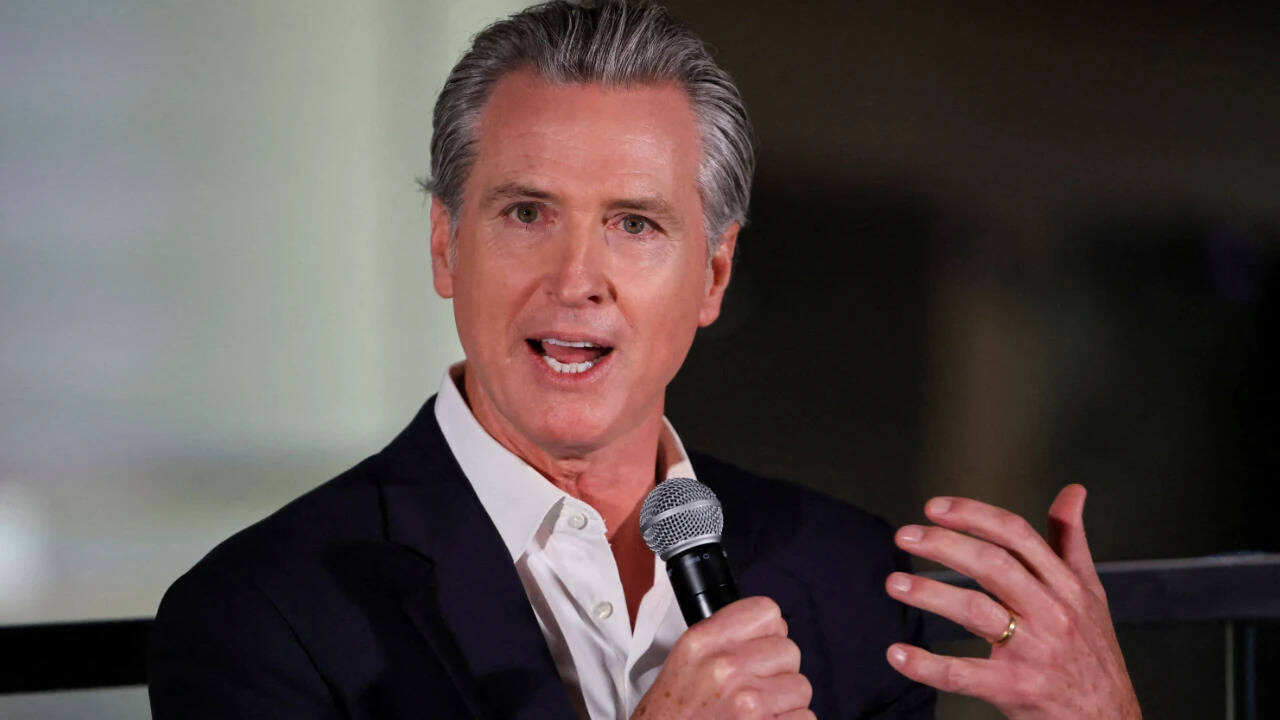
California Governor Gavin Newsom’s self-imposed January deadline to decide on a 2028 presidential bid is not an arbitrary date on a political calendar; it is a calculated forcing function designed to resolve a severe structural bottleneck in executive transition and national campaign architecture. As his second and final gubernatorial term concludes in early January 2027, Newsom faces an immediate drop in institutional power. Without a formal national apparatus waiting to absorb his political capital on day one of his post-gubernatorial life, his national relevance risks rapid depreciation.
Standard political commentary treats candidate decision deadlines as theatrical exercises in media suspense. In reality, declaring a fixed decision window two years prior to the primary season acts as an operational clearing mechanism. It forces major donors, national operatives, and rival Democratic contenders to price Newsom’s candidacy into their resource allocation models immediately after the 2026 midterm elections conclude.
The Structural Mechanics of the Post-Term-Limit Vacuum
In American executive politics, term-limited governors experience a predictable decay curve in political utility during their final twelve months in office. Lobbyists, state legislators, and federal stakeholders shift their attention toward the incoming administration. When Newsom exits Sacramento in January 2027, he loses the direct legislative veto, state budget authority, and the built-in press corps that accompanies the governorship of the world’s fifth-largest economy.
To counteract this institutional vacuum, a prospective presidential candidate must execute a seamless transfer of relevance from a state-level executive platform to a national campaign infrastructure. Setting a January decision boundary serves three specific operational functions:
- Capital Preservation and Bundler Lock-In: High-tier Democratic financiers operate on strict commitment cycles. Following the November 2026 midterms, institutional donors immediately begin evaluating 2028 presidential prospects. By establishing a January threshold, Newsom signals to California’s dense network of Silicon Valley and Hollywood bundlers that they should hold their commitments rather than dispersing capital to early-moving rivals.
- Talent Acquisition Arbitrage: Top-tier campaign managers, data architects, and media strategists become free agents immediately after the midterm elections. If a candidate delays their decision until the spring or summer of 2027, the highest-performing operatives will have already signed retainers with competing exploratory committees. A January timeline aligns directly with the post-midterm labor market peak.
- Media Narrative Substitution: Leaving office without a declared federal trajectory creates a vulnerability to the "former governor" label, which carries diminished editorial weight. Converting his status directly from outgoing governor to active presidential contender prevents a lull in national earned media.
The Three Pillars of Newsom’s Strategic Positioning
Evaluating the viability of a 2028 Newsom campaign requires separating media optics from underlying structural assets and liabilities. His candidacy rests on three distinct pillars, each carrying an inherent trade-off between national viability and primary appeal.
1. The Financial and Infrastructure Engine
Newsom possesses an unmatched fundraising apparatus built over two decades in California politics, supplemented by his national political action committee, Campaign for Democracy. During the 2024 and 2026 cycles, he deployed millions of dollars across battleground states and down-ballot races. This expenditure was not purely altruistic; it was an acquisition strategy for voter data, local operative loyalty, and chits with state party chairs in early primary states like South Carolina, Nevada, and New Hampshire. The limitation of this asset is diminishing marginal returns: national primary voters rarely reward fundraising dominance alone if the candidate’s core policy record generates friction in swing districts.
2. The Ideological Counter-Programming Model
Over the past several years, Newsom has executed a deliberate media strategy centered on direct confrontation with conservative media ecosystems and Republican governors. By appearing on right-leaning networks and engaging in televised debates with figures like Florida Governor Ron DeSantis, he positioned himself as a primary communicator for the Democratic Party. This creates a clear cause-and-effect dynamic: high visibility among base voters who prioritize partisan combativeness, paired with heightened polarization among independent voters in the Rust Belt.
3. The Governance Liability Matrix
A governor’s primary currency in a presidential race is executive competence, measured through state-level economic and social indicators. Newsom’s record presents a sharp dichotomy. On one side, California remains the global epicenter of artificial intelligence development, venture capital deployment, and clean energy adoption. On the other side, the state suffers from chronic structural deficits, the highest poverty rate in the nation when adjusted for cost of living, visible urban homelessness, and persistent outbound domestic migration. Rival campaigns in both the Democratic primary and the general election will systematically weaponize these metrics as proof of administrative failure, forcing Newsom to defend California’s regulatory and tax environment on a national stage.
The Competitive Field and Opportunity Cost Calculation
A decision to run in 2028 cannot be made in isolation; it is a function of the competitive field’s density and ideological distribution. The Democratic bench entering the 2028 cycle is exceptionally crowded, populated by battleground-state governors who lack California’s specific political baggage.
Figures such as Pennsylvania Governor Josh Shapiro, Michigan Governor Gretchen Whitmer, Kentucky Governor Andy Beshear, and Illinois Governor JB Pritzker represent alternative archetypes of Democratic executive leadership. Whitmer and Shapiro, in particular, hold electoral proof-of-concept in the exact Midwestern states required to assemble 270 Electoral College votes. Furthermore, if former Vice President Kamala Harris—another California Democrat—elects to enter the 2028 primary, Newsom faces a catastrophic overlap in donor networks, home-state media markets, and institutional endorsements.
The opportunity cost of entering the race under these conditions is substantial. Running a modern presidential campaign demands total consumption of time, reputation, and political capital over a twenty-four-month period. If Newsom enters the primary and fails to gain traction against Midwestern governors or a unified front behind another candidate, he risks permanent damage to his brand, foreclosing alternative career paths in the private sector, institutional philanthropy, or a future federal cabinet appointment.
Cause-and-Effect Variables Governing the January Verdict
Between now and the January deadline, Newsom’s inner circle will not be relying on intuition. They will be evaluating four quantifiable indicators resulting from the November 2026 midterm elections:
- The Electoral Performance of California-Style Progressivism: If Democratic candidates in suburban swing districts underperform in November 2026 while running on platforms associated with coastal governance, the market appetite for a California governor drops precipitously.
- The Rust Belt Benchmark: The relative margin of victory for Democratic candidates in Michigan, Pennsylvania, and Wisconsin will dictate whether primary voters prioritize ideological alignment or pure geographic electability.
- The Harris Variable: Newsom’s team must establish with certainty whether Kamala Harris intends to mount another campaign. Competing directly against her splits the California financial base down the middle, artificially depressing both candidates' viability in early states.
- State Budget Solvency: Newsom’s final budget proposal in Sacramento, typically unveiled in early January, will serve as his closing fiscal argument. If California faces a severe revenue shortfall requiring deep service cuts or tax increases, launching a presidential bid in the same month creates an immediate messaging contradiction.
Strategic Forecast and Execution Blueprint
The framing of a "January deadline" is itself a strategic hedge. In modern presidential politics, a formal declaration in January 2027—nearly two years before the general election—is historically early, yet an exploratory committee or a formalized national listening tour is standard practice.
If the post-midterm data confirms that the Democratic electorate favors an aggressive national communicator and the California donor base remains unsplit, Newsom will not simply announce a candidacy in January; he will immediately convert his existing PAC infrastructure into a formal exploratory operation to lock down early-state staff before Midwestern governors finish their legislative sessions. Conversely, if the midterm results reveal severe voter fatigue with coastal Democratic governance, the January deadline provides an exit ramp to pivot toward a high-profile media platform, a venture capital partnership, or a policy institute—preserving his leverage while avoiding a low-probability primary battle. The January date is less a promise to run than an option contract on his own political relevance, engineered to expire at the exact moment his gubernatorial authority ends.