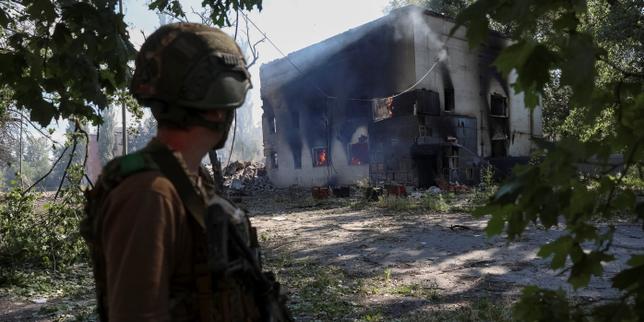
The escalation of Ukrainian long-range unmanned aerial vehicle (UAV) strikes against critical infrastructure inside the Russian Federation represents a fundamental shift from symbolic retaliation to systemic, asymmetric attrition. While media reporting frequently treats these cross-border drone incursions as isolated tactical events, a rigorous structural analysis reveals a highly coordinated operational doctrine. This doctrine does not aim for immediate territorial liberation; instead, it targets the economic and logistical architecture supporting Russian military sustainability. By analyzing the cost-benefit asymmetry, target selection criteria, and air defense saturation mechanics, we can map the true strategic trajectory of this campaign.
The Tri-Pillar Target Selection Framework
Ukraine’s deep-strike operations bypass frontline fortifications to exploit vulnerabilities deep within enemy territory. The campaign relies on a strict prioritization matrix designed to maximize systemic disruption per unit of expended capital. The targets fall into three distinct operational pillars.
Hydrocarbon Processing and Export Infrastructure
Refineries, oil depots, and export terminals represent the primary economic center of gravity. UAV strikes do not merely seek to destroy fuel reserves; they target high-value, long-lead-time components such as atmospheric distillation columns (AVT units).
These components are highly complex, capital-intensive, and frequently dependent on imported Western technology or specialized domestic manufacturing capabilities that are constrained by international sanctions. Disrupting a single AVT unit can reduce a refinery’s total output by 50% or more for months, creating regional fuel deficits and choking the state's primary revenue generation mechanism.
Logistical Chokepoints and Ammo Depots
The Russian military relies heavily on rail-bound logistics to move heavy armor, ammunition, and personnel. Deep strikes target regional railway junctions, traction substations, and forward-deployed ammunition storage facilities.
By forcing the dispersal of ammunition dumps further from the front lines, Ukraine introduces severe frictional friction into the Russian logistical chain. This forces a reliance on vehicular transport, which increases fuel consumption, accelerates vehicle wear, and expands the time-to-front latency for critical munitions.
Domestic Defense-Industrial Base (DIB) Facilities
The third pillar targets factories producing microelectronics, optical equipment, explosive materials, and aerospace components. By striking facilities hundreds of kilometers from the border—such as plants manufacturing solid-fuel rocket motors or assembly lines for domestic loitering munitions—Ukraine forces Russia to make a painful strategic choice: leave critical industrial hubs vulnerable, or redeploy scarce air defense assets away from the active combat theater.
The Economics of Asymmetric Air Defense
The foundational logic of Ukraine's drone campaign rests on a severe cost-exchange asymmetry that favors the attacker. This dynamic can be expressed through a simple cost function evaluating the cost of the offensive asset against the cost of the defensive interceptor and the value of the protected asset.
Net Economic Impact = Value of Target Saved - (Cost of Interceptor + Cost of Offensive Drone)
When a $20,000 long-range one-way attack drone (such as the Liutyi or Bober) forces the expenditure of a $2 million S-400 or Pantsir-S1 surface-to-air missile (SAM), the economic calculus heavily favors the attacker, even if the drone is successfully intercepted.
Offensive Cost Layer: Low-cost composite airframes + commercial-grade GPS/INS guidance + small combustion engines. Average cost: $15,000 - $40,000.

Defensive Cost Layer: Advanced phased-array radar tracking + solid-fuel rocket interceptors + active radar homing. Average cost per missile: $500,000 - $2,500,000.
This creates an unsustainable consumption rate for defensive interceptors. Russia’s domestic production capacity for high-end SAMs cannot keep pace with the depletion rate driven by massed drone salvos. Over time, this economic friction degrades the density of the air defense umbrella, creating gaps that subsequent drone waves can exploit.
Saturation Mechanics and Navigation Vectoring
Executing successful strikes against heavily defended airspace requires complex operational planning designed to overwhelm radar tracking systems and electronic warfare (EW) networks.
Multi-Axis Ingress Vectoring
Drone strikes are rarely launched along a single trajectory. Ingress routes are planned across multiple axes, utilizing terrain masking to stay below the horizon of early-warning radars. By entering target airspace simultaneously from the north, west, and south, a drone swarm splits the tracking and engagement capacity of local air defense batteries.
Decoy Integration and Kinetic Sequencing
The vanguard of a strike package often consists of ultra-low-cost, unarmed decoys. These decoys mimic the radar cross-section (RCS) of larger, weaponized UAVs. Their sole purpose is to force Russian air defense operators to activate their radars, reveal their positions, and expend their ready-to-fire missile complements. Once the defensive battery enters its reload cycle—a window lasting anywhere from 15 to 45 minutes—the primary, weaponized strike drones enter the engagement zone to hit the intended infrastructure.
Wave 1 (Decoys): Stimulate radar networks, drain ready-to-fire missile canisters.
Wave 2 (Electronic Warfare/Reconnaissance): Map active radar frequencies and identify blind spots.
Wave 3 (Kinetic Strike): Weaponized UAVs exploit identified gaps to strike the primary asset.
Resilient Guidance Systems
To counter heavy Russian global navigation satellite system (GNSS) jamming and spoofing, modern Ukrainian long-range drones increasingly utilize terrain contour matching (TERCOM) or optical scene matching technology (DSMAC). These systems compare real-time video feeds from onboard cameras against pre-loaded digital elevation models or satellite imagery of the target area. Because these systems are completely passive and contained entirely within the drone, they are immune to radio-frequency electronic warfare.
Operational Bottlenecks and Strategic Limitations
Despite the high efficiency of these deep-strike operations, the strategy faces fundamental structural limitations that prevent it from becoming a decisive, singular war-winning mechanism.
- Payload Capacity Constraints: Unlike conventional cruise missiles or tactical ballistic missiles, which can carry warheads weighing between 400 and 500 kilograms, long-range one-way attack drones are strictly limited by their power-to-weight ratios. Most operate with payloads ranging from 20 to 50 kilograms. This smaller explosive mass requires precise targeting; a strike must hit a volatile component (like a fuel valve or generator) to cause catastrophic failure, as structural concrete and hardened steel can easily absorb the blast.
- Scale and Scalability Bottlenecks: To truly cripple a nation's industrial output, an attrition campaign must achieve a continuous, high-volume operational tempo. Launching dozens of drones per week creates localized disruption; shifting the strategic balance requires launching hundreds of drones daily. This demands a massive, highly decentralized supply chain for engines, composite materials, and guidance chips, leaving production facilities vulnerable to resource bottlenecks and counter-intelligence disruption.
- Asset Relocation Adaptations: Physical infrastructure like oil refineries cannot be moved. However, tactical assets like aircraft, mobile command posts, and logistic nodes can be relocated. In response to deep strikes, Russian forces have routinely moved high-value aviation assets further inland to airbases outside the nominal range of current Ukrainian UAV platforms. This increases the transit time and fuel consumption for Russian sorties, but it successfully preserves the airframes from kinetic destruction on the tarmac.
The Strategic Path Forward
To maximize the return on investment for long-range drone campaigns, operations must evolve beyond uncoordinated infrastructure strikes into a synchronized system-level degradation strategy.
The optimal play requires pairing deep infrastructure strikes with frontline electronic intelligence gathering. When a deep strike forces a Russian air defense asset to move from the frontline to protect an oil refinery in the rear, that specific sector of the front line must be immediately exploited by tactical aviation or local drone reconnaissance.
Furthermore, targeting priority must shift away from general oil storage facilities toward the highly concentrated bottlenecks of the defense supply chain—specifically, the electrical substations feeding chemical plants and specialized metallurgy facilities. By disabling the unmovable, un-crewed power infrastructure that drives the defense-industrial base, Ukraine can achieve a multiplier effect that degrades frontline military capabilities far more effectively than targeting dispersed battlefield units directly. The war of attrition is won not by destroying the sword, but by systematically dismantling the forge.