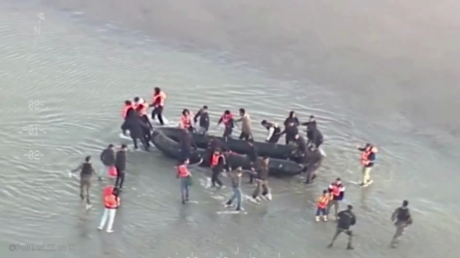
Every few months, dramatic footage loops across news networks. Heavily armed French riot police storm a windswept stretch of coastline. Zodiac boats roar into the surf. Tarpaulins are slashed, rubber dinghies are deflated with dramatic knife thrusts, and a few individuals are hauled away while cameras flash. The broadcast frames this as a victory. Order restored. The border held.
It is theater. Expensive, cynical, highly broadcastable theater.
The lazy consensus in mainstream reporting treats these beach raids as tactical interventions against a smuggling problem. Watch the footage, nod along with the officials claiming a breakthrough, and assume that if the police just slash enough boats, the flow will stop. That assumption is mathematically illiterate, economically ignorant, and fundamentally detached from how supply chains and human migration actually operate.
Stop trying to police the point of departure when the economic gravity pulls entirely toward the destination.
The Economics of Inelastic Demand
Economics 101 teaches that when you restrict supply while demand remains constant or increases, prices rise, margins expand, and new, more aggressive operators enter the market. Every time French authorities destroy a stockpile of outboard motors or puncture a batch of inflatable dinghies, they are not destroying the business model. They are subsidizing it.
Smugglers do not absorb the cost of lost inventory. They pass it down the line, jacking up prices for desperate passengers who have already liquidated their life savings to reach northern France. The higher the risk of interdiction, the higher the premium charged by criminal networks.
Why Coastal Raids Fail Basic Supply Chain Logic
- Infinite Substitutions: Inflatables and outboard engines are low-tech, globally traded commodities. You can seize a warehouse full of them in Calais, and a replacement shipment arrives from a distributor in Eastern Europe or Turkey within seventy-two hours.
- Low Capital Barriers: Entering the smuggling trade requires minimal fixed assets. You do not need a factory or a corporate headquarters. You need a beachhead, a WhatsApp group, and cheap gear.
- Decentralized Networks: Modern trafficking cells operate like decentralized franchises, not hierarchical cartels. Taking out one cell on a specific stretch of sand merely redistributes market share to three competitors waiting in the shadows a mile down the coast.
The Geography Trap
Look at a map of the English Channel. Twenty-one miles of water separate Dover from Cap Gris-Nez. It is one of the busiest shipping lanes on the planet, crisscrossed by massive container ships, ferries, and fishing vessels.
Politicians love to talk about securing the border as if the Channel were a gated suburban driveway. It is a marine highway. You cannot build a wall across open water. You cannot station a police officer every ten feet of a jagged, hundreds-of-kilometers-long coastline.
When police clear one beach, the operations simply shift twenty miles east to a quieter dune or a marshy estuary. The coastline is too porous, too long, and too difficult to monitor continuously. Treating this as a law enforcement failure misses the reality of geography. You cannot police your way out of a hydrographic layout that favors departure over interception.
The harder you push down on one part of a flexible balloon, the faster it bulges out somewhere else. Beach raids are the political equivalent of pressing your thumb into an ocean of water and expecting a dry spot to form.
The Counter-Intuitive Truth About Deterrence
Governments double down on physical deterrence because it looks decisive on the evening news. It projects strength. Voters want to see action, so politicians deliver dramatic beach raids.
Yet, empirical evidence from border control efforts worldwide shows that increased enforcement at primary departure points does not deter movement; it merely professionalizes the smugglers. When small-scale, amateur crossings become too risky due to police presence, the market consolidates. Small operators get squeezed out, and sophisticated transnational syndicates take over, offering higher-tier logistics, forged documents, and better coordination.
By raiding the beaches, European states are accidentally forcing the market to mature. They are turning fragmented local operators into streamlined, resilient criminal enterprises.
The Wrong Question entirely
Observers constantly ask: "How can we give police more resources to stop departures on the French coast?"
That is the wrong question. It accepts the premise that a sovereign nation can indefinitely police another nation's sovereign coastline against individuals who are already determined to cross.
The right question is why policy continues to ignore the structural incentives driving the market in the first place. As long as legal pathways are entirely severed while labor demands, family ties, and security crises persist, the black market will find a way through. Smugglers do not create the desire to move; they merely exploit the vacuum left by bureaucratic paralysis.
Stop funding theatrical raids that serve domestic political cycles while enriching criminal syndicates. Until policymakers understand that supply chain economics always defeat theatrical enforcement, those boats will keep launching, no matter how many knives the police bring to the beach.