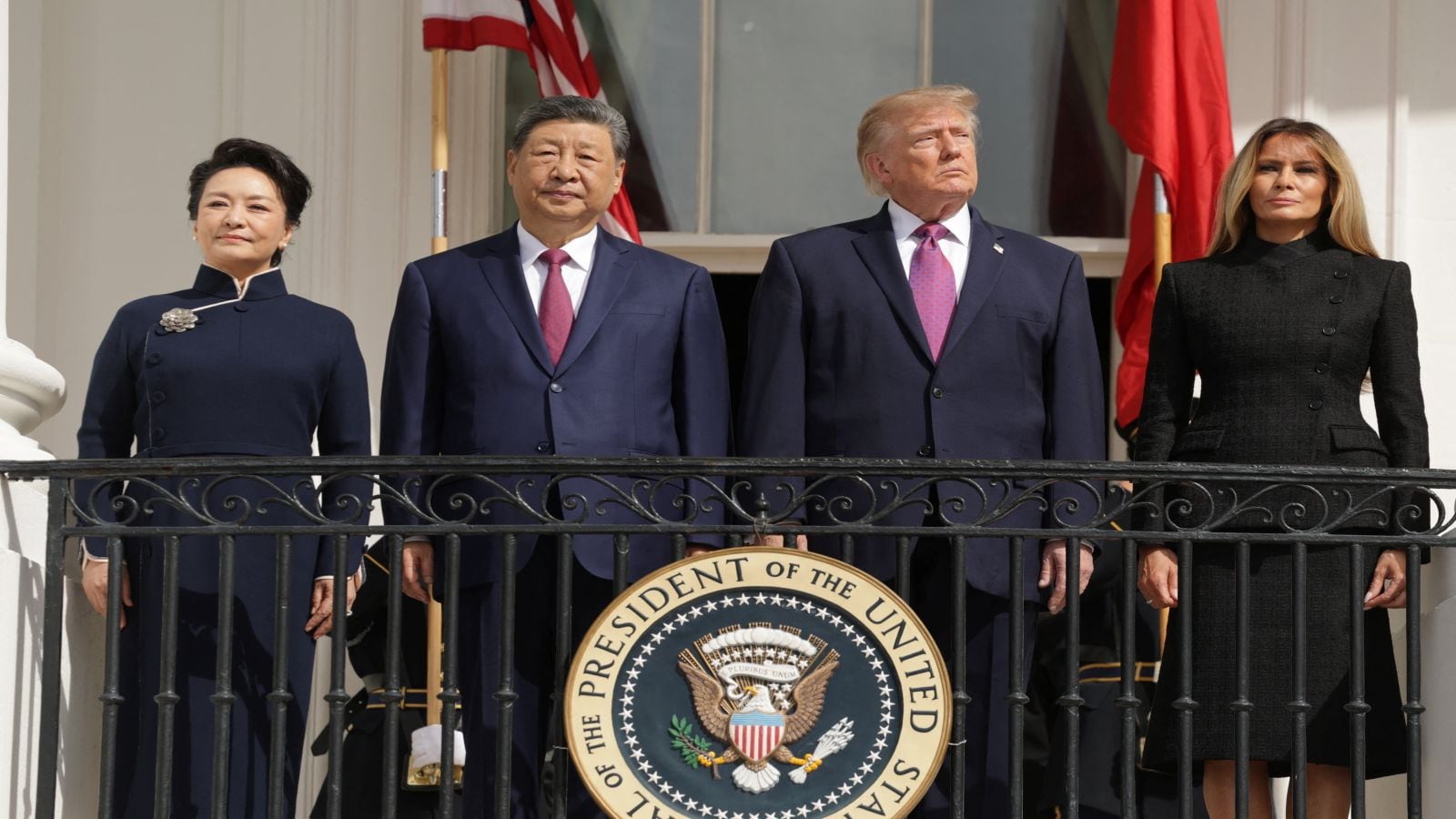
Everyone in Silicon Valley and on K Street is losing their minds over a headline that treats corporate survival like a reality television elimination round. The lazy consensus currently dominating financial media frames the intersection of Donald Trump and Jensen Huang as a dramatic rescue mission—a political titan extending an olive branch to a founder supposedly on the ropes.
That narrative is pure theater. It misunderstands how semiconductor monopolies actually operate, how executive power in Washington really functions, and why the fate of a single leather-jacket-wearing chief executive is a distraction from a much uglier structural reality.
If you are reading coverage that treats a political endorsement as a lifeline for Nvidia’s leadership, you are looking at the wrong scoreboard. Politicians do not grant second chances to companies that own the foundational architecture of modern computing. Companies that control the compute layer grant second chances to politicians who need domestic manufacturing wins before the next election cycle.
The Myth of the Embattled Founder
Let us dismantle the premise immediately. When mainstream pundits use words like "embattled" to describe a semiconductor chief executive, they are usually projecting Washington’s obsession with optics onto a balance sheet they barely understand.
In the technology sector, "embattled" usually means one of three things:
- Regulatory friction: Antitrust inquiries from the Department of Justice or the European Commission.
- Geopolitical crossfire: Export controls restricting sales to Beijing, forcing awkward product redesigns for the Chinese market.
- Market expectations: A single quarter where gross margins dip from seventy-five percent to seventy-two percent, causing algorithmic traders to hyperventilate.
None of these constitute an existential threat to a founder whose architecture powers every major frontier model on earth.
I have sat in boardrooms where enterprise infrastructure buyers spent eight figures on hardware they could not even plug in yet because their data centers lacked the power substations to run them. When your customers are willing to build dedicated nuclear power plants just to keep your silicon cool, you are not "embattled." You are the landlord of the twenty-first century.
The media loves a redemption arc. It is easy to write. It requires zero technical literacy. You take a political quote—a casual remark about giving a prominent executive another shot—and you inflate it into a high-stakes drama about loyalty, grievance, and corporate survival.
Meanwhile, the actual mechanics of power are moving in the opposite direction.
Why Political Endorsements Do Not Move Silicon
To understand why the "second chance" framing fails, you have to look at the physical bottlenecks of semiconductor manufacturing. Rhetoric is instant. Fab construction takes five years and twenty billion dollars.
Suppose a president—any president—decides to champion a specific technology leader. What does that actually buy in the physical world?
- It does not speed up extreme ultraviolet lithography. ASML in the Netherlands still holds the monopoly on the machines required to print sub-three-nanometer transistors. No speech at a rally changes the physics of tin droplets vaporized by lasers.
- It does not conjure CoWoS packaging capacity out of thin air. Taiwan Semiconductor Manufacturing Company controls the advanced packaging bottlenecks that determine how many high-bandwidth memory stacks can be fused to a logic die.
- It does not rewrite CUDA. Developers have spent nearly two decades building software libraries on top of Nvidia’s proprietary parallel computing platform. A political favor cannot break that moat, nor can a political snub fill it in.
When observers fixate on whether Trump backs Huang—or whether any administration views a chief executive favorably—they confuse regulatory permission with technological capability. Washington can impose tariffs. Washington can block mergers, just as regulators killed the Arm acquisition years ago. Washington can restrict H100 or Blackwell shipments to Shenzhen.
What Washington cannot do is build an alternative software ecosystem by executive order.
The Real Transaction Behind the Soundbite
If a political figure publicly expresses support for a major tech leader, stop asking whether the executive needs the help. Ask what the politician is pricing in.
In trade negotiations and industrial policy, chief executives of critical infrastructure companies are not supplicants. They are sovereign actors without flags. When Trump or any senior policymaker signals warmth toward a semiconductor chief, it is rarely an act of charity. It is a signaling mechanism aimed at three distinct audiences:
1. Domestic Supply Chain Leverage
The United States spent decades offshoring fabrication to East Asia because Wall Street rewarded fabless balance sheets. Now, both parties are desperate to prove they can bring high-margin manufacturing back to Arizona, Ohio, and Texas. You cannot claim victory on domestic semiconductor resilience if you are openly at war with the companies designing the chips that go into those fabs.
2. The Sovereign AI Pitch
For the past few years, the smartest play in enterprise hardware has been convincing nation-states that they need their own domestic artificial intelligence infrastructure. Every country wants its own language models trained on its own cultural data, hosted on sovereign soil. That pitch turns a hardware vendor into a diplomatic envoy. A president who aligns with that vendor gains a proxy in global infrastructure negotiations.
3. Capital Market Stability
The S&P 500 has become heavily concentrated in a handful of mega-cap technology stocks. Pension funds, retirement accounts, and institutional portfolios rise and fall on the guidance issued by a few key semiconductor and hyperscale leaders. Attacking those leaders too aggressively creates immediate market turbulence. Offering a public vote of confidence stabilizes sentiment without costing the Treasury a single dime.
What Everyone Gets Wrong About Executive Vulnerability
There is a massive gap between how political reporters define vulnerability and how institutional investors measure risk.
Political reporters look at headlines: congressional subpoenas, antitrust probes, export license denials, or shifting alliances in Mar-a-Lago and Washington. To them, an executive facing regulatory headwinds looks wounded.
Institutional operators look at switching costs.
Consider what it actually takes for a hyperscaler—Microsoft, Meta, Google, or Amazon—to rip out an entrenched hardware and software stack. Even though every single one of those cloud giants is designing custom application-specific integrated circuits (ASICs) to reduce their dependence on third-party merchant silicon, they still buy massive allocations of off-the-shelf GPUs.
Why? Because custom silicon is rigid. It works brilliantly for known workloads like recommendation engines or specific inference tasks. When model architectures mutate every six months—shifting from dense transformers to mixture-of-experts to test-time compute—programmable general-purpose parallel processors remain the only safe bet.
I have watched engineering teams burn millions of dollars trying to port production training runs onto alternative accelerators just to save twenty percent on hardware acquisition costs. Six months later, they quietly moved back to the incumbent stack because the debugging overhead and lost engineering velocity wiped out the hardware discount ten times over.
That is real leverage. Compared to developer lock-in, a politician’s opinion is background noise.
The Uncomfortable Downside of Political Entanglement
Here is where the contrarian take cuts both ways. Just because an executive does not need a political lifeline does not mean accepting political embrace is free of risk.
In fact, the greatest threat to a dominant technology company is rarely a hostile regulator. It is becoming a political mascot.
When a chief executive becomes closely associated with a specific political movement or leader, three structural liabilities immediately emerge:
- Retaliatory Regulation Abroad: European and Asian regulators already view American tech giants with deep suspicion. If a company is perceived as an extension of a specific White House administration, foreign antitrust bodies and procurement ministries tighten the screws. Sovereignty concerns suddenly override technical superiority.
- Partisan Whiplash at Home: American politics runs on two-year and four-year cycles. Semiconductor roadmaps run on five-to-seven-year architectures. Tying your corporate brand to one administration invites scrutiny, audits, and hostility the moment the pendulum swings back in the opposite direction.
- Internal Talent Friction: The engineers who design next-generation interconnects and compiler optimizations are globally recruited and fiercely independent. Turning a pure engineering culture into a political football creates internal distraction that competitors eagerly exploit.
The best chief executives in technology history—figures like Andy Grove at Intel during its peak or Morris Chang at TSMC—understood how to engage Washington without letting Washington own their narrative. They treated politicians like weather systems: something you forecast, prepare for, and build around, never something you rely on for survival.
Stop Asking the Wrong Question
If you are an investor, an operator, or simply someone trying to understand where the technology sector is heading, stop clicking on articles that frame industrial policy as a personal soap opera.
Do not ask: "Will Trump save Jensen?" or "Does Huang deserve a second chance?"
Ask the questions that actually determine where capital flows over the next decade:
- Who controls the energy grid? Compute is no longer bottlenecked by transistor density alone; it is bottlenecked by gigawatts. Watch who secures long-term power purchase agreements and grid interconnects.
- Where does the software abstraction layer sit? If open-source compilers like Triton or PyTorch backends successfully decouple model development from proprietary hardware instructions, the hardware monopoly cracks regardless of who sits in the Oval Office.
- How fast can domestic packaging scale? Front-end wafer fabrication means nothing if wafers still have to be shipped across the Pacific for advanced packaging and testing.
The media wants you to believe that the future of artificial intelligence and semiconductor dominance comes down to a handshake or a quote from a political podium. It makes for great drama and terrible analysis.
Silicon does not care about political endorsements. Compilers do not run on campaign promises. And the companies that actually control the infrastructure of the modern economy do not ask permission for a second chance—they write the specifications everyone else is forced to follow.