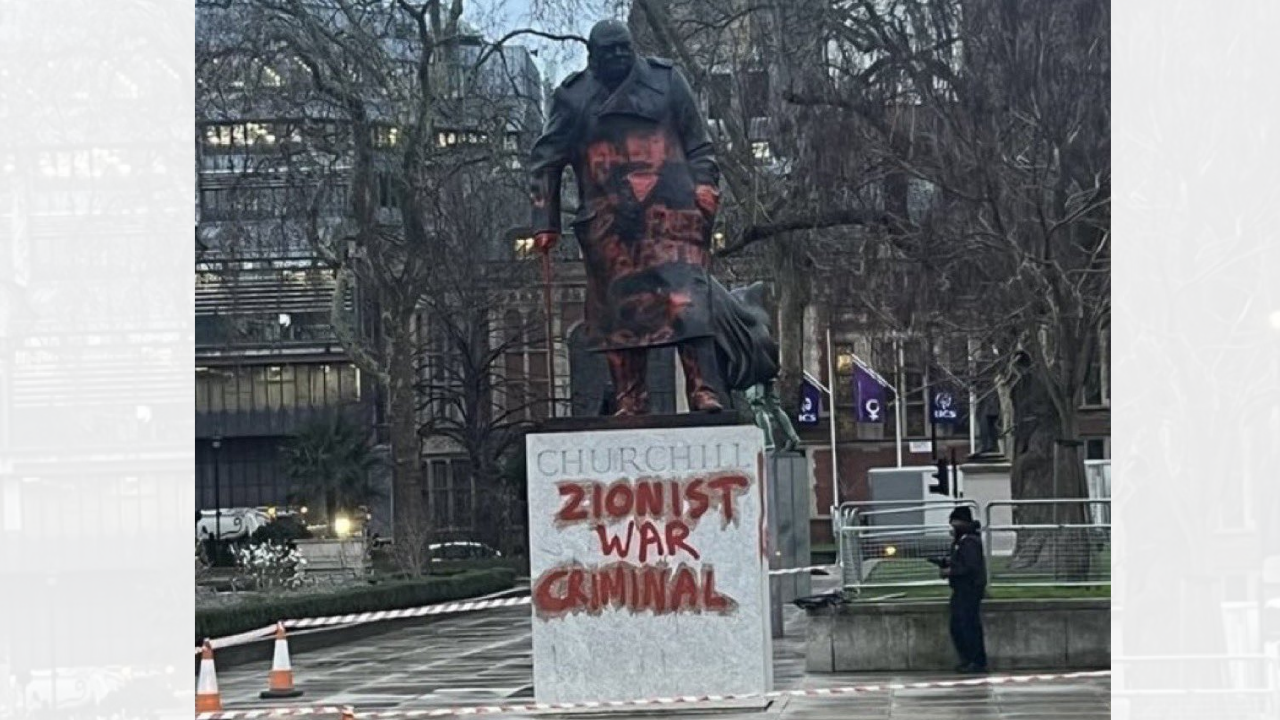
The outrage machine is predictable. A man writes "Free Palestine" on the base of Winston Churchill’s statue in Parliament Square, and the national psyche suffers a collective, performative aneurysm. The headlines follow a weary script: "Vandalism," "Arrest," "Desecration." They treat the slab of metal like a holy relic and the graffiti like a glitch in the simulation of British history.
They are all missing the point.
Statues are not history. They are snapshots of power. When we treat a bronze figure as an untouchable deity, we aren't "protecting our heritage"—we are admitting that our culture is too fragile to handle a conversation. The act of defacing a monument isn't a "erasure" of the past; it is the most honest engagement with the past we’ve seen in decades.
The Myth of Neutral Public Space
The "lazy consensus" dictates that public squares should be neutral zones of quiet reflection. This is a lie. Every statue in London is a political statement. You don't put a man on a pedestal because you want to teach a history lesson; you put him there to signal which values are currently dominant.
When Winston Churchill was cast in 1973, it was an act of post-imperial branding. It was a way for a shrinking global power to say, "We were once the giants." To get angry when someone uses that same space to voice a modern political grievance is to misunderstand the very nature of public squares. They are arenas of conflict, not outdoor museums.
The man arrested for the "Free Palestine" tag didn't ruin a historical record. He added a layer to it. He turned a static, ignored piece of street furniture into a live wire of political discourse. If you walked past that statue a week ago, you probably didn't look at it. Today, everyone is looking.
The False Equivalence of Vandalism vs. Erasure
Critics scream that this is "rewriting history." Let’s get one thing straight: history is written in books, archives, and the lived experiences of millions. It is not written in bronze.
You cannot "erase" the Battle of Britain with a spray can. You cannot "delete" the 1945 Yalta Conference with a marker. To suggest that a bit of ink on a plinth somehow endangers our understanding of the 20th century is an insult to the intelligence of the British public.
What the critics are actually afraid of isn't the loss of history—it’s the loss of narrative control. They want a version of Britain that is frozen in a 1940s victory loop, where the complexities of Churchill’s record (from the Bengal Famine to his views on white supremacy) are buried under the weight of "The Greatest Briton" polls.
Graffiti disrupts the monologue. It forces a dialogue. It asks: How does this man’s legacy sit with the current global reality? ## The Economics of Outrage
I’ve watched institutions spend hundreds of thousands of pounds on "protecting" monuments from the public they supposedly represent. It’s a massive waste of capital.
Instead of spending tax money on 24/7 surveillance and high-pressure power washers, we should be asking why we are so obsessed with the permanence of symbols. In the business world, if a product no longer resonates with the market, you pivot. You don't spend millions trying to force people to like the old version.
The obsession with keeping statues pristine is a form of cultural stagnation. It suggests that we have nothing new to say, so we must cling to what was said eighty years ago. A healthy society should be able to tolerate—and even appreciate—the friction between its past icons and its current movements.
Why 'Free Palestine' on Churchill is Poetically Apt
There is a specific irony in the "Free Palestine" slogan appearing on this specific statue that the mainstream media is too terrified to touch.
Churchill was a key architect of the geopolitical map that created the modern Middle East. He was the Colonial Secretary during the formative years of the British Mandate for Palestine. Whether you view him as a hero or a villain, his fingerprints are all over the current conflict.
Writing that slogan on his base isn't "random vandalism." It is a direct, if crude, confrontation with the consequences of his statecraft. It is the chickens coming home to roost in 12-point font.
To call it "mindless" is a coping mechanism for people who don't want to think about the causal links between British imperial history and today’s headlines. It’s far easier to call a man a "thug" than to admit he might have read a history book and decided to leave a comment on the author's grave.
The Statue as a Lightning Rod
Imagine a scenario where we stopped policing these monuments. If we allowed them to become what they actually are: giant message boards for the national mood.
What would happen? The statue wouldn't disappear. It would just become a living record. Layers of paint, slogans, and arguments would accumulate. It would be a more accurate representation of British identity than a clean piece of metal could ever be.
The current approach—arresting anyone who touches the bronze—only increases the "forbidden fruit" appeal of the act. It turns a simple political statement into a high-stakes crime, which in turn ensures that more people will do it. We are literally incentivizing the behavior we claim to hate.
Stop Being Fragile
The British public is often told that these statues are the "backbone" of our identity. If your identity is so weak that it can be toppled by a man with a Sharpie, you don't have an identity; you have a brand. And brands are meant to be challenged.
We need to stop treating the defacing of statues as a national tragedy. It’s a footnote. It’s a Tuesday. It’s a sign that people still believe the public square matters enough to leave a mark on it.
If you truly respect Churchill, you shouldn't need a pristine statue to remember him. You should be confident enough in his legacy to let it stand up to a bit of paint. If it can't handle a "Free Palestine" tag, maybe the legacy wasn't as solid as you thought.
Clean the statue if you must. But stop pretending that the man with the pen is the one destroying history. The real destruction happens when we stop talking about what these figures actually did and start treating them like lawn ornaments for a country that’s forgotten how to argue.
Put down the pearls. Pick up a book. The bronze isn't bleeding.


