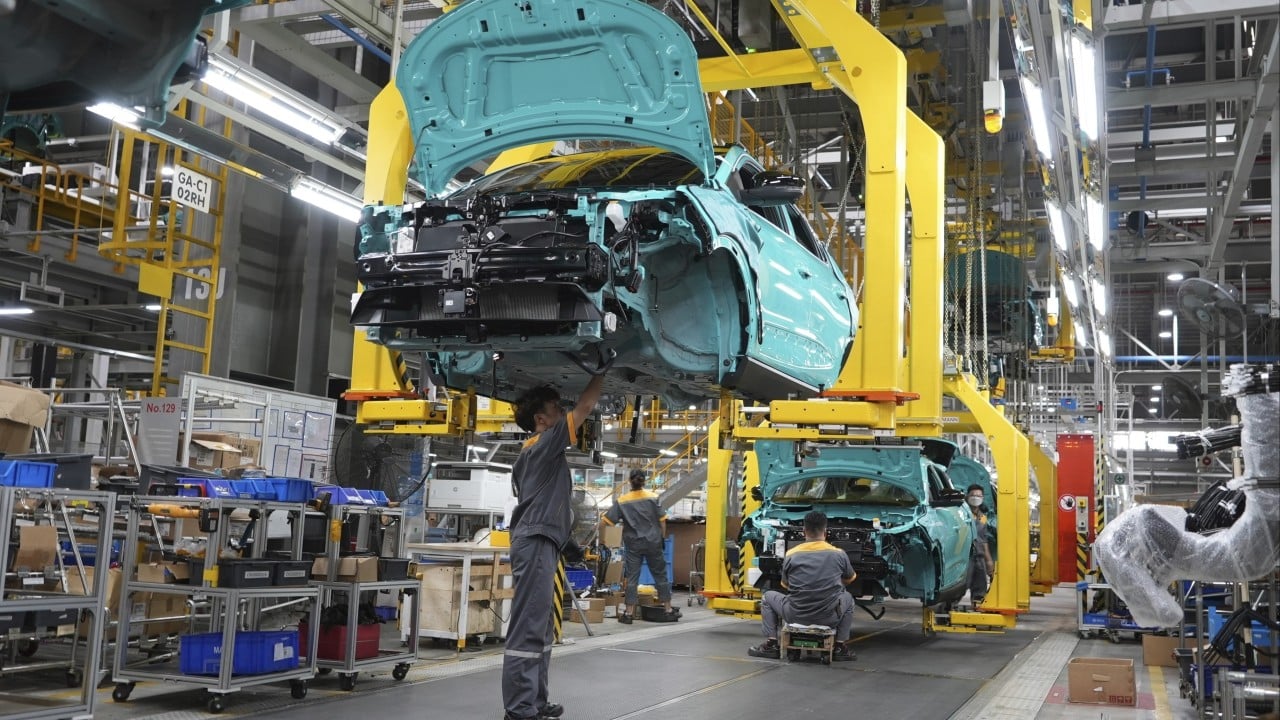
Boardrooms across North America and Europe are patting themselves on the back for executing a "China Plus One" strategy. They leased shiny new industrial space in Hai Phong or Bac Ninh. They moved final assembly out of Shenzhen. They changed the "Made in" label on the packaging.
They didn't decouple. They just added a shipping leg.
The mainstream financial press loves to point out the obvious: Vietnam’s manufacturing boom still relies heavily on Chinese raw materials, components, and sub-assemblies. That is the lazy consensus. Journalists treat this dependency like a temporary growing pain—a minor operational hiccup that Vietnam will naturally outgrow once local suppliers catch up.
That framing misses the entire point. The reliance on Chinese inputs isn't a bug in Vietnam’s manufacturing model. It is the core architecture. And if you think you are de-risking your supply chain by assembling Chinese parts in a Vietnamese factory, you aren't hedging against geopolitical risk. You are paying a 15% logistical tax for geographic theater.
The Myth of the Vietnamese Alternative
When Western executives talk about "diversifying" into Vietnam, they usually imagine a parallel industrial ecosystem. They picture local Vietnamese toolmakers, chemical refiners, precision injection molders, and textile mills operating independently of Beijing.
That ecosystem does not exist at scale.
Look at the actual trade flows. Whenever Vietnam’s exports to the United States surge, Vietnam’s imports of intermediate goods from China surge in near-perfect lockstep. Whether you are looking at smartphones, solar panels, footwear, or furniture, the upstream Tier 2 and Tier 3 suppliers—the companies making the printed circuit boards, the synthetic fabrics, the specialty adhesives, and the aluminum extrusions—are overwhelmingly located in Guangdong, Zhejiang, and Jiangsu.
I have walked dozens of "Vietnamese" factories over the last six years. You step onto the floor in Bac Giang, look at the machinery, and every control panel is printed in Mandarin. You check the bills of lading at the loading dock, and the raw materials came across the land border at Lang Son forty-eight hours earlier. Often, the factory floor supervisors themselves are Chinese nationals on temporary work visas.
Companies have blown millions of dollars setting up dual-sourcing operations in Southeast Asia only to discover that during a border closure or a raw material shortage in southern China, their Vietnamese lines grind to a halt on the exact same Tuesday as their Guangdong lines.
Why "Localizing" in Vietnam Fails on Basic Math
To understand why you cannot simply "build up" a local Vietnamese supply base to replace China, you have to understand industrial clustering and scale economics.
China didn't become the world's factory because of cheap labor. China lost its cheap labor advantage over a decade ago. China dominates global manufacturing because of agglomeration economics—the hyper-dense geographic concentration of specialized sub-suppliers, raw material processors, tooling engineers, and port infrastructure.
In Dongguan, if a plastic injection mold cracks at 2:00 PM, a specialized machinist three blocks away can cut a replacement die and have your line running again by 6:00 PM. In northern Vietnam, that same broken mold gets put on a truck, sent back across the border into China for repair, and costs you ten days of downtime.
Vietnam has a population of roughly 100 million people. China has 1.4 billion. You cannot replicate the deep, multi-tiered industrial base of the Pearl River Delta inside a country with one-fourteenth the population and a fraction of the capital stock.
Consider the upstream reality of basic manufacturing inputs:
- Petrochemicals and Plastics: Resins, polymers, and specialty coatings require massive, multi-billion-dollar refining complexes. China built dozens of them. Vietnam has two major operational refineries, and neither produces the breadth of industrial polymers needed for modern consumer electronics or automotive parts.
- Metallurgy and Fasteners: Turning iron ore and bauxite into high-grade, cold-rolled steel or aerospace-grade aluminum requires enormous power grids and heavy industrial infrastructure. Vietnam’s electrical grid already struggles with seasonal brownouts during peak summer months.
- Textiles and Yarn: Vietnam is a global powerhouse in garment cut-and-sew, yet it imports well over half of its fabric and yarn from China. Dying and finishing fabric is water-intensive, chemical-heavy, and tightly regulated. Vietnam lacks the industrial wastewater treatment infrastructure to absorb China’s textile milling capacity.
What Everyone Gets Wrong About "China Plus One"
If you search for advice on moving production to Vietnam, you run into the same recycled questions from procurement teams. Every single one of those questions is built on a flawed premise.
Is Vietnam cheaper than China now?
Only if you look exclusively at assembly-line hourly wages. Once you factor in lower labor productivity, higher turnover rates, the cost of shipping raw materials from China to Vietnam, port congestion in Haiphong, and customs clearance delays, your landed unit cost is frequently higher than manufacturing in inland China. You don't go to Vietnam to save money anymore. You go to Vietnam to dodge Section 301 tariffs.
How long until Vietnam builds its own Tier 2 supply chain?
It won't—at least not in the way Western buyers hope. The capital flowing into Vietnam to build Tier 2 component factories isn't coming from domestic Vietnamese conglomerates. It is coming from mainland Chinese suppliers following their customers south.
When Apple or Samsung tells their Chinese component makers to diversify out of mainland China, those Chinese firms buy land in Vietnamese industrial parks, ship over Chinese machinery, bring in Chinese management, and set up a subsidiary. Your Tier 2 supplier didn't change. Their zip code did.
Does assembling in Vietnam protect us from US tariffs?
For now, on paper, yes. In practice, you are walking into a regulatory minefield.
The US Department of Commerce and US Customs and Border Protection (CBP) are not stupid. They have spent years tracking the explosion of Chinese intermediate exports into Vietnam followed by finished exports to the US. This is called transshipment or circumvention, and Washington is actively dismantling the loopholes.
Under US rules of origin, simply screwing together Chinese parts in a Vietnamese warehouse does not legally transform the product into a Vietnamese good. It requires "substantial transformation"—a murky, subjective legal standard that CBP enforces aggressively. We have already seen the Commerce Department slap massive retroactive anti-dumping and countervailing duties on solar panels assembled in Vietnam, Cambodia, Thailand, and Malaysia because the underlying silicon wafers and cells were Chinese.
If your Vietnam strategy relies on importing 80% of your bill of materials from China and doing final assembly in Hanoi, you are sitting on a ticking tariff time bomb. One customs audit can wipe out five years of margin.
The Unspoken Reality of Chinese Supply Chain Ownership
Here is the part that makes corporate risk officers break out in a cold sweat when they actually audit their sub-tiers: China isn't losing market share in global manufacturing; it is capturing the upstream margin while outsourcing the low-margin assembly.
Think about the economics of a typical consumer product—say, a mid-range cordless power tool or a smart home device.
Ten years ago, a Chinese contract manufacturer handled everything: sourcing the copper, molding the housing, populating the circuit board, assembling the motor, and packing the box. They made a slim 5% to 8% net margin on the whole process.
Today, because of geopolitical pressure, the brand forces that contract manufacturer to move final assembly to Vietnam. What happens?
- The Chinese factory keeps the high-margin, capital-intensive component production (the motor windings, the PCB fabrication, the precision tooling) inside mainland China.
- They open a bare-bones assembly plant in Vietnam where lower-paid workers snap those Chinese sub-assemblies together.
- The Chinese firm still captures the profit on the components, avoids the US tariff on the finished good, and bills the Western brand extra for the cross-border logistics.
Academics like Richard Baldwin at IMD Business School have pointed out this exact phenomenon: the "Factory Asia" supply chain isn't fragmenting; it is lengthening. The distance between the raw material and the final consumer is growing, and every extra mile passes through Chinese-owned infrastructure.
Even Vietnam's ports and industrial parks are increasingly wired into Chinese capital. While Japanese, Korean, and Singaporean developers pioneered early industrial zones like VSIP (Vietnam-Singapore Industrial Park), a massive wave of recent industrial real estate development in northern Vietnam is backed by Hong Kong and mainland Chinese capital specifically designed to house Chinese Tier 1 and Tier 2 suppliers.
How to Actually De-Risk Your Supply Chain
If you are a VP of Supply Chain or a founder trying to build real resilience—not just a slide deck for your board—you need to stop pretending that geography equals independence. Moving an assembly plant 500 miles south across the Gulf of Tonkin does not insulate you from a Taiwan Strait crisis, a US-China trade war, or Chinese export controls on critical minerals.
If you want true diversification, you have to change how you source, engineer, and contract. Here is what actually works in the real world.
1. Audit to Tier 3, Not Tier 1
Most companies have zero visibility past the factory that invoices them. They sign a contract with a Vietnamese assembler and call it a day.
Mandate full Bill of Materials (BOM) transparency down to the raw material processor. Use supply chain mapping platforms or hire boots-on-the-ground auditors to verify where the sub-components are actually stamped, molded, and etched. If your Vietnamese supplier refuses to disclose their Tier 2 and Tier 3 vendors, assume 100% of those inputs are coming from mainland China.
2. Re-Engineer for Local Inputs
You cannot force Vietnamese suppliers to suddenly start manufacturing high-precision micro-bearings or specialty fluoropolymers. If your product requires those inputs, you are tied to China (or Japan/Germany at triple the cost).
Instead, take your product back to your mechanical and electrical engineers. Strip out bespoke components that only exist in Shenzhen’s Huaqiangbei electronics markets. Redesign around standardized, off-the-shelf components that can be sourced from Korean, Taiwanese, Japanese, or ASEAN producers. Value engineering for supply chain resilience beats chasing cheap assembly labor every single time.
3. Split Your Geographic Bets by Product Complexity
Stop treating Vietnam as a one-size-fits-all replacement for China. Use each region for what it actually does well:
- Keep complex, high-mix, low-volume products in China (if your market allows it). You need China’s engineering speed and dense supplier network when you are iterating fast.
- Move high-volume, labor-intensive, mechanically simple assembly to Vietnam or Indonesia. Think footwear, basic apparel, wooden furniture, and simple plastic goods where localizing raw materials (like timber, rubber, or basic textiles) is actually achievable over a three-to-five-year horizon.
- Look at Mexico or Eastern Europe for heavy, bulky, or high-tariff goods destined for North American or European markets. Paying for ocean freight from Haiphong to Los Angeles for a product made of 85% Chinese steel makes zero economic sense when you can bend domestic steel in Monterrey under USMCA rules.
4. Admit the Trade-Offs Up Front
Let’s be brutally honest about the downsides of real decoupling, because consultants rarely mention them until after you’ve signed their retainer.
If you genuinely eliminate Chinese inputs from your supply chain, your costs will go up by 15% to 35%, your lead times will stretch by weeks, and your minimum order quantities (MOQs) will spike. You will lose the speed and flexibility that spoiled Western brands for twenty years.
There is no magic country waiting in the wings with China’s infrastructure, China’s speed, and 1990s Vietnamese wages. India has massive scale and domestic market potential, but its infrastructure, port efficiency, and bureaucratic friction make Vietnam look like Switzerland. Mexico has proximity to the US, but it lacks deep component ecosystems and struggles with severe power, water, and security bottlenecks in key industrial corridors.
Stop Buying the Illusion
The companies winning right now aren't the ones bragging about their "China Plus One" press releases. They are the ones cold-eyed enough to recognize what Vietnam actually is: an extension of the southern Chinese manufacturing zone, separated by a customs border and a geopolitical loophole.
Using Vietnam as a tariff-mitigation valve is a perfectly valid tactical move—provided you price in the risk that Washington closes the valve tomorrow. Calling it supply chain independence is a delusion.
Audit your sub-tiers today. Find out where your raw materials are actually born. Because if your entire Vietnamese operation depends on a daily convoy of trucks crossing the Friendship Pass from Guangxi, you don't have a China Plus One strategy. You just have China with extra steps.