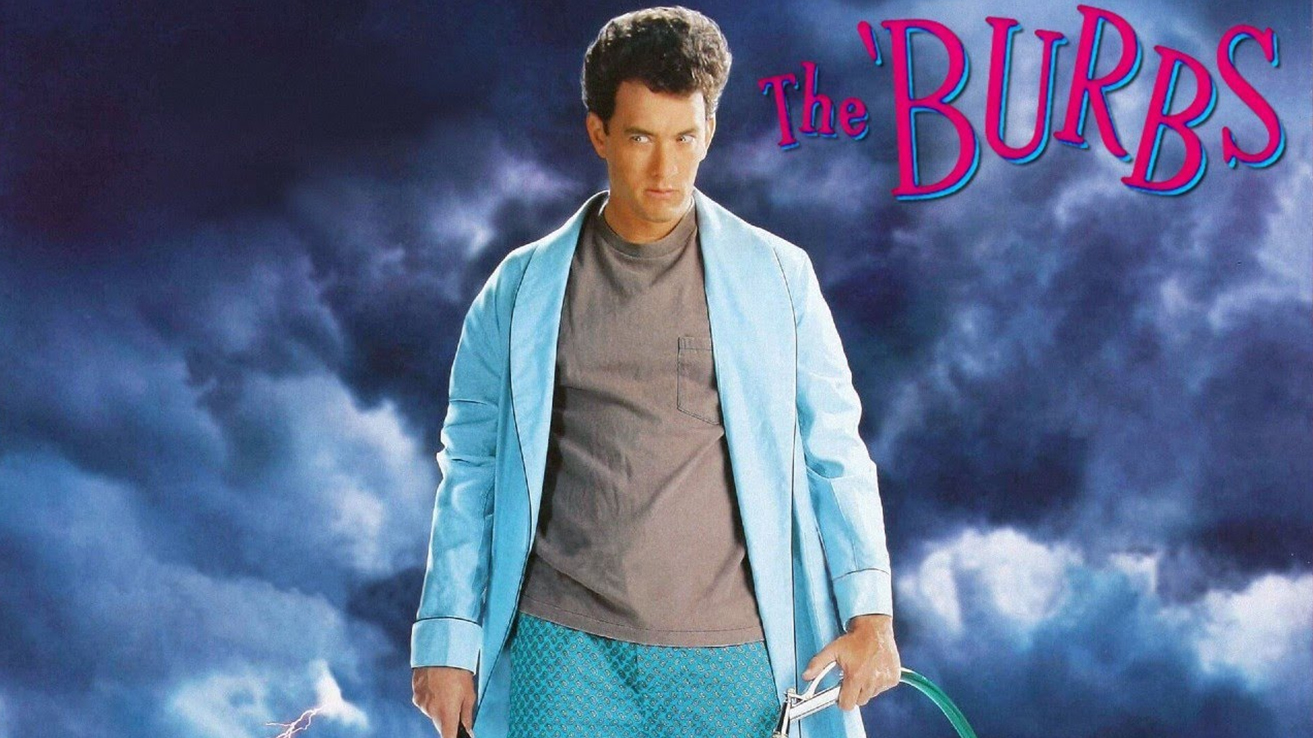
Joe Dante didn't make a "charming" movie about nosy neighbors. He made a horror film about the mental collapse of the American middle class.
The lazy consensus around The 'Burbs usually follows a predictable, sugary script: it’s a cult classic, Tom Hanks is at his comedic peak, and it’s a fun "mystery" about whether the new neighbors are serial killers. That reading is not just shallow; it is fundamentally wrong.
Calling The 'Burbs a mystery is like calling Moby Dick a book about a fish. It misses the psychological rot at the center of the frame. The real antagonist isn't the Klopek family. It is the suffocating, soul-crushing boredom of Mayfield Place.
The Myth of the Charming Cast
Critics love to talk about the "chemistry" between Tom Hanks, Bruce Dern, and Rick Ducommun. They see a trio of bumbling heroes. I see three men in various stages of a psychotic break.
Let’s look at Ray Peterson. He isn’t a hero. He’s a man who has achieved the post-war ideal—the house, the family, the vacation time—and he finds it so utterly hollow that he would rather risk a felony conviction than sit in a lawn chair for a week. His obsession with the Klopeks isn't driven by a sense of justice. It’s driven by a desperate need for anything to happen.
Art Weingartner isn't "comic relief." He’s a paranoid narcissist who uses his neighbor's psychological fragility to fuel his own delusions. Mark Rumsfield isn't a "tough guy" veteran; he’s a man LARPing a war he clearly misses because civilian life has no stakes.
We are taught to root for these men because they are familiar. We should be terrified of them. They represent the precise moment when the American suburban experiment curdled into a fever dream of surveillance and entitlement.
Suburban Voyeurism as a Disease
The film is often compared to Hitchcock’s Rear Window, but Dante flips the script in a way most viewers fail to grasp. In Hitchcock’s world, the voyeurism is a byproduct of physical limitation. In The 'Burbs, the voyeurism is a choice.
Ray, Art, and Rumsfield have every resource at their disposal. They have freedom. They have mobility. Yet, they choose to spend their existence staring through binoculars at a house that looks different from theirs.
The "mystery" is a projection.
Think about the psychological toll of radical conformity. When every lawn is mowed to the same height and every house follows the same floor plan, any deviation is viewed as a threat. The Klopeks’ crime isn't murder—initially, anyway. Their crime is having a brown lawn and not coming out to say hello. In the eyes of the cul-de-sac, that is a capital offense.
The Klopek Paradox
The most common defense of the "charming mystery" narrative is the ending. But they were actually killers! people scream at their screens.
That is the biggest trap Dante ever set.
By making the Klopeks guilty in the final five minutes, Dante isn't justifying Ray’s behavior. He is showing us the birth of the "justified" extremist. Imagine a scenario where Ray blows up the house and finds nothing but old wallpaper and a dusty furnace. The movie becomes a tragedy about a man losing his mind. By making the Klopeks "monsters," Dante allows the audience to feel a false sense of catharsis.
But look closer at the cost.
To "save" the neighborhood, Ray has to:
- Abandon his family.
- Destroy property.
- Violate every social and legal boundary.
- Nearly die in a gas explosion.
The Klopeks represent the "Other." Every society needs a boogeyman to justify its own internal dysfunction. If the Klopeks didn't exist, Ray would have eventually turned his sights on Art, or Rumsfield, or the mailman. The guilt of the Klopeks is a narrative convenience that masks a deeper, darker truth: the "normal" people are far more dangerous than the "weird" ones.
The Aesthetics of Anxiety
Dante’s use of sound and camera movement is designed to keep you on edge, not to make you feel "charmed." The score by Jerry Goldsmith is a masterpiece of irony, blending Spaghetti Western motifs with suburban dread.
The camera doesn't just observe the neighborhood; it stalks it. Every zoom is aggressive. Every wide shot feels lonely. This isn't the cinematography of a comedy. This is the visual language of an invasion film where the invaders have been living there for ten years.
I’ve spent twenty years deconstructing how films handle the concept of "home." Most directors treat the home as a sanctuary. Dante treats it as a cage. When Ray says, "I’m not leaving my house," he isn't being stubborn. He’s a prisoner identifying with his cell.
Dismantling the "Feel-Good" Cult Classic Label
Stop calling this a "comfort movie."
If you find comfort in The 'Burbs, you’re likely ignoring the fact that it is an indictment of your own lifestyle. It mocks the obsession with property values. It ridicules the idea that a man’s home is his castle. It shows the American middle class as a collection of overgrown children who would rather burn down their world than admit they are bored.
The film is a direct ancestor to movies like American Beauty or Fight Club, but it’s more effective because it hides its venom behind 1980s slapstick. It uses Tom Hanks’ "everyman" persona as a Trojan horse. We trust Ray Peterson because we trust Tom Hanks, and Dante uses that trust to make us complicit in a literal witch hunt.
The Reality of the Cul-de-Sac
The cul-de-sac is a psychological dead end.
Physically, it is designed to keep things out. It is a circle that leads nowhere. In urban planning, the cul-de-sac was marketed as a safe haven for families. In practice, it became an echo chamber for paranoia.
When you remove the external world—the "city," the "other," the "noise"—the human brain begins to eat itself. Ray Peterson is the result of that self-cannibalization. He is a man who has "won" the game of life and realized there is no prize.
The Klopeks are just a mirror. They represent the parts of ourselves we can’t control: the mess, the darkness, the secrets. The neighborhood’s attempt to excise them is a desperate act of self-preservation, not for their lives, but for their delusions.
You Are Asking the Wrong Questions
People always ask: "Were the Klopeks really killers from the start?" or "Was Walter really in danger?"
These questions are irrelevant.
The real question is: Why do we want the Klopeks to be guilty?
We want them to be guilty because it validates Ray. It validates the nosy neighbor. It validates the guy on the Nextdoor app reporting a "suspicious person" for walking down the street at night. If the Klopeks are guilty, then Ray isn't a lunatic—he’s a hero.
But if you watch the film with a critical eye, you see the truth. Even with the "win" at the end, Ray is broken. He ends the movie on a stretcher, having lost his house and his sanity. He won the battle against the Klopeks, but he lost the war against the suburbs.
The final shot isn't a celebration. It’s a warning.
The burbs didn't change. The houses are still there. The lawns are still green. And there is another family moving in next door.
If you think this movie is a "charming mystery," you’re the one being watched. Pack your bags and leave the cul-de-sac before you start smelling something in the basement.