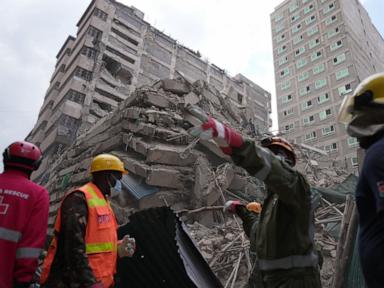
One survivor pulled from the rubble. Dozens still missing beneath pancake-stacked slabs of unreinforced concrete. Emergency crews digging with bare hands and rented excavators while politicians stand near the yellow tape promising a "thorough investigation."
You have read this exact story a dozen times. Every major outlet runs the same script. They frame the collapse as a sudden, heartbreaking disaster—a bolt from the blue where heroic rescuers battle the clock against an unpredictable catastrophe.
That narrative is a lie. And by repeating it, the media acts as an unwitting PR agency for the people responsible.
A building collapse in Nairobi, Kiambu, or Mombasa is not a tragedy. A tragedy is an earthquake, a flash flood, or a lightning strike. What happens across East Africa’s booming construction sector is an intentional, calculated financial transaction where human lives are traded for a 15% bump in profit margins. Calling it a "disaster" absolves the architects, developers, county inspectors, and concrete suppliers who engineered the failure long before the first shovel hit the dirt.
If you want to understand why people are currently trapped under tons of pulverized stone in Kenya, stop looking at the rescue efforts. Start looking at the spreadsheet.
The Myth of the "Rogue Developer"
Whenever a six-story residential block folds in on itself, the official post-mortem blames a "rogue developer." The National Construction Authority (NCA) issues a stern press release. Someone claims the owner added three illegal floors to a foundation built for two. The public shakes its head at one greedy villain, and the industry moves on.
This is lazy consensus. There is no such thing as a rogue developer operating in a vacuum.
You cannot secretly build a six-story apartment complex in a dense urban neighborhood. Concrete trucks have to drive down public roads. Cranes and scaffolding tower over the skyline for months. Sand, ballast, and steel rebar are delivered in broad daylight. Utility companies connect water and electricity to the structure.
For a structurally unsound building to reach completion, dozens of gatekeepers have to look the other way.
- The Structural Engineer who stamped drawings they never verified on-site.
- The County Planning Officer who signed off on the occupation certificate without checking concrete cube test results.
- The Quantity Surveyor who watched the steel specification drop from 16mm high-tensile bars to 12mm mild steel and kept quiet to protect their retainer.
- The Site Foreman who knew the curing time for the floor slabs was cut from 28 days to 7 days just to hit a rental deadline.
When you blame a single "rogue" individual, you protect the ecosystem that enables them. I have walked onto active commercial sites in East Africa where the contractor proudly showed me how they "saved" millions of shillings by watering down the cement mix and spacing stirrups twice as far apart as the British Standards (BS 8110) or Eurocode 2 require. They didn't act like criminals hiding in the shadows. They acted like sharp businessmen optimizing cash flow.
The Physics of a Pancake Collapse
To understand why these rescues are so desperately slow—and why survival rates plummet after the first 24 hours—you have to understand the exact mechanics of how these buildings fail.
In properly engineered reinforced concrete structures, ductility is everything. Steel rebar gives concrete tensile strength. If a column is overloaded, the steel stretches and bends before snapping. The building groans, cracks appear in the plaster, doors jam, and walls bulge. It gives occupants warning signs—minutes, hours, or even days to get out.
Cheaply built structures do not bend. They shatter.
When a developer cuts corners on steel reinforcement and uses river sand contaminated with silt or clay, the chemical bond between the cement paste and the aggregate fails. The concrete becomes brittle. Furthermore, without adequate shear links (the smaller steel hoops wrapped around the main vertical bars in a column), the concrete core has nothing holding it together under vertical compression.
Once a single ground-floor column reaches its failure threshold, it explodes outward.
Instantly, the entire load of the upper floors transfers to the adjacent columns, which are already operating near their breaking point. Within fractions of a second, every support on that level fails simultaneously. The second floor drops straight down onto the first. The kinetic energy of thousands of tons of falling masonry hits the ground floor slab, which was never designed to absorb dynamic impact loads. It shears right off its supports.
This is called progressive pancake collapse.
The floor slabs stack directly on top of one another with almost zero void space between them. In a steel-frame collapse or a timber-frame failure, fallen beams create triangular pockets—the "triangle of life"—where trapped victims can breathe and wait for search-and-rescue teams. In a concrete pancake collapse, those voids are crushed flat. Survivors are pinned in inches of space, buried under dust that causes fatal crush syndrome and asphyxiation long before heavy lifting gear even arrives at the site.
When news reports celebrate the miraculous rescue of one person from the rubble, they miss the darker reality: the rescue itself was made nearly impossible by the exact same material shortcuts that caused the collapse.
Why Stricter Building Codes Are a Complete Waste of Time
Every time a rescue operation dominates the headlines, commentators demand tougher laws. They ask why the government doesn't pass stricter building regulations or increase fines for non-compliance.
They are asking the wrong question entirely.
Kenya does not have a legislation problem. On paper, the regulatory framework is rigorous. The National Construction Authority Act, the Physical and Land Use Planning Act, and the updated Building Code provide clear, legally binding standards for soil testing, structural design, material quality, and site supervision.
Passing more laws when the existing ones are treated as optional menu items is pure theater. It gives politicians a talking point while changing nothing on the ground.
Consider the economics of enforcement versus bribery. Suppose a developer is building a 40-unit apartment block in a rapidly growing satellite town like Ruaka or Syokimau. Cutting structural steel by 25%, skipping geotechnical soil investigations, and rushing the concrete curing schedule saves roughly 15 million Kenyan shillings (over $115,000).
If an inspector flags the site, the developer faces two choices: tear down the defective work and lose 15 million shillings plus six months of rental income, or pay a 500,000-shilling bribe to make the stop-work order disappear.
Rational economic actors will take the bribe every single time. Until the financial penalty for a structural failure exceeds the capital value of the entire development—and until that penalty is enforced automatically without judicial delays—the math favors cutting corners.
The Real Reason Rescues Take Days Instead of Hours
Look closely at the footage of any building collapse response in Nairobi. You will see immense human bravery. Neighbors digging through jagged concrete with hammers. Volunteers passing buckets of debris down a human chain. Kenya Red Cross medics crawling into unstable crevices.
What you will rarely see in the crucial first six hours is coordinated, heavy urban search-and-rescue (USAR) capability.
Heavy cranes, concrete-cutting diamond saws, acoustic listening devices, thermal imaging cameras, and hydraulic shoring jacks are rarely staged and ready for immediate deployment. Why? Because municipalities treat building collapses as black-swan anomalies rather than predictable operational hazards.
Imagine a scenario where a coastal city prone to hurricanes refused to buy water pumps or train swift-water rescue teams because "floods are tragedies that shouldn't happen." You would fire the mayor on the spot. Yet major African cities treat structural collapses as unforeseeable shocks, leaving under-equipped first responders to improvise while the golden window for survival ticks away.
Even worse, uncoordinated heavy machinery often kills the very people it is sent to save. Bringing a standard excavation backhoe onto a collapsed concrete pile shifts the load distribution of the stacked slabs. One wrong pull on a protruding rebar strand can drop an entire intact section of ceiling by six inches, crushing survivors trapped beneath it. True USAR requires structural triage—stabilizing the rubble with timber cribbing and pneumatic struts before lifting a single ton of concrete. That takes specialized engineering teams on permanent standby, not a contractor lending an excavator out of goodwill.
The Uncomfortable Truth About Housing Demand
Before we cast all developers as cartoon villains, we have to confront the market force driving this entire crisis: desperate, price-insensitive demand.
Urbanization in Kenya is exploding. Hundreds of thousands of people move into urban centers every year needing affordable housing within commuting distance of jobs. A middle-class or working-class tenant looking for a one-bedroom apartment at 15,000 shillings a month does not ask the landlord for the geotechnical bore-hole report. They do not demand to see the mill test certificates for the Y16 rebar used in the transfer beams.
They look at the ceramic floor tiles, the granite kitchen countertops, and the fresh coat of bright paint.
Developers know this. They understand that cosmetic finishes sell and lease apartments, while structural integrity is completely invisible to the buyer. In a market where capital is expensive—with commercial bank loan interest rates routinely sitting in the mid-to-high teens—developers are under crushing pressure to finish construction fast, get tenants paying rent, and service their debt.
Every week a concrete slab sits curing in formwork without upward progress is a week of compounding interest eating the developer's equity. So they strip the formwork early. They pour the next floor before the lower columns have reached 70% of their design strength. The invisible debt accumulates inside the concrete matrix until gravity finally calls the loan.
How to Actually Stop Buildings From Falling Down
If you want to end these collapses, stop relying on government inspectors, public outrage, or moral appeals to developers. You have to weaponize the only two forces that actually control behavior in real estate: bank financing and insurance liability.
Mandatory Structural Latent Defects Insurance (Decennial Liability)
In countries like France under the Spinetta Law, developers cannot legally sell or lease a new building without a 10-year structural defects insurance policy. Here is why that changes everything overnight: insurance underwriters do not take bribes. If an insurer is on the hook for millions of dollars if a building cracks or collapses within ten years, the insurer hires their own ruthless, independent structural engineers to inspect the site at every pour. No rebar check, no insurance policy. No insurance policy, no occupation permit.Escrow-Linked Construction Drawdowns
Commercial banks currently release construction loan tranches based on basic progress milestones certified by the developer's own consultants. Banks must be legally barred from releasing funds for the next floor until an independent, third-party testing laboratory uploads verified 28-day concrete compressive strength results directly to a public registry. If the concrete fails the crush test, the money stops.Piercing the Corporate Veil Automatically
Right now, developers hide behind single-purpose vehicle (SPV) limited liability companies. When a building collapses and kills people, the SPV declares bankruptcy, the assets are ring-fenced, and the directors open a new company the following month. Legislation must make criminal negligence and financial restitution attach directly to the personal assets of the company directors, the lead structural engineer, and the signing county officials.
The Downside Nobody Wants to Hear
There is a massive catch to implementing these three fixes, and pretending otherwise would be dishonest.
If you enforce strict third-party testing, mandatory structural insurance, and full 28-day curing cycles across the board, the cost of urban construction in Kenya will jump by 20% to 30% overnight. Construction timelines will double. Thousands of marginal developers will go bankrupt, and the supply of cheap rental housing will dry up, driving rents higher for the exact working-class families currently living in high-risk buildings.
That is the brutal trade-off behind every collapsed building in Nairobi. Society has quietly decided it prefers cheap, fast housing today over safe, expensive housing tomorrow—and it only pretends to be shocked when the bill comes due in human lives.
Stop Reading the Obituary and Audit the Blueprint
The next time a multi-story building crumbles into dust, watch how the coverage unfolds. Count how many paragraphs are dedicated to the emotional rescue of a single survivor, and how many sentences name the structural engineering firm that stamped the blueprints, the commercial bank that financed the project, and the county official who signed the approval.
Until journalists, buyers, and regulators stop treating structural failure like an act of God and start prosecuting it like premeditated financial fraud, the excavators will keep idling on standby. The concrete is already pouring on the next collapse.