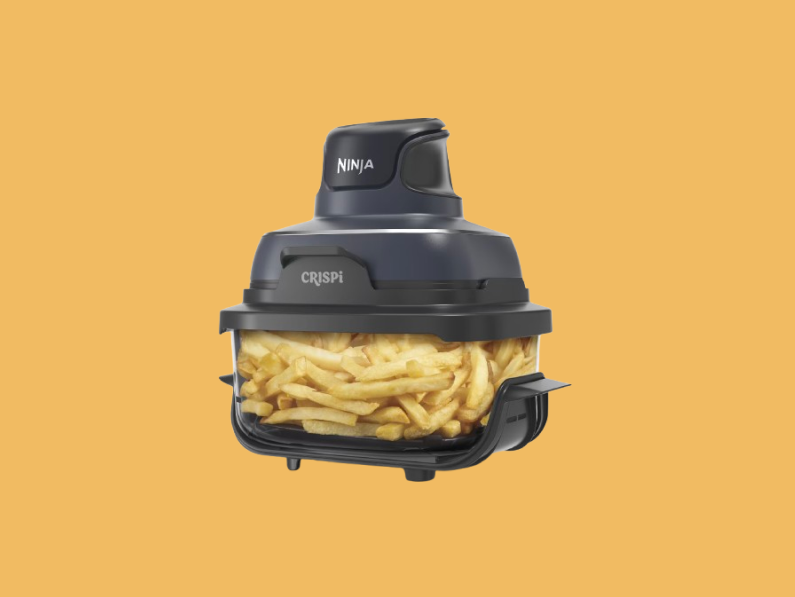
Every appliance review site on the internet currently suffers from the same terminal delusion. They look at your kitchen counter, see four square feet of laminate, and immediately suggest you clutter it with a monstrosity boasting dual independent zones, Wi-Fi connectivity, and a footprint large enough to land a Cessna.
The lazy consensus in the culinary media landscape states that bigger is better, smart features are mandatory, and every home cook needs a massive appliance capable of roasting a turkey while simultaneously dehydrating kale chips.
That advice is garbage.
I have spent the last decade tearing down commercial kitchens, analyzing thermal dynamics in consumer hardware, and watching manufacturers slap a digital touchscreen on a glorified hair dryer to mark up the price by two hundred percent. The air fryer boom created a gold rush of over-engineered junk. If you want better food with less clutter, you need to ignore the mainstream appliance curators entirely.
The Physics of the Basket Conundrum
Let us start with the core engineering lie: the dual-basket revolution. Appliance brands realized they hit a saturation point with single-drawer machines. Everyone owned a basic basket unit. Growth stalled. Their solution was to weld two smaller baskets side by side, brand it as a family-sized powerhouse, and charge you a premium for the privilege of cooking a tiny portion of fries next to a disappointingly cramped chicken breast.
Thermal dynamics do not care about your marketing budget. An air fryer is a convection oven scaled down to the size of a toaster. It works through forced air circulation—a high-speed fan driving heat past a coil, creating turbulence around your food.
When you split a housing unit in half to create dual zones, you drastically reduce the volume-to-surface-area ratio of each cooking chamber. You also restrict airflow patterns. The fan has to work harder against tighter physical constraints, leading to uneven browning and hot spots that require you to pause, pull the drawer, and shake anyway. You traded a spacious single cavity for two cramped tubes where your food steams instead of crisps.
If you are cooking for a family of four, a dual-basket machine forces you to batch-cook in installments anyway because the individual drawers are too narrow to lay proteins flat. You end up stacking food, which ruins the crisping effect. You bought a bigger box to save time and wound up doubling your kitchen friction.
Why Smart Features Are a Waste of Silicon
Manufacturers love adding touchscreens, preset menus for obscure proteins, and smartphone integration to kitchen gadgets. It gives them an excuse to charge three hundred dollars for a plastic box containing thirty dollars worth of electrical components.
Ask yourself a brutal question. Do you really need an app notification telling you that your french fries are done? Are you wandering two miles away from your kitchen while dinner cooks?
An air fryer is a high-intensity, short-duration cooking tool. Most meals take between twelve and twenty minutes. You should be standing right there, prepping a salad, making a pan sauce, or managing the rest of the meal. Smart features solve a problem that does not exist while introducing unnecessary failure points. Capacitive touch panels fail when exposed to kitchen steam and grease splatters. Mechanical dials made of heavy-duty spring steel outlast digital motherboards every single time.
When buying hardware, look for the boring parts. Heavy-gauge aluminum baskets with ceramic or PTFE-free coatings that do not flake off into your food after six months of use. A fan motor that sounds like a jet engine rather than a dying wasp. Simple analog timers and temperature knobs that click with authority.
The Capacity Fallacy
Let us dismantle the "compact versus family-sized" debate that standard buying guides love to push. They tell you to buy a three-quart model if you live alone, and a ten-quart dual-zone beast if you have kids.
This is a false dichotomy designed to make you buy two appliances over five years as your living situation changes.
A compact air fryer is useless. The moment you try to roast a whole head of cauliflower or lay down four chicken thighs without overlapping, you fail. The basket is too shallow, and the heating element is too close to the food, burning the top before the center reaches a safe temperature.
Conversely, massive countertop units steal valuable prep space. In a modern kitchen, prep space is your most valuable currency. If your air fryer is so large that you have to store it in a pantry and haul it out every Tuesday night, you will stop using it within a month. Friction kills habits.
The sweet spot is a single-drawer unit with a wide, shallow footprint—typically around six quarts—with a square basket rather than a round one. A square basket gives you significantly more usable surface area than a round basket of the same nominal volume. You can fit a standard baking dish, a whole chicken splayed flat, or multiple cutlets in a single, even layer.
How to Actually Choose Your Setup
If you want to bypass the marketing noise and buy something that will survive heavy daily use for the next decade, apply these four ironclad rules.
- Prioritize square footage over total volume. Look for wide, flat baskets. Depth is useless if food must stack to fit.
- Reject digital complexity. Mechanical dials are immune to power surges, steam damage, and software bugs. Simplicity is a feature, not a compromise.
- Inspect the coating. If the non-stick coating feels like cheap teflon that scratches if a fork looks at it harshly, walk away. Ceramic coatings or bare, heavy-gauge stainless steel interiors hold up far better under high heat cycles.
- Measure your counter depth. If an appliance forces you to sacrifice your cutting board space, it does not belong in your kitchen, no matter how good its convection fan sounds.
Stop treating your kitchen counter like an electronics showroom. Buy the single, wide-basket workhorse, master its thermal quirks, and ignore every review telling you that you need a dual-zone cockpit to crisp up some broccoli.