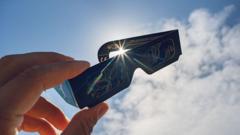
The panic is entirely manufactured. Every single time a shadow sweeps across the continent, media outlets and online opportunists peddle the exact same narrative: stocks are running low, cardboard viewers are vanishing from shelves, and you better scramble before you miss the celestial event of a lifetime. It is a masterclass in artificial scarcity. Millions of people rush to pay twenty bucks for a piece of printed polymer glued to cereal-box paper, convinced they are securing a rare ticket to science.
Let us be brutally honest. You do not need a frantic Amazon order for custom branded paper specs to watch an eclipse safely. The obsession with commercial solar viewing glasses is a triumph of marketing over basic physics.
The Anatomy of the Eclipse Panic Machine
I have watched this playbook run for decades. A celestial alignment approaches, PR agencies spin up panic reports about depleted warehouse inventories, and suddenly ordinary citizens are hoarding flimsy paper shields like toilet paper in March 2020.
The lazy consensus says you must secure certified ISO 12312-2 filters immediately or risk instant blindness. The fear is weaponized to move inventory. Yes, looking at the uneclipsed or partially eclipsed sun with unprotected eyes destroys retinal tissue. That is a biological fact. But treating ISO-certified polymer filters as scarce luxury commodities is a joke.
The underlying material costs pennies. The markup on convenience is astronomical. When people complain that stocks are running low, they are usually talking about novelty cardboard frames featuring corporate logos or cartoon moons. They are not talking about a shortage of optical density.
The Physics They Refuse to Explain
Let us look at what an eclipse filter actually is. It is a polymer film or coated glass that reduces visible sunlight by a factor of about 100,000, while also blocking harmful infrared and ultraviolet radiation.
ISO 12312-2 certification is a standard, not a magical branding stamp. Any piece of material that meets the optical density transmission requirement of 0.00001 percent safe light transmission works. The cardboard holding it to your face is irrelevant to your retinas.
Yet, the market treats these specs like designer sunglasses. People spend hours refreshing inventory pages for specific brands, driving up secondary market prices on eBay. It is absurd. If you understand how light dispersion and projection work, you realize you do not even need to look directly at the sun to experience an eclipse.
The Unconventional Playbook For Realists
If you actually want to witness an eclipse without falling for the retail stampede, abandon the direct-viewing dogma entirely.
Embrace Indirect Projection
The sharpest, most mesmerizing views of a partial eclipse do not happen through a tiny piece of cardboard held against your nose. They happen on the ground beneath your feet.
Look down under the canopy of a leafy tree during a partial phase. Every single gap between the leaves acts as a natural pinhole camera, projecting hundreds of crescent suns onto the pavement. You get a panoramic display of optical physics for free, with zero risk of eye strain and no shipping delays.
Build Your Own Rig in Thirty Seconds
If you want a direct projection tool, grab two pieces of stiff white paper. Punch a pinhole in one. Stand with your back to the sun, let the sunlight pass through the pinhole, and project the image onto the second piece of paper in your shadow. You now have a functional, high-contrast solar projector built from office supplies sitting in your junk drawer.
Use What You Already Own
Welders know this better than anyone. Shade 14 welding filters provide superior protection to standard consumer eclipse glasses. If you happen to have a welding helmet or a spare shade plate sitting in your garage or workshop, you are already better equipped than the person frantically refreshing tracking numbers for a paper visor.
The Cost of Manufactured Urgency
When society treats basic scientific observations as commercial bottlenecks, we train people to panic instead of think. We create an environment where a natural wonder becomes an exercise in consumer logistics.
The next time an eclipse approaches and the headlines scream about vanishing inventories, take a breath. Check your pantry for a colander, look at the shadows cast by the trees, or build a simple projection box. Let the panic buyers fight over the cardboard scraps. You have better physics on your side.

