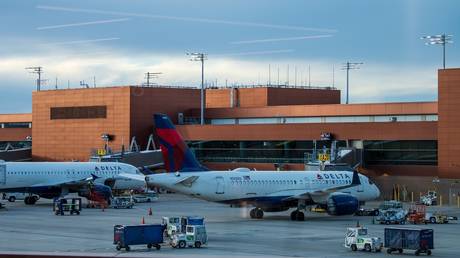
Every time an airline melts down and strands fifty thousand travelers on airport terminal floors, the mainstream press runs the exact same headline. System failure disrupts thousands of US flights.
It is lazy journalism. Worse, it is a convenient lie that lets airline executives and federal regulators off the hook.
When a carrier grounds its entire domestic fleet because a crew-scheduling database or a Notice to Air Missions server goes dark, you are not witnessing a sudden technological freak accident. You are watching the inevitable collapse of a business model engineered to run at 99.9 percent capacity with zero margin for error. Calling these events "IT glitches" is like blaming a house fire on a single match while ignoring the open cans of gasoline stacked in the living room.
The Lie of the Isolated System Failure
The standard media narrative treats aviation meltdowns like meteorological events. A server crashes. A fiber-optic cable gets cut. A legacy mainframe chokes on a corrupt file. Suddenly, planes stop moving, and the airline issues a tearful apology about "unforeseen technical difficulties" while promising to upgrade their infrastructure.
Buyers of this narrative misunderstand how modern commercial aviation actually operates.
Software breaks every single day in every major industry on earth. Banks lose connectivity. Cloud providers drop availability zones. Retail payment processors stall. Yet when a regional bank’s internal ledger lags for two hours, the entire global financial system does not grind to a halt for six days.
Aviation does. Why? Because commercial airlines have spent the last two decades systematically stripping away operational slack in the name of quarterly margin expansion.
I have sat in operations centers watching network planners celebrate squeezing an extra four minutes of turnaround time out of a narrow-body jet at a congested hub. On paper, that optimization looks brilliant. It adds millions to the bottom line over a fiscal year. In reality, it removes the physical buffer that absorbs minor disruptions.
When a schedule has zero slack, a ninety-minute software outage does not cause a ninety-minute delay. It causes a cascading synchronization failure across crew duty limits, aircraft maintenance cycles, and gate availability that takes a week to untangle.
How Hub-and-Spoke Fragility Turns Glitches Into Catastrophes
To understand why a minor database hiccup ruins your vacation, you have to look at the geometry of the American airspace system.
US airlines rely heavily on the hub-and-spoke model, a network design where flights route passengers through massive central airports—think Atlanta, Dallas-Fort Worth, Chicago O'Hare, or Denver—rather than flying point-to-point. This model maximizes seat occupancy, known in the industry as load factor. Before the 2000s, an airline might operate profitably with planes 70 percent full. Today, domestic load factors routinely hover above 85 percent, often hitting 95 percent during peak travel windows.
Here is the mathematical trap nobody talks about:
- High load factors eliminate rebooking capacity. When an airline cancels 500 flights and planes are already 90 percent full, there are literally no empty seats left in the sky to absorb the displaced passengers.
- Crew legality clocks never stop ticking. Under Federal Aviation Administration Part 117 regulations, pilots and flight attendants face strict limits on flight duty periods and mandatory rest windows. When a system outage delays departures by three hours, crews time out sitting on the tarmac. Even after the computers come back online, the airline no longer has legal crews to fly the planes.
- Aircraft and crews separate. In a tightly wound schedule, the pilot scheduled to fly a Boeing 737 from Chicago to Miami might be arriving on an inbound flight from Boston, while the first officer is coming from Seattle, and the aircraft itself is coming from Phoenix. Break one digital link in that chain, and three different cities lose departures.
Imagine a scenario where a major carrier suffers a two-hour outage in its weight-and-balance calculation software at 7:00 AM on a Tuesday. Even if engineers restore the database by 9:00 AM, the morning departure bank at three mega-hubs has already missed its takeoff slots. Inbound planes cannot reach their gates because outbound planes are still blocking them. Flight attendants reach their maximum duty hours before leaving the ground. By noon, the airline has lost track of where half its flight crews actually are, because the automated tracking software cannot process manual reassignments faster than human schedulers can enter them.
That is not a computer problem. That is an architectural choice.
The Technical Debt Shell Game
When critics finally look past the weather and the hubs, they usually point at "legacy code"—the ancient COBOL and mainframes running crew scheduling and reservation systems. Pundits love to mock airlines for running 1970s architecture.
They have it completely backwards.
The core mainframe transaction engines—systems like Sabre or TPF (Transaction Processing Facility)—are actually the most reliable components in the entire aviation stack. Built specifically for high-volume, deterministic transaction processing, these core engines rarely fail on their own.
The real rot lives in the patchwork of middleware, APIs, and bolted-on cloud wrappers built around those mainframes over the last thirty years. Instead of executing painful, multi-billion-dollar core replacements, airline boards repeatedly approve cheap patches that duct-tape modern web interfaces onto decades-old databases.
Consider the Federal Aviation Administration’s own NOTAM (Notice to Air Missions) system, which famously crashed and grounded every US flight in January 2023. The root cause was not a sophisticated cyberattack or an unsolvable algorithmic flaw. A contractor accidentally deleted files while working to synchronize a live database with a backup database. A single human keystroke brought American commercial airspace to a standstill because a critical federal safety system lacked basic automated rollback protections and active-active failover architecture.
Private carriers make the exact same compromises. In 2022, Southwest Airlines suffered a holiday meltdown that canceled nearly 17,000 flights. Executives initially blamed historic winter storms. Industry insiders knew better. While competitors recovered from the exact same weather front within 48 hours, Southwest’s point-to-point network collapsed because its crew-scheduling software, SkySolver, could not automatically pair displaced crews with aircraft once manual overrides exceeded a certain threshold. Schedulers had to resort to pen, paper, and endless hold queues on rotary-era phone trees to figure out which pilots were stranded in which hotel rooms.
Why Airlines Refuse to Fix the Real Problem
If industry insiders know that lean scheduling and technical debt create systemic fragility, why does nothing change after congressional hearings and Department of Transportation fines?
Follow the incentives.
Building true operational resilience requires spending money today to prevent a catastrophic loss that might only happen once every five years. In public markets, Wall Street analysts punish airlines that carry excess capacity, hold spare aircraft on standby, or invest billions in non-revenue-generating backend infrastructure.
Let us look at the brutal economics of redundancy:
- Spare aircraft sit idle. Parking five extra wide-body jets at major hubs strictly as recovery assets costs hundreds of millions in capital expenditure and maintenance while generating zero ticket revenue on normal days.
- Reserve crews cost money. Paying pilots and flight attendants to sit at home on short-call reserve raises unit labor costs—measured as CASM (Cost per Available Seat Mile)—which immediately compresses operating margins.
- Infrastructure upgrades carry career risk. A Chief Information Officer who initiates a five-year, $2 billion core system migration risks career suicide if the cutover goes poorly. Keeping the legacy patchwork alive for another four quarters gets them their annual bonus.
Even Department of Transportation enforcement actions rarely alter this math. When regulators slap a carrier with a $100 million penalty for consumer protection violations, executives treat it as a delayed tax. Over a five-year cycle, stripping out operational buffers saves far more than the occasional regulatory fine or passenger voucher payout costs.
Until the financial penalty for a network collapse exceeds the multi-year profit gained from running at maximum friction, airlines will continue optimizing right up to the cliff edge.
Answering the Questions Travelers Actually Ask
When flights start dropping off departure boards by the thousands, panicked travelers flood search engines with predictable questions. Most of those questions are built on false assumptions about how aviation works.
"Are airlines being targeted by cyberattacks when systems go down?"
Almost never. Ransomware groups and state-sponsored actors certainly probe aviation networks, and third-party vendors occasionally suffer data breaches. However, massive operational ground stops are overwhelmingly self-inflicted wounds. Complex distributed systems fail internally far more often than they fall to external hackers. Blaming shadowy cybercriminals is great movie material, but the real culprit is almost always a botched database migration, an expired security certificate, or an unpatched memory leak.
"Which US airline has the most reliable IT infrastructure?"
None of them are immune, and anyone claiming one major carrier has solved this problem is selling you loyalty points. Delta Air Lines long held a reputation as the operational gold standard in the US—until a single faulty software update from cybersecurity vendor CrowdStrike in July 2024 knocked out Delta’s crew-tracking tools and triggered over 5,000 flight cancellations across five days, long after rivals United and American had fully recovered. Reliability in aviation is temporary; complexity eventually catches every carrier.
"Does booking earlier in the day actually protect me from system failures?"
Yes, and this is one of the few pieces of conventional travel wisdom that holds up under operational scrutiny. Airlines reset their networks overnight. Maintenance crews clear backlogs, aircraft sit positioned at their origin gates, and flight crews start their shifts with fresh legal duty clocks. A 6:30 AM flight leaves before the daily cascade of delays begins. By 4:00 PM, minor morning hiccups have compounded across three or four flight legs, turning every afternoon departure into a gamble.
How to Bulletproof Your Travel Against Inevitable Meltdowns
You cannot force multibillion-dollar corporations to abandon lean management practices, and you cannot rewrite legacy federal aviation software. You can, however, stop traveling like an amateur who trusts airline schedules at face value.
If you fly regularly, adopt the defensive playbook used by aviation professionals:
- Fly nonstop or die trying. Every connection multiplies your exposure to network fragility exponentially, not linearly. A layover at a congested hub like Newark or Chicago means two separate aircraft, two separate flight crews, and two separate ground operations must align simultaneously. Pay the extra hundred dollars for the direct flight.
- Never book the last flight of the night. If a system outage delays the final departure of the day, there is no backup aircraft behind it. You are guaranteed a night on a terminal cot. Always leave at least two later flights on the same route behind your booked itinerary.
- Book directly with the operating carrier. Third-party online travel agencies act as bureaucratic walls during a meltdown. When an airline’s automated rebooking engine breaks down, gate agents have far less flexibility to manually push tickets issued through external aggregators.
- Hold backup reservations on separate alliances during peak windows. If you are traveling for an unmissable event—a wedding, a board meeting, an international cruise departure—book a fully refundable fare on a competing carrier using a completely different hub network, scheduled three hours after your primary flight. If your primary airline melts down, you already hold a confirmed seat while ten thousand other passengers are screaming at customer service desks.
The Trade-Off Nobody Wants to Admit
There is an uncomfortable truth buried beneath the outrage over canceled flights. Travelers share partial blame for the fragility they despise.
Modern commercial aviation is the safest, cheapest mass-transit miracle in human history. Adjusted for inflation, domestic airfares have plummeted over the last forty years while safety records have reached near-perfection. You can cross an entire continent in five hours for the price of a nice dinner specifically because airlines eliminated empty seats, retired spare aircraft, and automated crew scheduling down to the minute.
If regulators forced US carriers to maintain 20 percent spare fleet capacity, triple reserve crew pools, and rebuild every backend database from scratch, system-wide meltdowns would largely vanish. So would $150 cross-country tickets.
You can have dirt-cheap fares, or you can have a resilient air travel network. You cannot have both. Every time you sort flight search results from lowest price to highest, you are casting a vote for the exact system that leaves you stranded on the tarmac.



