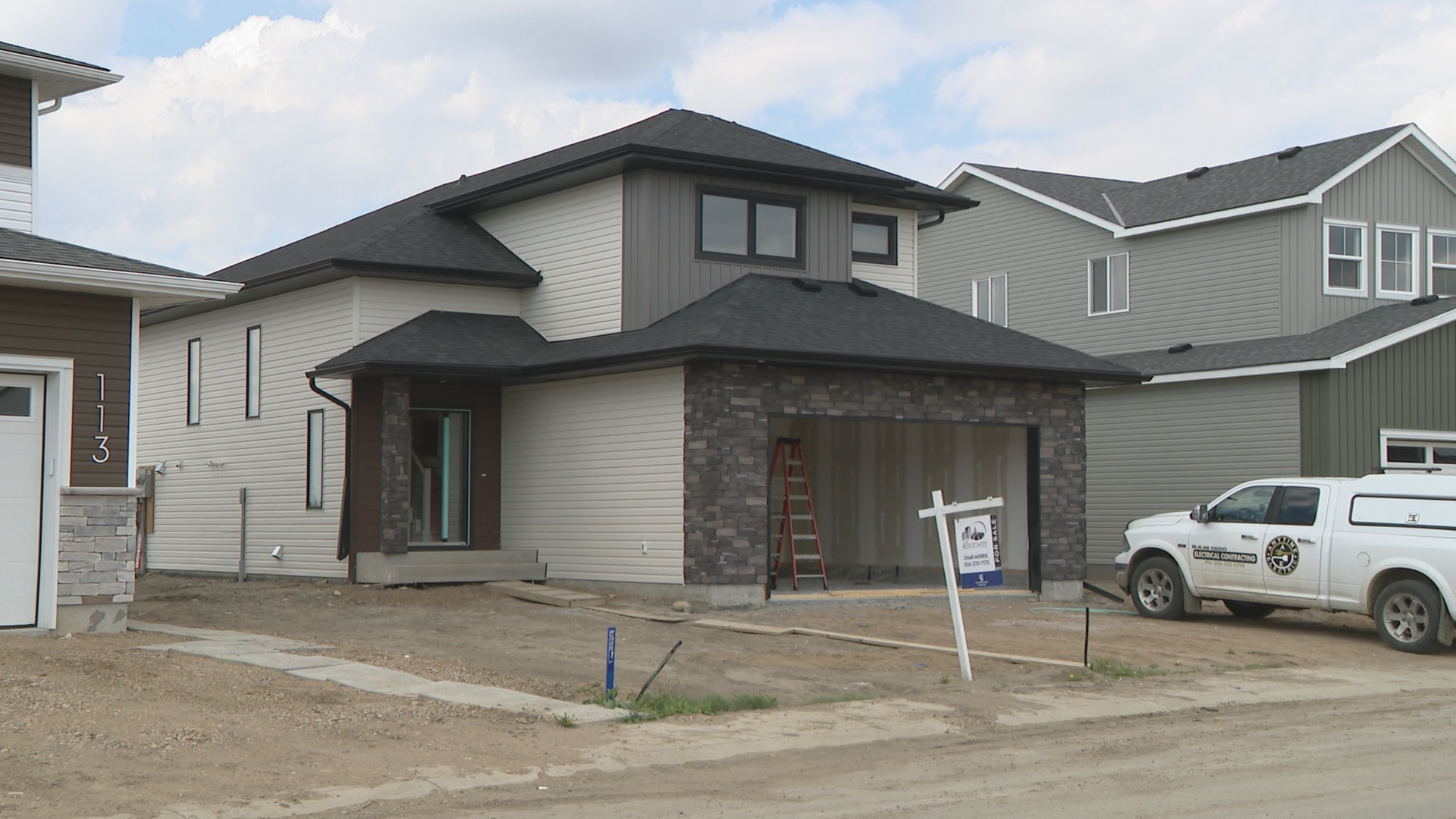
The media is serving up a lazy narrative about Saskatchewan real estate, and everyone is swallowing it whole.
Open any local news outlet and you will read the exact same hand-wringing: Saskatoon and Regina are facing an unprecedented supply crisis. Inventory is 50 percent below the 10-year average. Saskatoon is sitting at a razor-thin 1.6 months of supply. The Saskatchewan Realtors Association is sounding the alarm that a lack of listings is "threatening growth potential." The prescribed cure? Panic-buy a condo, lower your expectations, and pray that developers build higher-density townhomes faster.
It is a comforting, simplistic lie. It allows buyers to blame a faceless "shortage" and allows real estate agents to whip up bidding wars by telling you that houses "disappear the day they hit the market."
The real estate cartel wants you to look at the supply column because they do not want you looking at the capital column. Saskatchewan cities are not hitting record-high housing prices because there are too few sticks of wood on the prairie. They are hitting record highs because the province has suddenly become the premier capital dump for failing equity from Toronto and Vancouver, supercharged by an industrial commodity cycle that the local market is completely unequipped to absorb.
If you think buying a $444,400 bungalow in Saskatoon today is a smart move driven by "local economic growth," you are walking straight into a structural trap.
The Migration Myth: You Are Importing Asset Inflation, Not Neighbors
The consensus view says interprovincial migration is a sign of a healthy provincial economy. People are moving for the jobs in potash, uranium, and the NextGen Mine. They need roofs over their heads, so prices go up.
Look at the actual mechanics of the money. I have watched real estate markets across Canada for nearly two decades, and the pattern never changes. What we are witnessing is not a labor migration; it is an equity flight.
Buyers from British Columbia and Ontario are exiting collapsing, correcting markets where benchmark prices are dropping. They are cashing out their over-leveraged suburban townhomes in Brampton or Surrey, taking $400,000 in liquid equity, and landing in Regina or Saskatoon. To a local family making the median provincial income, a $381,100 provincial benchmark price feels staggering. To a refugee from the Toronto real estate casino, that same house looks like a rounding error.
They are not outbidding you by 10 percent because they love the neighborhood. They are outbidding you because they are playing with house money from a different province.
When you have ten offers on a $500,000 home in Saskatoon, the problem isn't that the city didn't build an eleventh home. The problem is that five of those offers are unconditional, cash-heavy bids from out-of-province capital that does not care about local wage realities. You are not competing against your neighbor; you are competing against the carcass of the Ontario housing bubble.
The Illusion of the Supply Crisis
Let's dismantle the inventory numbers that the headlines love to quote. Yes, active listings are historically low. But low inventory does not inherently mean prices must skyrocket to historic records.
In a normal, isolated economic ecosystem, when supply drops and prices rise beyond local affordability metrics, sales volume plummets until prices correct. That is basic economics. Yet, Saskatchewan year-to-date sales remain well above the 10-year average. The market is highly active despite the prices.
Why? Because the purchasing power is external.
Consider this thought experiment: Imagine a small, isolated town with 100 homes and 100 families. The average income is $60,000. If 10 homes go up for sale, they sell for $200,000. If suddenly only 2 homes go up for sale, the price might tick up to $220,000, but it cannot hit $500,000 because nobody in the town has the money or the borrowing capacity to pay it. The market hits a hard ceiling dictated by local wages.
Now, introduce three buyers from a metropolis who just sold their condos for $800,000 cash. The supply didn't change—it is still 2 homes. But the price instantly warps to $450,000.
Saskatchewan’s inventory "crisis" is a symptom, not the cause. The cause is that the local pool of housing has been breached by macro-regional capital. Building more high-density apartments in Warman or Martensville will not fix this. It will simply create more cheap inventory for secondary investors to scoop up as rental properties.
Saskatoon is Now More Expensive Than Edmonton: The Ultimate Red Flag
Local industry leaders are pointing to the fact that Saskatoon's average home price has surpassed Edmonton's as if it were a badge of honor. "Saskatoon is now more expensive than Edmonton... I suspect we'll see Saskatoon surpass even places like Calgary," boasts the industry consensus.
This is absolute lunacy. It should terrify anyone looking to buy property in the province.
Edmonton is a major metropolitan center with massive infrastructure, an international airport hub, a highly diversified industrial base, and a population of over a million people. Saskatoon is a beautiful regional city of roughly 300,000 people heavily reliant on primary resource extraction.
When a secondary market's housing costs eclipse a major metropolitan market's costs, it is never because the secondary market suddenly became inherently more valuable. It is because the secondary market is smaller, less liquid, and easily distorted by a sudden influx of capital.
It takes very little external money to completely break the real estate market of a city the size of Saskatoon. A few thousand buyers moving across provincial lines can dry up 1.6 months of supply in a flash. But what happens when that external capital dries up? What happens when the trade uncertainties and U.S. tariffs hitting Canadian exporters begin to drag down commodity values?
Saskatchewan has a historical, deeply ingrained vulnerability to single-industry exposure. Potash, uranium, and oil are highly cyclical. When the commodity cycle turns—and it always turns—the external investment capital evaporates overnight. When that happens, you are left with an illiquid market, high asset prices, and a local economy that cannot support the mortgages.
The False Promise of Condos and "Recalibration"
The current advice coming from the real estate establishment is patronizing. Buyers are being told to "recalibrate their expectations," give up on the dream of a single-family home, and buy an apartment-style condo instead.
This is dangerous financial advice.
The condominium market in a mid-sized prairie city is a notoriously poor store of value. Unlike Toronto or Vancouver, where land constraints force vertical living, Saskatchewan has no shortage of physical space. The moment the current frenzy cools, single-family detached homes will retain their premium, while the overbuilt condo inventory in suburban bedroom communities will crater.
Look at the current data from the Canadian Real Estate Association (CREA). While single-detached homes are flying off the market in 29 days, apartment units are seeing their median days on market increase. The ground-level reality is that people do not move to Saskatchewan to live in a 700-square-foot concrete box. Forcing first-time buyers into properties that historically underperform in appreciation just to "get on the ladder" at the absolute peak of a macro-fueled cycle is a recipe for manufactured equity destruction.
Stop Asking How to Win a Bidding War
People looking at the Saskatchewan market right now are asking the wrong questions. They are asking:
- How do I write a competitive unconditional offer?
- Should I pay $20,000 over asking price to secure a home?
- How can I get into a neighborhood before prices jump another 10 percent?
These questions assume that the current trajectory is permanent. It is not. You are looking at a market that is fundamentally decoupled from local fundamentals.
Instead of trying to win a rigged game, you need to understand the structural downside of the current environment. High interest rates are locked in for the foreseeable future as the Bank of Canada holds steady, and a massive wave of pandemic-era mortgages are scheduled for renewal at significantly higher rates. That renewal shock is going to force a steady stream of domestic listings onto the market out of pure financial necessity, regardless of seasonal transitions.
If you buy a home today at a record benchmark price with an unconditional offer, you are buying at the point of maximum vulnerability. You are taking on peak debt at a time when the global trade environment is volatile, domestic unemployment risk is elevated, and the provincial market is being artificially propped up by transient interprovincial cash.
The smart move is the contrarian move: step back. Let the out-of-province buyers fight over the 1.1 months of active net inventory. Let them overpay by $30,000 for a bungalow in Martensville. When the macro-economic reality of higher mortgage renewals hits home, and when the external equity flight slows down as Ontario and B.C. prices find their true floor, the artificial demand fueling Saskatchewan’s "record high" market will vanish just as quickly as it arrived.
Do not let a real estate board convince you that a temporary flood of hot money is a permanent shortage of dirt.