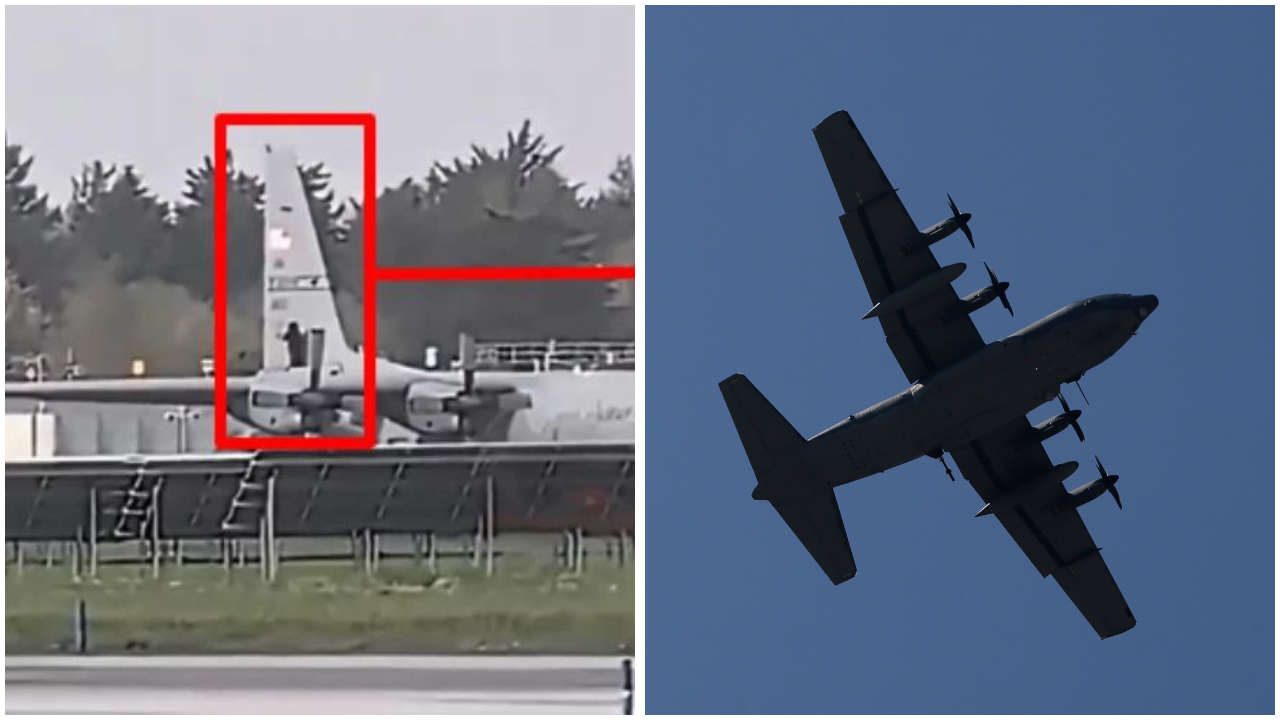
Everyone is laughing at the absurdity of a guy walking onto a secure military installation with a hardware-store hatchet and a jug of corrosive chemicals to trash a $60 million aircraft. The mainstream coverage reads like a late-night monologue punchline. A lone saboteur. Primitive tools. Billion-dollar hardware reduced to scrap metal.
The lazy consensus is that this was a freak physical security lapse—a rogue anomaly where one gate guard fell asleep at the switch. Discover more on a similar issue: this related article.
That narrative is dead wrong. It is a convenient fairy tale told by defense contractors and Pentagon bureaucrats to distract you from a massive, systemic rot in how we build, store, and defend high-value assets.
If a $60 million flying supercomputer can be totaled by twenty dollars' worth of steel and bleach, the vulnerability isn't the perimeter fence. The vulnerability is the engineering philosophy that treats billion-dollar fleets like fragile museum pieces. Further journalism by The Guardian highlights similar perspectives on this issue.
The Myth of the "Impenetrable" Perimeter
Defense journalism loves a simple villain. When an incident like this hits the wire—whether it’s an insider threat at a domestic airfield, an activist breaching a depot, or an opportunistic saboteur slipping past a checkpoint—reporters immediately zoom in on the breach itself. They ask how the perpetrator got past the wire. They demand to know why the cameras didn't catch him.
They are asking the wrong question entirely.
In physical security and military logistics, any perimeter can be penetrated given enough time, insider access, or sheer unpredictability. Relying on a chain-link fence and a sleepy sentry to protect an unhardened $60 million asset is like keeping your life savings in a glass piggy bank on your front porch and blaming the neighborhood kids when someone throws a rock.
I have spent over a decade consulting on critical infrastructure and defense supply chain resilience. I’ve watched organizations blow hundreds of millions of dollars on biometric turnstiles, AI-driven perimeter radar, and triple-layered fencing, only to leave their core assets completely exposed once you step five feet past the door. We call this the "crunchy shell, soft center" fallacy.
When a military aircraft—whether a rotary-wing transport, a tactical fighter, or an intelligence-gathering platform—sits on a tarmac without localized hardening, compartmentalized access, or basic chemical resistance, it is an invitation to disaster. You don't need a hypersonic missile to ground an air wing. You just need a crowbar and five minutes of unsupervised time.
Why $60 Million Aircraft Are Terrifyingly Fragile
To understand why an axe and household chemicals can cause eight figures of damage, you have to understand what modern military aviation actually is.
We no longer build flying tanks. We build flying server racks wrapped in exotic, razor-thin composite skins.
- Composite Delamination: Modern airframes rely heavily on carbon-fiber-reinforced polymers and radar-absorbent materials (RAM). These materials are miraculous for weight-to-strength ratios and stealth profiles. They are also notoriously sensitive to blunt-force impact. A single strike from a fire axe doesn't just leave a dent you can hammer out like an aluminum fuselage from the 1970s. It causes internal delamination—microscopic fractures spreading through the structural matrix that render the entire airframe unsafe to fly. Replacing a single composite bulkhead or wing spar can cost more than the rest of the plane.
- Chemical Vulnerability: Aviation-grade alloys and stealth coatings are engineered to withstand extreme aerodynamic friction and thermal stress, not concentrated industrial acids or commercial caustics. Pouring an aggressive oxidizer or alkaline stripper over open avionics bays, hydraulic lines, or sensor apertures initiates immediate, irreversible corrosion. Even if the chemicals don't melt through the metal on contact, microscopic residue trapped in wiring harnesses creates a permanent safety hazard. No flight surgeon or maintenance chief will ever sign off on clearing that aircraft for combat again.
- Single-Point Avionics Failure: Modern aircraft centralize their nervous systems. Smash one mission-computer rack or sever a primary fiber-optic trunk line, and you haven't just broken a part; you’ve bricked the entire system. Because these components are custom-built in low-rate production runs, replacement lead times stretch into years.
When the media reports "$60 million in damage," they aren't talking about $60 million worth of smashed aluminum. They are talking about a total write-off triggered by localized structural and chemical contamination that makes repair economically and safely impossible.
Dismantling the "People Also Ask" Fallacies
Whenever a story like this trends, the public rushes to search engines with the exact same predictable questions. Almost every single one of them is built on a flawed premise.
"How did someone get onto a secure military base with an axe?"
They walked on, drove on, or already worked there. The public imagines military bases as subterranean bunkers guarded by laser grids. In reality, a major air installation is a small city. Thousands of civilian contractors, delivery drivers, maintenance personnel, and service members flow through the gates every single day. Tools like axes, hammers, and industrial solvents aren't contraband on an airfield—they are standard equipment in every crash-rescue truck and hangar tool crib on the tarmac. Screening every vehicle for a hatchet is a logistical impossibility.
"Why wasn't the aircraft locked up?"
Because tactical aircraft don't have ignition keys or deadbolts. Canopies are designed to be opened quickly from the outside by emergency rescue crews in the event of a crash or pilot incapacitation. Avionics panels use quick-release latches so ground crews can turn aircraft around in minutes during high-tempo operations. Speed and accessibility in combat directly conflict with theft and sabotage prevention on the ground.
"Will the military tighten base security after this?"
They will issue a memo, conduct a few extra bag checks at the front gate for two weeks, and change absolutely nothing about the underlying architecture. Security theater is cheap. Re-engineering hangars, redesigning airframe survivability, and fixing systemic personnel vetting costs real money and requires admitting that current procurement strategies are flawed.
The Unspoken Truth About Asymmetric Sabotage
We are obsessed with high-tech threats. Pentagon budgets pour billions into counter-drone directed-energy weapons, cyber defense grids, and satellite interceptors. Meanwhile, we have completely forgotten the oldest, cheapest, and most devastating form of warfare: low-tech asymmetric sabotage.
Imagine a scenario where a peer adversary doesn't bother trying to shoot down a fleet of advanced aircraft over contested airspace. Why risk a $200 million fighter jet or a $2 million surface-to-air missile when you can pay ten disgruntled insiders or recruited operatives $5,000 each to walk onto domestic airfields with hardware-store tools?
This isn't a hypothetical fantasy. History is littered with examples of high-tech militaries being crippled by primitive sabotage. During World War II, the British Special Operations Executive (SOE) famously published field manuals detailing how a single agent with sand, sugar, or a heavy wrench could disable heavy machinery, locomotives, and aircraft far behind enemy lines. In 2012, an 82-year-old nun and two pacifist activists cut through chain-link fences at the Y-12 National Security Complex in Tennessee—the nation's primary repository for enriched uranium—and spray-painted slogans on the building before anyone stopped them.
The threat has never been sophisticated. Our defenses are just calibrated for the wrong war.
Military planners suffer from what defense theorist Edward Luttwak called "technological utopianism"—the belief that superior engineering automatically translates to superior security. They assume that because an aircraft has an advanced radar suite and encrypted datalinks, it is inherently formidable.
On the ground, with its engines cold and its canopies unlatched, a $60 million aircraft is entirely defenseless. It is a sitting duck made of brittle carbon fiber and sensitive electronics.
The Contractor Incentive Trap
Why don't defense primes build tougher, more repairable aircraft? Follow the money.
Under current defense acquisition models, major contractors make massive margins not just on the initial sale of the airframe, but on sustainment, spare parts, and depot-level maintenance. If an aircraft is engineered with modular, easily swappable panels and ruggedized internal bulkheads that a mechanic can fix in an afternoon with standard tools, the contractor loses recurring revenue.
When a complex composite fuselage gets cracked by a blunt instrument, the military has no choice but to ship the wreckage back to the manufacturer—or write off the entire hull and buy a brand-new unit from the next production block.
Fragility is profitable. Repairability is a threat to the business model.
The Department of Defense has tried to push back with initiatives like Modular Open Systems Approaches (MOSA), championed by acquisition reformers and groups like the Defense Innovation Unit (DIU). The goal is to force contractors to standardize interfaces and make components interchangeable. Yet progress remains glacial because prime contractors fiercely guard their proprietary architectures. Until the Pentagon penalizes manufacturers for building hyper-fragile platforms that require total replacement after minor localized damage, this cycle will continue.
How to Actually Secure High-Value Assets (Without Security Theater)
If we want to stop losing eight-figure assets to ten-dollar tools, we have to abandon the obsession with perimeter fences and completely rethink asset protection from the inside out.
1. Kill the Open-Tarmac Default
Leaving $60 million aircraft parked in neat, exposed rows on open flight lines is a relic of peacetime complacency. Every high-value airframe needs physical compartmentalization. Hardened aircraft shelters (HAS) aren't just for surviving artillery barrages in forward combat zones; they are basic access-control mechanisms. Even lightweight, locked clamshell hangars with localized motion sensors create a critical delay barrier that forces an intruder to make noise and spend time before touching the skin of the plane.
2. Mandate "Sabotage-Resilient" Engineering
Procurement contracts must include strict survivability metrics against non-ballistic, low-tech tampering.
- Sacrificial Outer Skins: Critical composite structures should feature replaceable, impact-absorbing outer fairings that take the brunt of blunt-force strikes without transferring energy into the primary load-bearing frame.
- Sealed Avionics Bays: Internal wiring harnesses and mission computers need positive-pressure sealing and chemical-resistant coatings. A splash of commercial acid on the exterior shouldn't be able to wick into the central nervous system of the aircraft.
- Physical Lockouts for Ground Mode: While emergency rescue hatches must remain accessible, non-essential maintenance panels and avionics bays need electronic or mechanical lockouts when the aircraft is powered down on a domestic base.
3. Shift From Perimeter Defense to Point-of-Asset Telemetry
Stop spending millions on perimeter cameras that generate thousands of false alarms every time a coyote walks past the fence. Put the sensors on the asset itself. Modern industrial IoT accelerometers, acoustic glass-break/impact detectors, and chemical-vapor sniffers cost pennies compared to the aircraft they protect. If someone strikes a wing with a metal object or pops an access hatch after hours, the aircraft itself should immediately trigger a localized strobe, an ear-splitting acoustic deterrent, and a direct alert to the nearest quick-reaction force—bypassing central dispatch entirely.
4. Fix the Insider Threat Pipeline
Most catastrophic sabotage doesn't come from ninja-like infiltrators scaling fences in the dark. It comes from people who already have badges, or people who exploited routine complacency at the gate. Background checks are point-in-time snapshots; they tell you who someone was five years ago, not whether they are currently experiencing a severe mental health crisis, drowning in gambling debt, or becoming radicalized online. Continuous evaluation programs and genuine on-base mental health intervention do more to protect flight lines than another battalion of armed guards.
The Trade-Offs Nobody Wants to Admit
Applying this contrarian approach isn't free, and it comes with brutal operational friction.
Putting every aircraft inside a locked, alarmed shelter slows down sortie generation. When a squadron needs to launch twelve jets in ten minutes, unlocking hangars, disabling point-of-asset alarms, and removing physical lockouts adds precious seconds that combat commanders hate.
Similarly, adding impact-resistant fairings and chemical-resistant shielding adds weight. In aviation, weight is the ultimate enemy. Every pound of protective armor you add to the airframe steals fuel capacity, reduces range, or limits payload.
That is the real debate military leaders should be having. Not "How did this guy sneak an axe past the gate?" but "Are we willing to sacrifice two percent of an aircraft's aerodynamic performance and five minutes of launch readiness to ensure it can't be destroyed by a hardware-store vandal?"
Right now, the establishment's answer is no. They prefer maximum performance on paper and zero resilience on the ground.
So keep laughing at the guy with the axe and the jug of chemicals. Call him crazy. Blame the gate guards. Demand another perimeter security review. Just don't act surprised when the next $60 million aircraft gets totaled by a guy with a hammer and a can of spray foam.