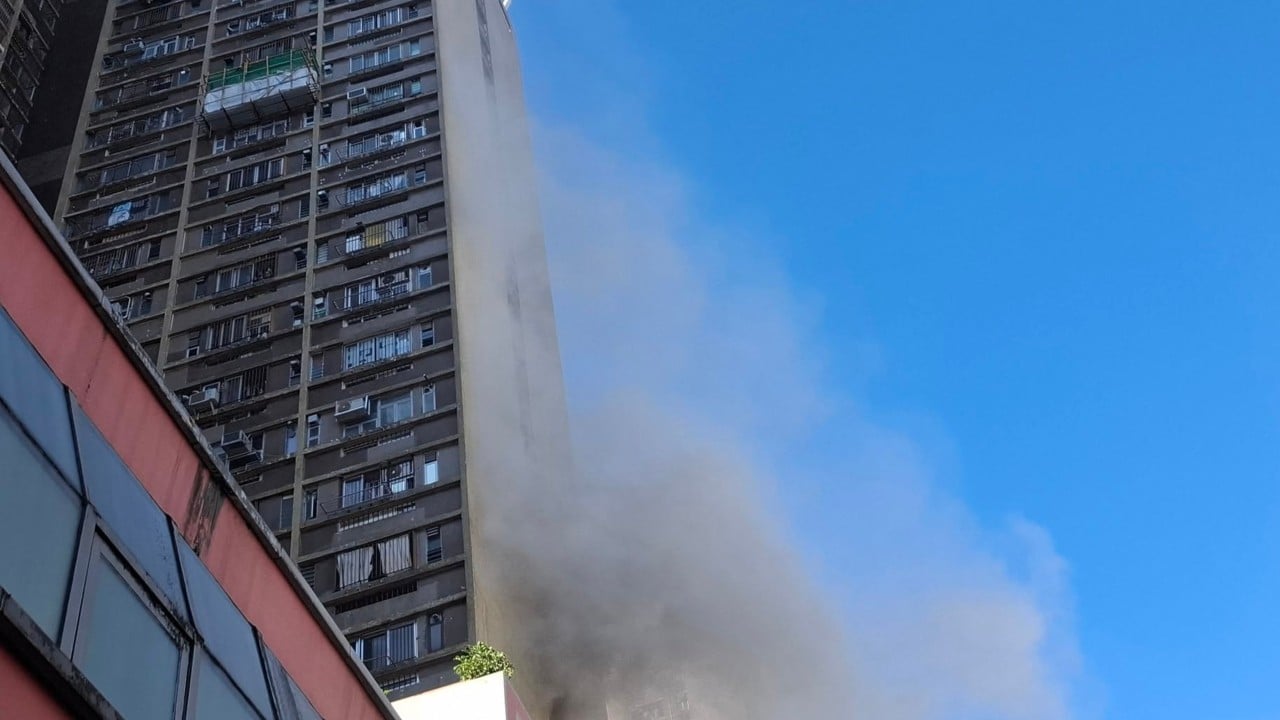
Every time an elderly resident dies in a cramped Hong Kong flat, the local press runs the exact same autopsy before the smoke has even cleared. They zoom in on the newspapers stacked to the ceiling. They photograph the scavenged cardboard. They put the word "cluttered" right in the headline, signaling to every reader that the victim essentially built their own funeral pyre.
It is lazy journalism. Worse, it is a convenient lie that lets housing authorities, building managers, and municipal policymakers wash their hands of systemic lethal negligence.
When fire crews pull a body from a smoke-blackened unit in Wong Tai Sin, the clutter did not light the match. The clutter did not fail to sound an alarm. And the clutter did not trap a mobility-impaired senior behind a single, unventilated exit corridor. Blaming hoarding for a fatal apartment fire is like blaming dry grass for a downed power line. You are staring at the fuel load while completely ignoring the ignition source, the detection vacuum, and the architectural death trap surrounding it.
The Anatomy of the Lazy Consensus
Read any standard dispatch covering a fatal public housing blaze in Kowloon or the New Territories. The narrative arc is rigid. First, the time of the emergency call. Second, the number of residents evacuated. Third, the reveal: firefighters struggled to enter because the flat was packed with miscellaneous items.
The public reads that third sentence and immediately checks out. Empathy curdles into mild judgment. Well, she kept too much junk. What did she expect?
That psychological sleight of hand is the exact reason nothing changes. By framing the tragedy as an eccentric personal failing—a quirky old woman who couldn't throw away plastic bags—the coverage absolves the infrastructure. I have spent years reviewing municipal fire investigation reports and sitting across from forensic engineers who examine post-blaze structural failures. The pattern is identical across dense Asian metropolises. The media fixates on the visible mess inside the doorway because cameras can photograph a pile of boxes. Cameras cannot photograph the absence of a hardwired smoke detector. They cannot photograph an aging electrical circuit slowly baking behind concrete walls for forty years.
Fuel Load Is Not Fire Cause
Let's separate fire dynamics from moral panic. In fire protection engineering, the items inside a room constitute the fuel load—the total amount of combustible material available to burn. Does a high fuel load increase heat release rates and extend firefighting operations? Yes. Nobody disputes basic thermodynamics.
However, a high fuel load has zero bearing on ignition or early survivability.
- Ignition requires heat meeting fuel. In older public housing estates built between the 1960s and 1980s, the primary culprits are degraded wiring, overloaded multi-plug adaptors, unattended incense, or faulty space heaters.
- Survivability depends almost entirely on time-to-detection and egress capability.
Research from the National Fire Protection Association (NFPA) and international fire safety boards consistently shows that modern residential fires reach flashover—the point where every combustible surface in a room ignites simultaneously—in under five minutes. Often in three. In a compact 300-square-foot flat, toxic carbon monoxide and hydrogen cyanide reach incapacitating levels long before flames ever touch a stack of old newspapers in the corner.
Whether a flat holds three chairs or three hundred cardboard boxes, an elderly resident sleeping without a working smoke alarm has the exact same survival window once a mattress or curtain catches fire. Zero.
The Architecture of High-Density Isolation
Wong Tai Sin is one of the most densely populated districts on earth, packed with aging public housing estates where thousands of seniors live alone. Look closely at the physical reality of these units, and the "clutter" narrative falls apart even further.
When you compress a human life into a microscopic floor plan with zero external storage, ordinary living looks like hoarding. A wheelchair, a walker, winter bedding, bulk groceries bought on pension day, and a few decades of personal effects will choke a 250-square-foot studio. Calling that "clutter" is an indictment of square footage, not mental health.
Then look at the building design itself. Legacy housing blocks rely on passive compartmentation—thick concrete walls meant to contain a fire within a single unit so it doesn't engulf the whole floor. That design protects the neighbors. It does nothing for the person locked inside the box.
- No residential sprinklers: Retrofitting wet-pipe sprinkler systems into occupied, aging high-rises is expensive and disruptive, so housing authorities simply don't do it.
- No mandatory interconnected alarms: Until remarkably recent legislative shifts, private and older public flats operated without strict, enforced mandates for standalone smoke detectors in living and sleeping areas. Even where battery-operated alarms exist, expecting an 85-year-old with arthritis to climb a step stool to change a chirping 9-volt battery is absurd.
- Single-point egress: One front door, often secured with a heavy metal security gate locked from the inside with a key. If fire blocks the front corridor, or if smoke disorients the resident before they find their keys, the concrete box becomes a sealed kiln.
When a fatality happens inside this environment, pointing at a stack of magazines is an insult to basic engineering.
Why People Also Ask the Wrong Questions
Whenever these stories trend, search engines light up with predictable queries. Every single one misses the point.
How can we force elderly hoarders to clean out their flats?
You can't, and trying to enforce forced clear-outs actually increases mortality risk. Social workers and geriatric psychologists have documented this for decades. Compulsive hoarding disorder—recognized as a distinct clinical condition in the DSM-5—is deeply tied to trauma, grief, and loss of control. When housing officers or well-meaning relatives barge in and dump a senior's possessions into a skip, the trauma triggers acute distress, severing the resident's trust in social services. Within six months, the items return, except now the resident refuses to open the door to welfare checks, community nurses, or fire safety inspectors. Forced clean-outs drive vulnerable people underground.
Are cluttered apartments a fire hazard to neighbors?
Less than you think, provided building fire doors remain closed. Concrete high-rises in Hong Kong are built like vertical egg cartons. Fire-rated doors and masonry walls are engineered to hold back a fully developed compartment fire for one to two hours. The real danger to neighbors isn't the clutter inside Unit 402; it is propped-open stairwell fire doors, blocked common corridors, and unsealed utility shafts that allow lethal smoke to migrate vertically through the building.
Why didn't the neighbors smell smoke sooner?
Because modern synthetic furnishings—polyurethane foam cushions, polyester bedding, PVC wiring insulation—burn fast and produce dense, acrid black smoke that knocks out a victim inside the room long before enough pressure builds to push smoke under a weather-stripped front door. By the time a neighbor across the hall smells something burning, the window for a rescue inside the origin flat has usually closed.
The Uncomfortable Trade-Offs of Real Prevention
If we stop blaming the clutter, we are forced to pay for solutions that actually save lives. None of them are cheap, and none of them make for tidy press releases.
First, we have to accept harm reduction over decluttering. Fire departments in progressive jurisdictions—including specialized task forces in North America and parts of Europe—have largely abandoned the demand that severe hoarders achieve spotless homes before receiving safety upgrades. Instead, they negotiate narrow, non-negotiable survival zones: a clear 36-inch pathway from the bed to the exit door, a three-foot halo around any heat source or electrical panel, and zero items stacked within two feet of the ceiling where heat banks down. You leave the rest of the room alone so the resident doesn't slam the door in your face.
Second, detection must be passive and externally monitored. A local buzzer inside a flat does nothing for a resident with severe hearing loss or dementia. True protection requires photoelectric smoke and heat sensors linked via low-power wide-area networks (LoRaWAN) or cellular IoT directly to estate management desks and emergency dispatch. When heat spikes in a high-risk senior's flat, the fire brigade rolls automatically—not ten minutes later when a passerby on the street spots flames licking out a window.
Third, we must admit the downside of this approach: it requires aggressive surveillance and serious capital expenditure. Installing networked sensors inside private living spaces raises legitimate privacy concerns. Maintenance teams have to track battery telemetry across tens of thousands of units. Municipal budgets have to absorb millions in hardware and monitoring costs instead of passing the blame onto the dead.
Stop Writing Obituaries Like Property Inspections
The next time a siren echoes through Wong Tai Sin, Kwun Tong, or Sham Shui Po at three in the morning, watch how the story gets told. Watch how quickly the public narrative shifts from a human being who died alone in the dark to an inventory of the rubbish found beside her bed.
A cluttered room does not kill a person. A spark without a circuit breaker, a fire without a sensor, and a society that prefers blaming a victim's housekeeping over fixing its aging housing stock—that is what kills them. Stop auditing the rubble and start demanding wired detection in every single senior's flat before the next match strikes.


