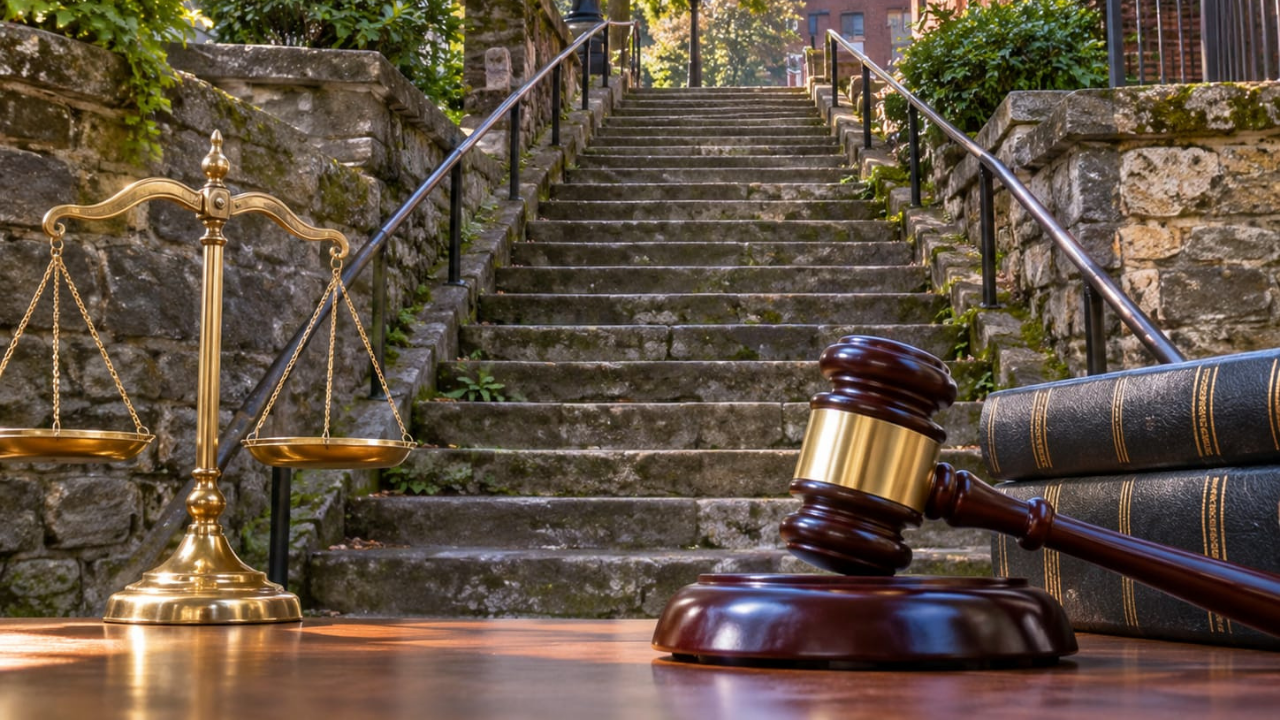
Concrete does not care about municipal budgets.
It cracks in the freeze-thaw cycle of a western Pennsylvania January, heaves upward when tree roots push beneath its poured slab, and crumbles into gray gravel under the weight of ten thousand winter boots. Once the rebar inside begins to rust, the steel expands, popping the concrete from the inside out like a slow-motion explosion. You can see the orange weeping stains bleeding through the gray face of an aging hillside staircase long before a riser actually gives way beneath someone's heel.
Walk up any steep river town in the Allegheny plateau—places carved out of coal seams, steel smoke, and sheer vertical stubbornness—and you will find them. Public steps. Hundreds of them, clinging to shale cliffs like stone ladders, connecting the working-class neighborhoods perched on the ridges to the mills, bus stops, and corner groceries down in the valley flats.
For more than a century, those steps were the literal circulatory system of Pennsylvania's hill towns. Today, many of them are treated like an embarrassing inheritance nobody wants to claim.
That quiet tug-of-war between civic memory and modern austerity recently landed in a Pennsylvania appellate court, producing a ruling that sounds, at first glance, like a dry footnote in municipal property law. A Pennsylvania court upheld a borough's legal duty to maintain a set of public steps after 130 years of continuous public use.
Read that headline again, slowly. One hundred and thirty years.
When those first risers were laid down in the 1890s, Grover Cleveland was in the White House, horses still pulled freight wagons over cobblestones, and the men climbing those stairs carried tin lunch pails toward blast furnaces that lit up the night sky like low-hanging suns. Empires rose and collapsed. Entire industries vanished into rust. Yet across four generations, residents kept climbing those exact steps every single morning.
And then, more than a century later, the local government looked at the crumbling concrete, looked at the repair bill, and argued that the staircase wasn't really its problem anymore.
The court disagreed.
To understand why a municipality would fight in court to disown a flight of stairs, you have to stand at the bottom of one on a Tuesday morning in November when the freezing rain starts coming down sideways.
Consider a hypothetical resident—let's call her Clara, a sixty-four-year-old home health aide who doesn't own a car and catches the 6:15 a.m. bus at the bottom of the hill. Without the hillside steps, walking around the serpentine vehicle roads adds nearly two miles of blind curves with no sidewalks, where delivery trucks hug the yellow line in the dark. With the steps, her walk takes six minutes.
Now, picture the borough manager sitting three blocks away, staring at a spreadsheet that refuses to balance. The tax base shrunk forty years ago when the local plant closed. State liquid-fuels money barely covers filling the potholes on Main Street, let alone bringing a hundred-year-old hillside structure up to modern safety codes. Liability insurance premiums climb every time an adjuster walks past a missing handrail or a spalling tread.
To the spreadsheet, those steps are an unfunded liability. To Clara, they are the only safe passage between her front door and her paycheck.
This is the collision happening quietly across hundreds of older American towns. Infrastructure built during an era of civic confidence and booming industrial tax rolls has reached the end of its physical lifespan right at the moment local governments have the fewest dollars to spare. When a road falls apart, drivers honk, business owners pack council meetings, and asphalt gets poured. When a pedestrian staircase falls apart, the people who rely on it most—the elderly, the car-free, schoolchildren, shift workers—often lack the political megaphone to force a line item into the budget.
So the steps are left to rot. Yellow caution tape gets tied to a rusted pipe railing. The tape shreds in the wind. People duck under it anyway because the alternative is walking along a state highway in the dark. Eventually, someone falls, or a neighbor demands repairs, and the town hall lawyers start digging through nineteenth-century deed books looking for an escape hatch.
Usually, that escape hatch has a specific legal name: abandonment.
Property law has a strange, poetic memory of its own, and it rarely favors institutions that try to walk away from promises made in brick and stone.
If you have ever wondered how a town gets stuck maintaining a structure nobody on the current council voted to build, the answer lies in a legal doctrine that predates modern zoning codes by centuries. In Pennsylvania—as in much of the country—a public right-of-way does not always begin with a ribbon-cutting ceremony or a neatly typed ordinance filed in a courthouse basement. Sometimes, it is born simply because the public walked there, day after day, decade after decade, with the open acceptance of the community.
Think of it like a footpath worn across a meadow. Nobody drew a blueprint for the path. Nobody passed a resolution declaring it a thoroughfare. Yet once ten thousand pairs of shoes have pressed the grass into hard-packed dirt, and the town has cleared brush from its edges or patched its ruts over the decades, the law recognizes a simple truth: the ground belongs to the public's movement.
In legal terms, this is often framed around implied dedication and public acceptance, or long-standing prescriptive use. When a municipality opens, accepts, or maintains a passageway—whether a brick alley, a wooden footbridge, or a steep flight of hillside stairs—it assumes a fiduciary duty of care toward the people who use it.
You cannot quietly stop mowing the grass, let the concrete crumble, and declare forty years later that the staircase was merely an informal shortcut.
I remember the first time I stood at the top of an abandoned municipal stairway in western Pennsylvania, looking down a sixty-foot drop where half the treads had sheared away into the weeds. At the top stood a faded metal sign bolted to a bent post, warning pedestrians to use the stairs at their own risk. Below me, worn smooth into the center of every surviving stone step, was a shallow dish-shaped hollow—two inches deep—carved purely by the friction of leather soles and rubber heels over a hundred years.
You could close your eyes and feel the sheer volume of human life that had passed over that single spot. Kids sprinting down to make the school bell. Mothers hauling canvas bags of groceries up one riser at a time. Men coming home from double shifts with soot in their collars, gripping the iron rail with both hands.
When a borough argues in court that it no longer owes a duty to maintain a staircase used continuously for 130 years, it isn't just making a technical argument about statutory definitions or deed language. It is arguing that time itself erases civic obligation—that if a government neglects a public asset long enough, neglect magically transforms into legal immunity.
The Pennsylvania court looked at that 130-year record and shut the door on that logic.
Why did the ruling hold? Because in the eyes of the law, public infrastructure is not a subscription service a municipality can silently cancel when the maintenance costs become inconvenient.
When the borough challenged its responsibility to keep the steps safe and intact, the core legal questions came down to two straightforward realities: first, whether 130 years of uninterrupted public passage established the stairs as a legitimate public thoroughfare rather than a private or informal path; and second, whether a municipality can shed its maintenance duty without formal, lawful abandonment procedures.
In Pennsylvania, shedding a public right-of-way is intentionally difficult. A town council cannot simply look the other way until the concrete turns to dust and claim the asset vanished on its own. Formal vacation or abandonment requires public notice, official action, and—crucially—the burden of proving that the passageway has genuinely ceased to serve a public necessity.
So long as residents still climb those stairs to reach bus lines, schools, and neighborhood streets, the necessity isn't theoretical. It is happening every morning at dawn.
Here is where the legal principle becomes intuitive if you compare it to something closer to home. Imagine a landlord who rents out a three-story walk-up for fifty years. Over time, the wooden back staircase begins to rot. Instead of replacing the boards, the landlord stops painting them, stops sweeping them, and eventually argues in court that because he hasn't touched the staircase in twenty years, he is no longer responsible when a tenant's foot punches through a plank.
No judge on earth would buy that excuse. Letting something decay is not the same thing as lawfully retiring it.
Yet municipalities try variations of this defense every single year, largely because they are caught in a genuine financial vise. Let's be honest about that part, because pretending small towns are sitting on vaults of unspent cash would be dishonest. Many Pennsylvania boroughs operate on razor-thin margins. Rebuilding a steep, multi-flight concrete hillside staircase with modern foundations, frost walls, drainage channels, and ADA-compliant handrails can easily run into hundreds of thousands of dollars—more than an entire year's street maintenance budget in a town of three thousand people.
I have sat in fluorescent-lit borough council chambers where honest, exhausted part-time council members—people earning fifty dollars a month to take phone calls about barking dogs and backed-up storm drains—stare at an engineering estimate for a hillside stairway and visibly wince. Nobody gets elected to local office dreaming of letting a neighborhood staircase fall apart. They get stuck choosing between fixing the steps on Elm Street, replacing a leaking roof on the volunteer fire hall, or paving the road where the school buses run.
That dilemma is real. It is painful. And it is precisely why the court's decision matters so much.
When courts hold the line on municipal maintenance duties, they force a hard, uncomfortable truth back into the daylight: infrastructure choices are moral choices disguised as engineering problems.
For the past half-century, American local governments have systematically prioritized motorized traffic over human footsteps. Even the smallest borough knows down to the square yard how many miles of paved roadway it owns, because state transportation formulas reward road mileage with annual funding checks. Pedestrian infrastructure—sidewalks, footbridges, hillside steps—rarely generates dedicated state reimbursements. It shows up in the ledger purely as an expense.
As a result, towns quietly created a two-tier citizenship. If you drive a two-ton SUV, the municipality spends millions ensuring smooth asphalt, painted lane markings, plowed snow, and cleared storm drains between your driveway and the grocery store. If you walk, push a stroller, or ride a bus, you are left to navigate broken slabs, missing curb cuts, and staircases held together by rust and prayer.
Consider what happens next when a court refuses to let a borough walk away from a 130-year-old stairway.
First, the invisible becomes visible again. A staircase that was treated as an orphan structure suddenly has a legally recognized owner with an enforceable duty of care. That changes the math inside town hall immediately. Ignoring a known hazard after an appellate court has affirmed your legal responsibility exposes a municipality to far steeper financial risk—via personal injury judgments and invalidated immunity defenses—than budgeting for phased structural repairs.
Second, it opens doors to grant funding that towns often fail to pursue when they pretend an asset isn't theirs. State and federal pedestrian safety grants, community development block grants, and greenway trail funds regularly finance stairway rehabilitations—provided the municipality formally claims the structure, documents its public use, and places it on an official capital improvement plan.
Pittsburgh, just down the river from dozens of these smaller hillside boroughs, learned this lesson the hard way. Home to more than seven hundred sets of public steps—the highest concentration in the United States—Pittsburgh spent decades watching its stone and concrete stairways crumble into weeds before finally conducting a citywide inventory, mapping every flight as official street infrastructure, and treating them as essential transit links rather than nostalgic relics.
Walk back to those 130-year-old steps at dusk, right as the streetlights flicker on with that warm sodium hum and the valley below starts glowing through the bare branches of the oaks.
Someone is always climbing them.
A teenager with headphones slung around his neck, taking the risers two at a time. An older man pausing on the middle landing to catch his breath, resting one hand on the cold iron pipe while looking out over the rooftops where his grandparents used to live. A woman balancing a bag of takeout in one hand and a keyring in the other, stepping carefully over a hairline crack that wasn't there last spring.
They do not know the case citation from the Pennsylvania court. They do not care about the Latin roots of implied dedication or the statutory mechanics of municipal abandonment. They only know that for as long as anyone in their family has been alive, those steps have been there when the hill was too steep to climb any other way.
A town is not defined by the highways that pass around its edges, nor by the spreadsheets filed in its vault. It is defined by whether the people who live inside it can still reach one another on foot—and whether the promises laid down in stone by one generation are kept intact for the next.