Breathe.
Just try to breathe when the white fog rolls off the asphalt near Place de la République, thick and sweet at first like burnt sugar, before it turns into a fist that punches the back of your throat and slams your eyelids shut.
If you have never stood on a Parisian boulevard during a general strike, the headlines make it look simple. You read the sterile wire reports—riot cops fire tear gas and water cannons as they swing batons at protesters after thousands take to streets across France—and your brain files the image away under a familiar, exhausted trope. The French are angry again. Someone raised the retirement age, or cut a pension, or pushed a budget through parliament without a vote, and now the bins are burning and the CRS riot police are marching in lockstep behind black polycarbonate shields.
That summary is tidy. It is also a lie by omission.
When you strip the human pulse out of a street protest and reduce it to a tally of canisters fired and windows smashed, you miss the invisible arithmetic happening in the kitchens of Lyon, the rail yards of Marseille, and the cramped fifth-floor walk-ups of eastern Paris. You miss why a sixty-one-year-old hospital orderly with bad knees is willing to stand in freezing rain facing a water cannon, and why a twenty-four-year-old police officer behind a visor is gripping a composite baton so tightly his knuckles have gone white.
The Anatomy of a Tuesday in Paris
Consider a hypothetical character, though you could find ten thousand versions of her walking down Boulevard Voltaire on any given strike day. Call her Claire. She is fifty-eight, a cafeteria supervisor at a public school outside Nantes, and she has been waking up at four-thirty in the morning since 1989.
Claire does not own a black balaclava. She has never thrown a cobblestone in her life. Before she boarded the pre-dawn bus to join the march in the capital, she packed two apples, a thermos of lukewarm coffee, and a small bottle of physiological saline solution—the kind mothers use to clear a baby’s stuffed nose—because her union steward told her it is the only thing that washes CS gas out of your eyes without making the burn worse.
Why is Claire here?
To an outsider, the French social model looks like a luxury cruise liner stubbornly refusing to acknowledge an iceberg. Critics point to demographic math, aging populations, and sovereign debt, arguing that working two years longer or accepting leaner public services is simply the price of living in the twenty-first century. On a spreadsheet in Brussels or a trading desk in London, those arguments are clean, rational, and bloodless.
On the street, however, those numbers have a smell. They smell like bleach on a hospital ward at three in the morning. They feel like the dull, permanent ache in Claire’s lower back after thirty-seven years of lifting thirty-kilogram trays of potatoes. When a government forces a reform through using Article 49.3—the constitutional mechanism that bypasses a parliamentary vote—Claire does not hear a fiscal adjustment. She hears a door slamming in her face. She hears a quiet, unmistakable message: Your body belongs to the balance sheet now, and you do not even get to speak.
The Choreography of Collision
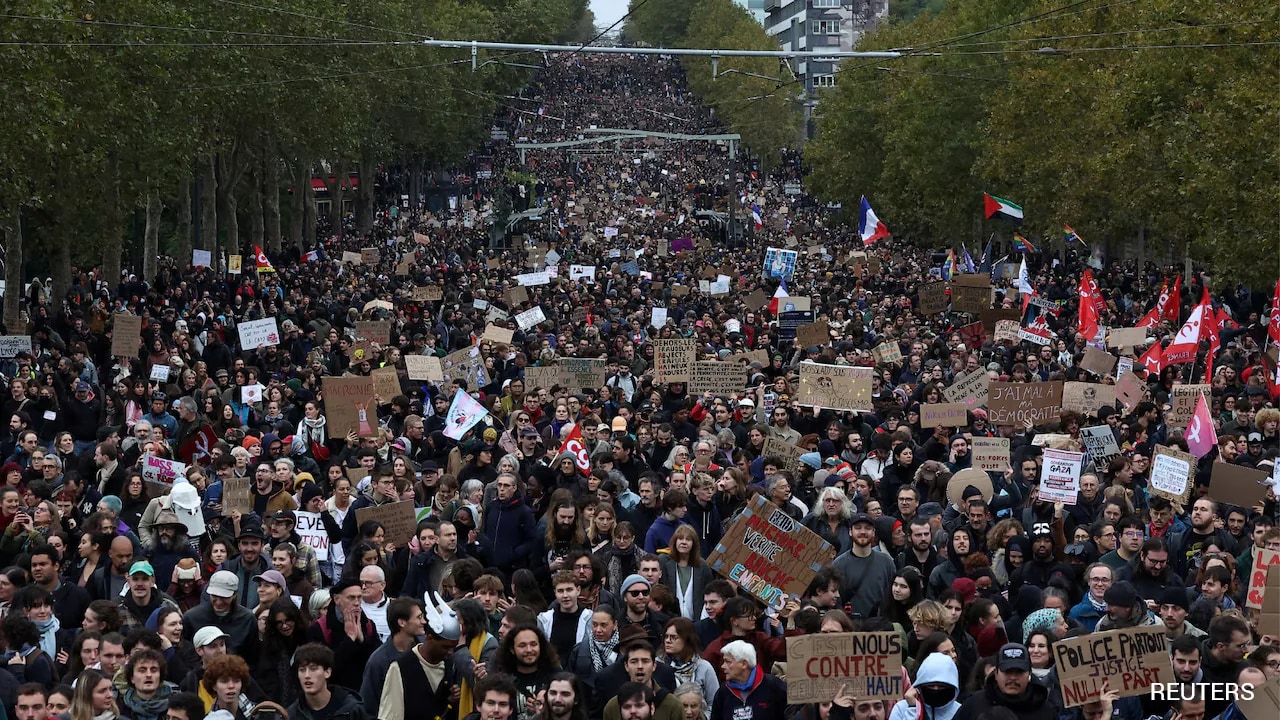
By two in the afternoon, the march stretches for kilometers. At the front, behind the inflated union balloons and the sound trucks blasting brass bands and French punk, the mood feels almost like a village festival. Families push strollers. Retired teachers hand out flyers. The air smells of merguez sausages grilling on makeshift shopping-cart barbecues, mingling with cheap rolling tobacco.
Then the rhythm changes.
You feel it in your chest before you see it. A low, rhythmic thudding echoes off the Haussmann limestone facades—the sound of hundreds of heavy boots hitting the pavement in unison, accompanied by the metallic rattle of shields. The Compagnies Républicaines de Sécurité, France’s specialized riot police, have sealed off the side streets.
To understand why French protests escalate so violently compared to demonstrations in Berlin or London, you have to understand the unique, almost ritualized collision between two deeply entrenched French traditions. Think of it like a fault line where two tectonic plates have been grinding against each other since 1789. On one side sits the constitutional right to manifester—a street culture where disruption is not a side effect of protest, but its entire point. If a strike does not block a roundabout, halt a train, or rattle the windows of a ministry, the French consider it a polite request, and polite requests are ignored.
On the other side sits the doctrine of maintien de l’ordre—the preservation of public order—which treats the defense of state authority as absolute. Over the past decade, that doctrine has hardened. Where police once held static lines at a respectful distance, modern French policing relies heavily on mobile, aggressive intervention units—the BRAV-M squads on motorbikes, the sudden baton charges designed to fracture a crowd before it can coalesce.
And caught in the narrow canyon between the union banners and the police visors is the cortège de tête—the radical vanguard, dressed in black, armed with hammers, fireworks, and a visceral hatred of the state.
Five Seconds Before the Canister Lands
Watch what happens when the front line fractures.
A bank window shatters under the blow of a crowbar. A flare arcs across the gray sky, trailing red smoke. Instantly, the order comes over the police radio. There is no gradual escalation, no gentle nudging back of the line. A launcher—the Cougar or the LBD, weapons that have drawn repeated criticism from European human rights observers—thuds.
A silver cylinder tumbles end over end through the air, hissing like an angry snake, and bounces off the cobblestones ten feet from where Claire is standing with her union banner.
Panic is not loud at first. Panic is a sudden, collective intake of breath.
Within three seconds, the cloud expands. Tear gas is a misnomer; it is not a gas at all, but an aerosolized solid—chlorobenzylidenemalononitrile—that clings to sweat, mucus, and wool coats. Your eyes clamp shut involuntarily, tricking your brain into thinking you have gone blind. Snot pours from your nose. Your lungs spasm, coughing violently to expel an invisible invader, which only pulls the chemical deeper into your bronchial tubes.
Now, picture the chaos when five thousand people try to run backward at the exact same moment while the avenue behind them is still packed with marchers who have no idea why the front is collapsing.
This is the moment the water cannons roll forward. High-pressure jets—capable of knocking a grown man off his feet and stripping the skin off an unprotected face—sweep across the asphalt in wide, freezing arcs. Behind the wall of water come the squads at a dead sprint, batons raised, swinging not with surgical precision, but with the frantic, adrenaline-soaked exhaustion of men who have been standing in thirty kilograms of body armor since dawn, dodging paving stones and mortar fireworks.
Someone trips over a felled metal barrier. A young student with a press armband taped to his helmet gets caught in the flank, taking two heavy strikes across the shoulders before scrambling behind a concrete planter. Claire is pressed against a shuttered pharmacy grille, her eyes streaming, furiously squirting saline solution into her face while a stranger holds her arm so she doesn’t get trampled in the surge.
The Invisible Ledger of Bruises
I have watched these confrontations unfold from the edge of the curb, tasting the metallic tang of smoke in my mouth hours after the streets were washed clean, and the thing that stays with you is never the fire. Fire looks dramatic on the evening news. It gives television anchors something bright to talk over while explaining GDP projections.
What stays with you is the quiet afterward.
Walk three blocks away from the tear gas at six in the evening, and Paris is having an aperitif. People are clinking glasses of white wine under heat lamps on café terraces while, four hundred meters away, municipal crews in neon vests are already hosing broken glass into the gutters and towing away burned-out scooters. The contrast is jarring, almost surreal, yet it reveals the deepest truth about modern France.
The street is not a breakdown of French democracy. It is its pressure valve.
In countries where parliamentary coalitions compromise quietly behind closed doors, anger dissipates slowly. In France, where power is heavily centralized in the presidency and the executive branch wields tools to bypass opposition, the pavement becomes the only chamber where ordinary citizens feel they hold a veto. Every swing of a baton, every volley of tear gas, every shattered bus shelter is part of a fierce, ongoing negotiation over what a human life is worth once it is no longer economically productive.
You do not have to romanticize the violence to recognize the desperation feeding it. Breaking a shop window does not pay a single pension, and swinging a baton at a fleeing protester does not restore faith in the Republic. Both sides leave the boulevard diminished—one nursing fractured ribs and a bitter certainty that the state views its own citizens as enemies, the other nursing concussions, burnout, and the quiet dread of doing it all again next Thursday.
What the Water Cannons Cannot Wash Away
Look closer at the photographs from those clashes. Look past the dramatic spray of the water cannon catching the streetlights, past the theatrical arcs of fireworks and the ranks of black helmets.
Look at the hands.
On one side, hands gripping wooden broomsticks taped to cardboard signs written in felt-tip marker, asking simply to grow old before their bodies break down. On the other side, hands gripping batons and launchers, belonging to young men and women recruited largely from the same working-class provinces as the people they are ordered to disperse.
That is the tragedy the wire stories never capture. When the smoke settles over the Place de la Bastille or the streets of Bordeaux, the fundamental math has not changed by a single decimal point. The bills are still due. The backs still ache. The anger has merely been pushed underground, pooling beneath the cobblestones like groundwater waiting for the next hard frost.
Claire took the night bus back to Nantes, her coat smelling so strongly of tear gas that she had to leave it on the balcony until morning. Her eyes were red-rimmed for two days. Her knees swelled from running on wet stone. When her daughter called that evening to ask if she was alright, if it had been worth going at all when the law was going to pass anyway, Claire sat at her kitchen table, rubbing the bridge of her nose, and answered without hesitation.
"If you don't go," she said, "they think you agreed."
Somewhere in a Paris precinct that same night, a twenty-four-year-old officer unbuckled his shin guards, stared at the dark purple bruise blooming across his forearm where a thrown bottle had caught him above the shield, and wondered what street he would be ordered to clear next week.
The water trucks rolled out before sunrise, scrubbing the soot from the limestone until the boulevards gleamed again for the morning commuters. By eight o'clock, there was barely a trace that anyone had been there at all—except for the faint, lingering sting in the air when the wind blew down the avenue, sharp enough to make your eyes water before you even knew why.