Paper.
That is all a passport really is when you strip away the gold-leaf crest, the ultraviolet watermarks, and the stiff, linen-textured cover. Just stitched pulp and ink. Yet, anyone who has ever stood in the fluorescent glare of a Dhaka passport office—sweat pooling at the small of their back while a ceiling fan clicks rhythmically overhead—knows that this small green booklet is the difference between a locked door and an open sky.
In the summer of 2024, that difference became the sharpest edge in South Asian politics.
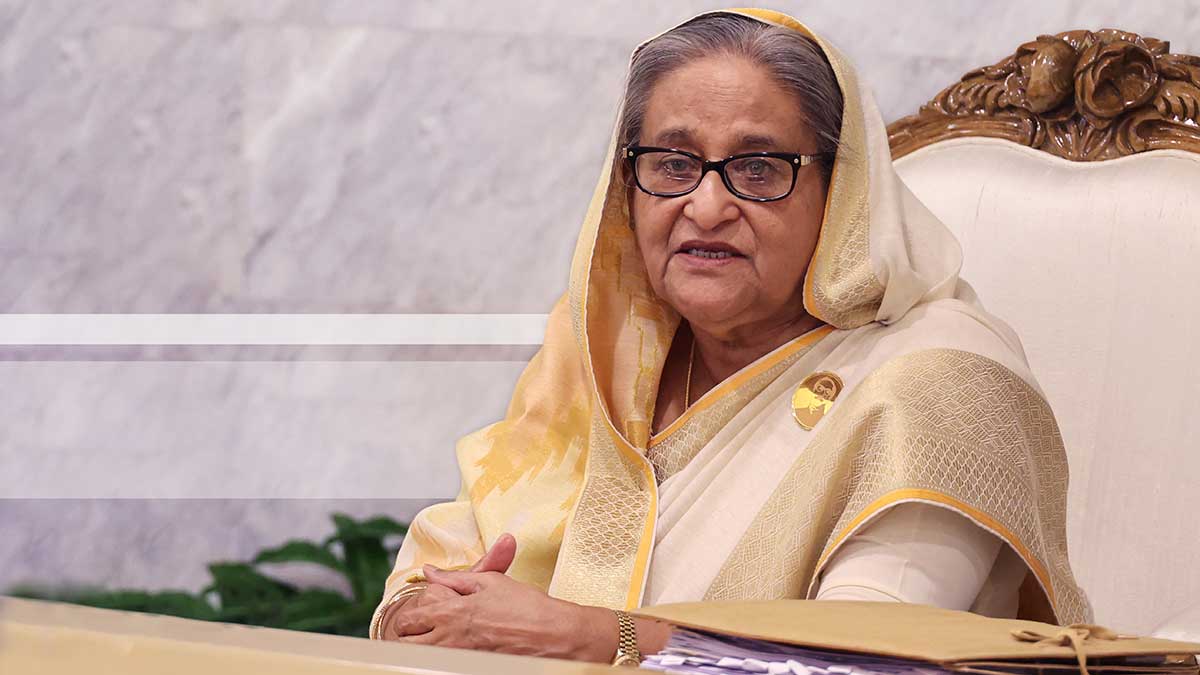
When Sheikh Hasina boarded a military helicopter on August 5, fleeing the student-led uprising that shattered her fifteen-year grip on Bangladesh, she carried the weight of a fallen dynasty. She landed at Hindon Air Base near New Delhi with little more than the clothes she wore and a diplomatic passport that had, hours earlier, become a relic of a vanished regime. Within weeks, the interim government in Dhaka, led by Nobel laureate Muhammad Yunus, revoked that red diplomatic document.
Then came the rumor, followed by the biting sarcasm of an exhausted public. Word rippled through the diplomatic corridors of Dhaka and New Delhi that the former prime minister wanted a standard passport. An ordinary green one.
The reaction from the Foreign Affairs Adviser in Dhaka, Touhid Hossain, was not wrapped in the usual silk of diplomatic ambiguity. It was laced with the dry, sharp-edged wit that only decades of South Asian political bloodsport can produce. Paraphrasing the mood in the capital, officials essentially asked a question that echoed across tea stalls from Uttara to Chittagong: Is Sheikh Hasina coming here to visit her in-laws?
To an outsider, the remark sounds flippant. Petty, even. Why would a state mock a seventy-seven-year-old woman’s request for basic travel documentation?
Because in Bangladesh, a passport is never just a travel document. It is a ledger of accountability.
The Clerk Behind the Glass
To understand why Dhaka’s hesitation is a masterclass in political survival rather than bureaucratic spite, consider a hypothetical character. Let us call him Rafiq.
Rafiq is twenty-four, a third-year engineering student at Dhaka University. During the monsoon rains of July 2024, he stood on the asphalt near Shahbagh, holding a cardboard sign while tear gas burned his throat and rubber bullets ricocheted off the concrete behind him. Over 1,400 people did not walk away from those streets, according to United Nations human rights estimates. Thousands more carry shrapnel in their legs or blindness in one eye.
Now, picture Rafiq walking past the Department of Immigration and Passports in Agargaon. Inside, citizens wait months for police verification—a notoriously slow, often corrupt ritual where an officer visits your neighborhood to confirm you are who you say you are, and that you have no pending criminal charges. If a twenty-two-year-old student has a single political arrest warrant from three years ago gathering dust in a local precinct, his application freezes. He cannot go to Toronto to study. He cannot go to Dubai to send remittances home to his mother.
Now imagine Rafiq reading in the morning paper that the woman facing dozens of arrest warrants from the International Crimes Tribunal—charges ranging from crimes against humanity to enforced disappearances—is asking the very state she fled to issue her a shiny new passport.
The administrative machinery would choke on the contradiction.
Under the Bangladesh Passport Order of 1973—a law ironically enacted during the administration of Sheikh Hasina’s own father, Sheikh Mujibur Rahman—the government holds sweeping authority to refuse, impound, or revoke a passport. The grounds are explicit. If a citizen is reasonably believed to be engaging in activities prejudicial to the sovereignty, integrity, or security of Bangladesh, or if they are facing criminal proceedings and a court has prohibited their departure, the state says no.
More practically, how do you issue an e-passport to someone who refuses to step foot inside the jurisdiction where her biometric data must be captured, and where a warrant awaits her the moment her boots touch the tarmac at Hazrat Shahjalal International Airport?
You don't.
A Matter of Biometrics and Exile
The logistics alone tell a story that political pundits often miss.
Bangladesh transitioned to biometric e-passports years ago. To get one, an applicant cannot simply mail a form from a safe house in Ghaziabad. Even at a diplomatic mission abroad—say, the Bangladesh High Commission in New Delhi—an applicant must appear in person. They must place their fingers on the glass scanner. They must look into the lens for an iris capture. They must present a valid National Identity Card and clear a digital background check routed directly through the Special Branch of the Bangladesh Police in Dhaka.
Let us trace what happens the second Sheikh Hasina’s National Identity number is typed into that terminal.
Red flags do not merely pop up; they cascade. The International Crimes Tribunal in Dhaka has already issued multiple arrest warrants for her, alongside dozens of her former cabinet ministers and police chiefs. The interim government has formally requested her extradition from India under the bilateral treaty signed between the two neighbors in 2013—a treaty, in a twist of historical irony, that Hasina’s own government championed to bring back insurgents hiding across the border.
If the Ministry of Foreign Affairs in Dhaka were to approve a passport application for her, it would be handing a legal lifeline to a fugitive from its own courts. It would allow her to board a commercial flight out of Indira Gandhi International Airport—perhaps to London, where her sister Sheikh Rehana holds British citizenship, or to the United Arab Emirates, where Gulf hospitality often softens the edges of exile.
Once she leaves India, Dhaka’s leverage evaporates.
Right now, New Delhi is caught in a delicate diplomatic bind. India backed Hasina unconditionally for fifteen years, viewing her as a bulwark against regional instability and a reliable partner on security. Hosting her now is an obligation born of old loyalties, yet it poisons India’s relationship with the new administration in Dhaka and the millions of young Bangladeshis who view New Delhi as an enabler of autocracy.
If Hasina remains in India without a valid passport, she is effectively tethered. She exists in a gray zone—a guest on an extended, quietly renewed Indian visa or travel permit, unable to hop across continents to rally international sympathy or reorganize her fractured Awami League from Western capitals.
Dhaka knows this. New Delhi knows this. And Hasina, a woman who spent four decades surviving assassinations, prison cells, and coups, knows it best of all.
The Architecture of a Sarcastic Question
Return for a moment to that biting rhetorical question circulating in Dhaka: Is she coming back to visit her in-laws?
In Bengali culture, going to one’s shoshurbari—the in-laws' house—is both a literal family obligation and a well-worn euphemism for going to prison. When a local thug or a corrupt official is arrested, neighbors wryly remark that he has gone to stay at his in-laws’ place, where the food is free and the doors lock from the outside.
By invoking the phrase, Bangladeshi officials were doing two things at once.
First, they were speaking directly to the domestic gallery. In a country where inflation has squeezed household budgets and political uncertainty hangs heavy in the humid air, the interim government needs to project resolve. They cannot afford to look timid when dealing with the old regime. Humor—sharp, vernacular, unmistakably local—bridges the gap between technocrats in suits and rickshaw pullers listening to the radio. It signals that the mighty have fallen so far they are now subject to the same punchlines as any common suspect.
Second, it was a subtle reminder of the only legal pathway open to her.
Countries routinely deny ordinary passports to citizens facing severe criminal indictments abroad. When they do, there is only one piece of paper they will willingly print: an Emergency Travel Document, often called a one-way outpass. It is a single sheet, valid for a brief window, good for exactly one flight—home.
If Sheikh Hasina wants a document from Dhaka, Dhaka is entirely prepared to give her one. It will take her straight from New Delhi to Dhaka, where an armored van will be waiting on the runway to escort her to her metaphorical in-laws.
The Ghost of 1975 and the Cycle of Exile
I remember the quiet terror that used to settle over dinner tables in Dhaka whenever politics came up over the past decade. You lowered your voice. You glanced at your phone, wondering who was listening, knowing that a single Facebook post criticizing the Prime Minister could land you in a blindfolded interrogation room under the Digital Security Act. People disappeared into unmarked microbuses—the infamous Aynaghar, or House of Mirrors—and vanished for years without a charge sheet or a phone call.
When you live inside that kind of silence for fifteen years, the sudden noise of freedom feels disorienting. It is exhilarating, messy, and frightening.
Yet, history in the Bengal delta rarely moves in a straight line. It moves in spirals.
In August 1975, a young Sheikh Hasina was in West Germany with her husband, the nuclear scientist M. A. Wazed Miah, and her younger sister. Back in Dhaka, rogue army officers stormed her family’s residence in Dhanmondi, assassinating her father, her mother, her three brothers, and nearly everyone else in the house. Overnight, the daughter of the nation’s founder became a stateless exile.
India took her in then, too. Indira Gandhi arranged a safe house on Pandara Road in New Delhi. For six years, Hasina lived in the shadows of Indian hospitality, stripped of power, mourning her dead, waiting for the political winds in Dhaka to shift. When she finally returned in 1981, weeping in the pouring rain before a sea of umbrellas, she carried the moral authority of a survivor.
Fifty years later, the geography is identical, yet the moral universe has inverted.
She is back in India. She is once again reliant on New Delhi’s quiet protection. The critical difference—the chasm that separates 1975 from today—is that in 1975, she was the victim of state terror. Today, tens of millions of her own countrymen view her as its architect.
Think of a passport as a contract between a citizen and a state. On the inside cover of every Bangladeshi passport, there is a formal request from the President of the People’s Republic of Bangladesh, asking all whom it may concern to allow the bearer to pass freely without let or hindrance, and to afford them every assistance and protection.
How can a state ask the world to afford "every assistance and protection" to a person it is actively trying to put on trial for ordering police snipers to fire on unarmed teenagers?
To sign that contract would be an act of institutional self-sabotage.
The Invisible Walls of Statelessness
What happens to a former head of state when the paperwork runs out?
Life in exile without a valid passport is a slow narrowing of walls. At first, nothing changes. You are in a secure villa, guarded by elite paramilitary personnel—in Hasina’s case, reportedly under the watchful eye of India’s National Security Guard. Tea arrives on time. Loyalists call via encrypted apps. You issue statements to the press, insisting you never formally resigned, framing the uprising that ousted you as a foreign-backed conspiracy.
Then the months stretch into years.
Without a valid passport, you cannot open a bank account in a new jurisdiction. You cannot quietly relocate to a villa in Dubai or an apartment in Mayfair when your host country’s geopolitical priorities inevitably shift. You become entirely dependent on the diplomatic generosity of a single government. If New Delhi decides tomorrow that repairing ties with Dhaka—and protecting billions of dollars in bilateral trade, transit routes to India’s landlocked Northeast, and water-sharing treaties—matters more than sheltering an aging former ally, your options shrink to zero.
Consider the precedent of other ousted leaders. When Gotabaya Rajapaksa fled Sri Lanka in 2022 aboard a military aircraft, he bounced from the Maldives to Singapore on temporary short-term visit passes, watching his options evaporate until he had little choice but to quietly fly back to Colombo once the immediate fury cooled. When Ashraf Ghani fled Kabul in 2021, he required the swift, wealthy embrace of the United Arab Emirates to avoid becoming a diplomatic hot potato.
Hasina has no billionaire Gulf state eagerly rolling out a red carpet—not without a valid travel document to get her through immigration control.
And what about her inner circle? Dozens of former Awami League ministers, lawmakers, and police officials also slipped across the porous 4,000-kilometer border into West Bengal, Tripura, and Meghalaya in August 2024. Many of them had their diplomatic passports revoked in the same stroke of the pen. Some are hiding in cheap hotels in Kolkata; others are burning through cash in safe houses, terrified that an Indian patrol will pick them up for illegal entry and hand them over to the Border Guard Bangladesh.
For them, the denial of a passport is not an abstract geopolitical chess move. It is a daily, suffocating reality. Every time a siren wails down a street in Kolkata, they wonder if their time has run out.
Where the Ink Meets the Pavement
It is easy, from a distance, to get lost in the legalisms of the 1973 Passport Order, the clauses of the Indo-Bangladesh Extradition Treaty, or the procedural timelines of the International Crimes Tribunal. Diplomats love these abstractions because abstractions do not bleed.
Back in Dhaka, however, the stakes remain stubbornly physical.
Walk down Mirpur Road in the late afternoon. The traffic is still chaotic, the horns still blare with the same impatient rhythm, and the street vendors still fry piaju in bubbling vats of oil. On the concrete pillars of the metro rail, layers of graffiti tell the story of the past two years—stenciled portraits of Abu Sayed, the student in Rangpur who stood with his arms outstretched before a shotgun blast ended his life; bold Bengali calligraphy demanding justice; painted slogans declaring that the blood of the martyrs will not go in vain.
For the mothers who still keep their dead sons’ university ID cards wrapped in clean cotton cloth inside their wardrobes, the question of whether Sheikh Hasina gets a passport is not a diplomatic puzzle.
It is a test of whether the new Bangladesh actually exists, or whether power still protects its own across borders.
If the interim government ever buckled—if it quietly slipped a fresh green booklet across a desk in New Delhi to make a diplomatic headache go away—the outrage on those streets would burn hotter than it did in July. The moral legitimacy of the entire post-Hasina transition rests on a single, fragile promise: that the law finally applies to the people who used to write it.
So when an adviser in Dhaka wryly wonders aloud whether the former prime minister plans to visit her in-laws, he is not merely telling a joke. He is drawing a boundary in ink.
There will be no green passport. There will be no quiet exit to London, no comfortable retirement in the Gulf, no diplomatic sleight of hand to erase the warrants waiting in Dhaka. If she wants a document from the country she ruled for fifteen years, the desk is open, the ink is wet, and the stamp is ready.
It is valid for one flight, one direction, and one destination—straight back to the city she left behind in the clouds.