Cold.
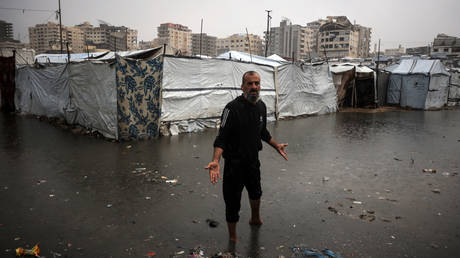
It does not arrive in Gaza with the romantic hush of a European winter, nor the crisp, invigorating snap that sends people reaching for wool coats and warm mugs. It arrives as a slow, graying bruise across the Mediterranean horizon, carrying the smell of wet ash, raw sewage, and salt. And when the rain finally breaks, it does not fall on roofs. It falls on plastic.
Consider a hypothetical family—let us call them the Haddads—huddled inside a makeshift shelter in Al-Mawasi, along the southern coast. They are not real in the journalistic sense of a single interview, yet they represent the exact, verified reality of hundreds of thousands of displaced people living under tarpaulins stitched together from rice sacks, salvaged nylon, and thin municipal sheeting. Around midnight, the wind off the sea picks up speed. First comes the drumming on the plastic overhead, a deafening, rhythmic roar that drowns out conversation. Then comes the sag. Without rigid rafters or pitched tiles to shed the water, rainwater pools in the center of the tarp, growing heavier by the liter until the fabric stretches like an overfilled skin—or tears open entirely.
Below, the sand turns to slurry. Within an hour, brown water creeps under the edges of the shelter, soaking the thin foam mattresses, the single bag of dry lentils, the spare socks wrapped in a grocery bag to keep them dry for morning.
You do not survive a flood like this. You endure it, shivering, standing upright in ankle-deep sludge until dawn because there is nowhere left to lie down.
The Architecture of Vulnerability
To understand why seasonal winter storms in Gaza turn deadly so quickly, you have to strip away everything you normally associate with a city.
Think of a modern urban neighborhood as an invisible umbrella. Beneath the asphalt of any functioning town lies a labyrinth of storm drains, concrete culverts, pumping stations, and sewage mains designed to swallow millions of gallons of rainwater and route it safely out to sea. Above ground, brick walls, sloped roofs, and elevated foundations keep human beings separated from the earth.
In Gaza, that umbrella has been pulverized.
Following prolonged bombardment and ground operations, United Nations satellite assessments have documented that roughly two-thirds of all structures across the Strip—more than 160,000 buildings—have been damaged or destroyed. When concrete apartment blocks collapse, they do not simply vanish. They turn into mountains of crushed masonry that block natural drainage paths, choke municipal storm grates, and redirect runoff straight into low-lying coastal basins where displaced families have pitched their tents.
At the same time, the mechanical heart of Gaza’s sanitation system has largely stopped beating. Stormwater pumps require electricity and diesel fuel; sewage treatment plants require intact pipes and replacement parts. Without them, rainwater does not flow away. It mixes with overflowing cesspits and damaged sewer lines, transforming routine seasonal downpours into toxic, knee-deep lakes.
Water always finds the lowest point. In Gaza, the lowest points are where the displaced were told to go.
When Evacuation Means Moving Into a Floodplain
Look at a topographic map of the Gaza Strip and a cruel geographic irony jumps off the page.
The coastal strip is narrow, bordered by the Mediterranean on the west and flanked by rolling sand dunes and low-lying valleys—known locally as wadis, such as Wadi Gaza—that naturally channel winter runoff from higher ground toward the sea. Historically, urban planners avoided building permanent housing directly inside these drainage basins or on the shifting coastal sands of Al-Mawasi.
Yet over the course of the conflict, evacuation orders pushed roughly 1.9 million people—nearly nine out of ten residents—into shrinking humanitarian zones along the coast and around Deir al-Balah and Khan Younis. Families erected tens of thousands of improvised shelters directly on bare sand, compacted mud, and low-lying agricultural land because there was simply nowhere else to stand.
I have walked through coastal displacement camps after heavy winter rains, and the sensory reality stays in your bones long after your boots dry out. The air tastes metallic and sour. Every step produces a wet, sucking sound as mud pulls at your soles. Children walk barefoot because wet sneakers rub skin raw within hours, and once a pair of shoes is soaked in contaminated floodwater, there is no radiator, no clothes dryer, and no sunlit balcony where it can dry before the next squall hits.
Aid agencies saw this coming months before the clouds gathered. Humanitarian coordinators from the UN Office for the Coordination of Humanitarian Affairs (OCHA) and the Shelter Cluster repeatedly warned that existing tent supplies were degrading under UV radiation and wind, and that fewer than a quarter of the winterization materials required—heavy-duty tarpaulins, timber framing, pallets to lift bedding off the mud, thermal blankets—had made it through border bottlenecks.
A tent is not a house. Under intense sun and salt wind, standard humanitarian tarpaulin has a functional lifespan of three to six months before its fibers weaken and fray. By the time the November and December storms arrive, hundreds of thousands of people are sheltering beneath fabric that is already dying.
The Silent Arithmetic of Hypothermia
When headlines report that floods have swamped tens of thousands in Gaza, the immediate image is dramatic: rushing torrents, collapsed walls, frantic rescues. Those moments happen, and they are terrifying. Concrete walls weakened by nearby explosions have buckled under saturated soil, crushing families asleep beside them. Flash runoff has swept away entire rows of tents in minutes.
But the deadliest arithmetic of a flood in a displacement camp happens quietly, over the seventy-two hours after the rain stops.
Medical workers on the ground describe a predictable, agonizing sequence. First comes hypothermia, particularly among infants, the elderly, and the chronically ill. A newborn baby loses body heat four times faster than an adult. When a mother’s own clothes are drenched and she has no dry blanket to wrap around her infant, core body temperature drops steadily even when the ambient air sits at a seemingly mild ten or twelve degrees Celsius. Without warm shelter or adequate caloric intake—malnutrition strips the body of the fat reserves needed to generate internal heat—cold becomes fatal.
Then comes the waterborne fallout.
Because the floodwaters carry raw sewage from shattered sanitation networks, every puddle becomes a vector for acute watery diarrhea, hepatitis A, and skin infections. In a functioning hospital, dehydration from gastrointestinal illness is easily treated with clean water and oral rehydration salts. In overcrowded field clinics operating with rationed fuel, scarce clean water, and depleted pharmacies, a simple stomach infection in a malnourished toddler can spiral into organ failure.
And finally, there is the respiratory wave. Huddled inside damp, unventilated plastic enclosures, families burn whatever they can find—scraps of wood, cardboard, even plastic waste—just to boil water or take the chill off the air. Smoke hangs thick inside the tents, inflaming lungs already weakened by dust and dampness, triggering outbreaks of bronchitis and pneumonia that sweep through camps like wildfire.
Why Conventional Disaster Relief Breaks Down Here
To grasp why this crisis defies standard emergency response, imagine trying to bail out a sinking boat while someone restricts the size of your bucket and punctures the hull faster than you can patch it.
In a typical natural disaster—an earthquake in Turkey, a flood in Pakistan, a hurricane in the Caribbean—the emergency has an outer boundary. Roads are eventually cleared. Heavy machinery rolls in. Fuel arrives in tankers. Engineering teams dig drainage trenches, lay gravel pads, and erect modular housing units with solid floors and insulated walls.
In Gaza, every single tool of flood mitigation is treated as a contested commodity.
- Gravel and cement needed to elevate tent floors above the waterline are severely restricted under dual-use controls.
- Timber and metal poles required to build frames strong enough to withstand coastal gales face protracted inspection delays at crossings.
- Heavy excavators and vacuum trucks needed to clear clogged storm drains and pump out sewage lagoons have been largely destroyed or lack spare parts and fuel to run.
Even sandbags—the most primitive flood defense known to human civilization—become scarce when burlap sacks and shovels cannot enter in sufficient numbers. Residents are left digging shallow trenches around their tents with broken plastic plates, kitchen pots, and bare hands, building tiny ridges of wet sand that dissolve the moment the next downpour begins.
Humanitarian logistics specialists openly admit the frustration. You can distribute ten thousand blankets on a Tuesday, and if a storm hits on Wednesday night without dry flooring or waterproof roofing, every single one of those blankets becomes a freezing, mud-soaked rag by Thursday morning. Without structural shelter, aid becomes a consumable that vanishes in the rain.
What Survival Actually Looks Like in the Mud
Yet if you spend time watching how families navigate these floods, you witness a relentless, exhausting ingenuity that refuses to surrender to the water.
When the forecast darkens, preparation begins hours before the first drop falls. Mothers roll up every piece of dry clothing and seal them inside salvaged plastic flour bags, tying the necks in tight double knots. Fathers scour the perimeter of the camp for discarded wooden pallets, broken doors, or chunks of flat concrete to create a raised platform—even three inches of elevation can mean the difference between sleeping dry and sleeping in a puddle.
Neighbors lash their tents together with nylon cord so the structures brace one another against forty-knot gusts blowing off the Mediterranean. When a tarp rips in the middle of the night, people hold the torn edges together with their bare hands for hours until the squall passes, taking turns so one person can warm their fingers under their armpits.
And when morning breaks and the clouds part briefly, the entire camp transforms into a vast, silent drying rack. Blankets, coats, mattresses, and children’s shoes are draped over rubble piles, tangled rebar, and taut ropes, racing against the afternoon sky to catch an hour of pale winter sun before the next storm front rolls in from the sea.
It is resilience, yes. But resilience is not a bottomless well. Each storm strips away another layer of physical strength, another few blankets that cannot be salvaged, another fragile margin of health from children who have already endured more than a lifetime of loss.
The Invisible Line Between Weather and Policy
We tend to talk about floods as acts of nature—unpredictable, inevitable, beyond human control. That framing is comforting because it absolves everyone of responsibility. Rain falls; rivers rise; people suffer.
In Gaza, the rain is natural. Everything that makes it lethal is not.
The difference between a manageable winter storm and a humanitarian catastrophe comes down to concrete, canvas, fuel, and access. It comes down to whether industrial-grade tents, mobile water pumps, timber framing, and sanitation equipment are allowed to cross a border a few miles away before the next low-pressure system forms over the eastern Mediterranean.
Until that happens, tens of thousands of people will remain trapped between the sea in front of them and the runoff behind them, listening to the wind pick up at dusk, watching the dark ceiling overhead begin to sag under the weight of the sky, and waiting to see whether their thin sheet of plastic will hold until morning.


