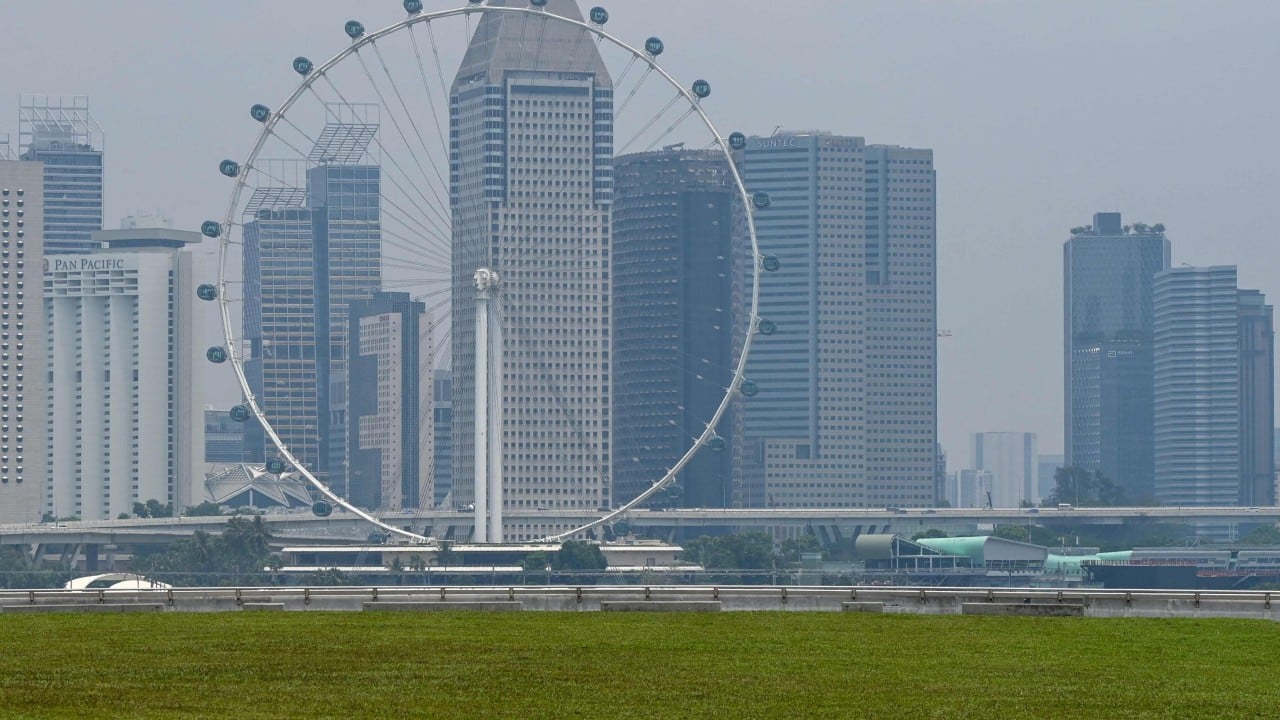
Governments love a predictable crisis. It lets bureaucrats dust off old playbooks, issue stern warnings, and pretend that nature is the only enemy. Every time the El Niño-Southern Oscillation (ENSO) cycle tilts toward a warm phase, the narrative machine shifts into high gear. The public is told to brace for a "severe" haze crisis in August and September. Air purifiers sell out. N95 mask stockpiles are checked.
It is a masterclass in missing the point.
Blaming El Niño for Southeast Asia’s recurring air pollution is like blaming a dry summer for arson. El Niño does not light fires. People light fires. By treating a human-engineered supply chain problem as an unavoidable meteorological event, policymakers and corporate leaders are failing to address the structural economics that make burning land profitable.
The Flawed Premise of Weather Fatalism
The standard reporting on regional haze follows a lazy, repetitive script. The Meteorological Service Singapore warns of dry weather, regional hotspot counts tick upward, and diplomatic fingers immediately point across the Malacca Strait toward Sumatra and Kalimantan.
This creates a comfortable illusion that the region is a victim of a climate roll of the dice. If the Oceanic Niño Index (ONI) crosses the threshold into a strong El Niño, severe haze is treated as an inevitability.
This logic is broken.
The relationship between climate anomalies and particulate matter ($PM_{2.5}$) levels is not a straight line. Look at the historical data. The 2015 El Niño was one of the strongest on record, resulting in a catastrophic haze season that cost Southeast Asia billions. Yet, subsequent years with distinct dry spells saw significantly lower pollution levels despite similar localized weather conditions.
Why? Because fire is an economic tool, not a natural phenomenon.
In industrial agriculture—specifically palm oil and pulpwood production—slashing and burning remains the cheapest method to clear degraded peatland. Peatland is naturally waterlogged. To plant on it, companies dig drainage canals. Once dried, this organic matter becomes a massive tinderbox.
El Niño merely accelerates the drying process of land that has already been systematically drained and prepared for combustion. The weather is a force multiplier, not the root cause.
The Trillion-Dollar Greenwashing Loophole
For over two decades, the response to transboundary haze has leaned heavily on regional treaties, satellite tracking, and corporate "No Deforestation, No Peat, No Exploitation" (NDPE) commitments.
Most of these initiatives are teethless public relations exercises.
I have spent years analyzing regional supply chains and corporate sustainability disclosures. The reality on the ground is messy, opaque, and deliberately complex. Major agribusiness conglomerates rarely set fires on their primary concessions today—the satellite scrutiny from organizations like the World Resources Institute is too intense.
Instead, the burning has been outsourced.
The supply chain relies on a complex web of middle-tier suppliers, smallholders, and speculative land grabbers who operate just outside the corporate spotlight. A major consumer brands company can claim its supply chain is 95% verified sustainable, while buying crude palm oil from mills that mix compliant fruit with fruit grown on illegally burned, illegally cleared land.
If you want to stop the smoke in August, you do not look at weather charts. You look at the financing.
Regional banks continue to extend credit lines to companies with highly questionable supply chain visibility. Until the capital explicitly penalizes lack of traceability down to the specific plot of land—not just the mill level—the incentive to burn remains intact.
Dismantling the PAA Conventional Wisdom
The public discussion around air quality is choked with misconceptions that prevent real action. Let us dismantle the three most common premises.
Can Singapore sue regional polluters under the Transboundary Haze Pollution Act?
In theory, yes. The act allows Singapore to prosecute entities outside its borders that cause unhealthy haze within the country. In practice, it has been an enforcement nightmare.
The legal bar to prove causation is absurdly high. You cannot just show a satellite image of a fire on a company's concession. You must prove that the specific fire caused the specific particulate matter that entered Singapore's airspace, and that the company acted with negligence or intent.
Because land ownership records in rural Indonesia are notoriously fragmented, overlapping, and shrouded in secrecy, identifying the true beneficial owners of a burning plot is nearly impossible. The law exists primarily as a diplomatic statement, not a functional deterrent.
Are smallholder farmers the main culprits of regional haze?
This is a convenient scapegoat used by large corporations and local politicians alike. The narrative says that poor, independent farmers are using traditional slash-and-burn methods because they lack access to mechanical clearing equipment.
While smallholders do use fire, they are rarely the drivers of the massive, prolonged peatland fires that black out regional skies. Those require large-scale drainage networks that only industrial operations have the capital to build. Furthermore, many "smallholders" are actually proxy frontmen for local elites speculating on land values. Blaming subsistence farmers is a deliberate distraction from institutional land mismanagement.
Will switching to sustainable palm oil solve the problem?
Not in its current iteration. Certified sustainable palm oil (CSPO) accounts for a fraction of global consumption. The premium paid for sustainable oil is often too low to offset the compliance costs for mid-sized producers.
More importantly, leaked supply chains mean that non-compliant oil always finds a buyer in less regulated markets. Unless there is a total, global ban on unverified oil—which will not happen due to food security concerns in developing nations—the dual-market system allows bad actors to keep burning with impunity.
The Uncomfortable Trade-offs of True Mitigation
If the current approach is failing, what actually works? The solutions are not pleasant, and they require breaking the polite diplomatic consensus of ASEAN.
True mitigation requires three aggressive shifts:
| Action | Economic Reality | Strategic Risk |
|---|---|---|
| Enforced Financial Blacklisting | Cut off banking access, trade financing, and insurance for any group unable to provide 100% geofenced traceability for its entire supply network. | High. It will cause short-term disruption in the agricultural sector and strain corporate banking revenues. |
| Permanent Peatland Rewetting | Forcefully fill in drainage canals on cleared peatlands to raise the water table, making the ground physically incapable of catching fire. | It renders thousands of hectares of existing plantations useless, destroying billions in asset value. |
| Jurisdictional Liability | Treat transboundary pollution as an economic trade violation, applying targeted tariffs on imports from regions failing to manage fire counts. | It violates the core ASEAN principle of non-interference, risking a diplomatic freeze. |
The downside to this contrarian approach is obvious: it hurts economically. It requires writing off massive agricultural assets and accepting that certain areas of low-lying peat should never have been developed in the first place. But the alternative is continuing to spend billions every few years on air filtration, medical bills, and lost tourism revenue while hoping for rain.
Stop monitoring the wind currents. Stop tracking El Niño as if it is an unpredictable monster coming out of the Pacific. The monster is a broken economic model that treats clean air as a free externality. Until the cost of burning a hectare of land exceeds the profit of the harvest, the skies will keep turning grey every August. Pack away the weather models and follow the money.