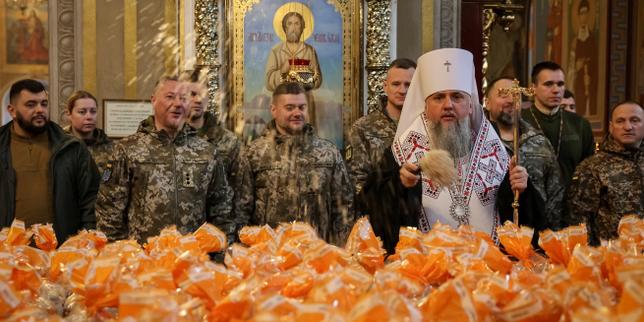
The ringing in the ears usually starts before the shells actually land. It is a biological quirk of the front lines—a phantom hum that vibrates in the jawbone when the heavy artillery begins its arc. But for the first time in months, the soldiers in the mud-slicked trenches of the Donbas are listening for a different kind of sound. They are listening for the absence of metal.
Vladimir Putin has called for a ceasefire.
The occasion is the Orthodox Easter, a time when the incense should be thicker than the smoke of burning diesel and the only red on the ground should be the dye from cracked eggshells. It is a moment of profound spiritual weight in a region where the cross and the rifle are often found in the same cramped bunker. Yet, as the word filters down through encrypted radios and whispered rumors, the reaction isn't a cheer. It is a long, shaky exhale.
Ukraine has signaled its favor. For thirty-six hours, the world is being asked to believe that the guns will go cold.
Consider a man we will call Mykola. He is forty-four, a former high school history teacher who now spends his days staring through a thermal scope at a treeline that used to be a bird sanctuary. For Mykola, "ceasefire" is not a political term. It is the possibility of hearing a bird. It is the chance to take off his boots for three hours without fearing he will have to run through a minefield in his socks.
The weight of this pause is not found in the grand halls of the Kremlin or the fortified offices in Kyiv. It is found in the stillness of the grip. When a soldier stops squeezing a trigger, the silence that follows is heavy. It is a physical pressure.
The Irony of the Altar
There is a deep, jagged irony in using a religious holiday to pause a war between two nations that share the same pews. The Orthodox faith is the skeletal structure of both Russian and Ukrainian identity. To call for peace on the day of the Resurrection is a move steeped in ancient optics. It is a reminder that even in the middle of a mechanized slaughter, the ghosts of the tsars and the saints still hold sway over the public imagination.
But the history of the "holiday truce" is a blood-stained ledger. We like to remember the Christmas Truce of 1914, where German and British soldiers played soccer in the frozen mud of No Man’s Land. We forget that on December 26th, they went back to killing each other with renewed efficiency.
A ceasefire is a tactical lungful of air.
For Russia, the pause offers a chance to rotate exhausted units and fix the logistical chains that have been snapped by Ukrainian drone strikes. For Ukraine, it is a moment to fortify, to breathe, and to mourn. To the civilian huddled in a basement in Kharkiv, the announcement doesn't mean the war is over. It just means the ceiling might stop shaking long enough for them to boil a pot of water.
The Invisible Stakes of a Holy Pause
Logistics are cold. Faith is hot. The intersection of the two is where this story actually lives.
When Putin announces this move, he isn't just speaking to the military command. He is speaking to the "babushkas" in rural Russia who lose sleep over their grandsons. He is framing the conflict as a defense of a shared civilization, even as the missiles he ordered continue to dismantle that very civilization. It is a performance of piety.
On the other side, Kyiv’s acceptance is a calculated risk. To refuse a ceasefire on the holiest day of the year would be a PR disaster in a country where the church remains a pillar of the community. So, they agree. They watch the skies with high-resolution satellites and Western-provided radar, waiting for the first sign of a lie.
The stakes are not just meters of territory. They are the shreds of remaining trust. In a conflict where every treaty has been treated like scrap paper, the Easter ceasefire is a test of whether the word "sacred" still has any currency.
The Ghost of 2022
Think back to the early days, when the maps were covered in red arrows and the world thought the fall of Kyiv was a matter of hours. Since then, the war has ground down into a grueling war of attrition—a slow-motion catastrophe that eats men and machines at a rate the modern world hadn't seen in nearly a century.
The numbers are staggering, but numbers are a way to hide from the truth.
Instead of looking at the thousands, look at the one. Look at the mother in Lviv who is decorating a willow branch, her hands shaking because her son is somewhere near Bakhmut. For her, the news of a ceasefire is a stay of execution. It is thirty-six hours where she doesn't have to jump every time the doorbell rings or the phone vibrates.
That is the human cost of the "dry facts" reported in the headlines. A ceasefire isn't a victory. It’s a delay of grief.
The Sound of the Bells
When the bells finally ring this Sunday, they will compete with the memory of sirens. In some places, the priests will lead processions through streets lined with anti-tank hedgehogs. They will carry candles that flicker in the draft of blown-out windows.
There is a specific smell to an Orthodox Easter service: beeswax, old wood, and incense. In Ukraine this year, that smell is mixed with the metallic tang of cordite and the damp scent of freshly dug earth. The contrast is enough to break a person.
The ceasefire is a fragile thing. It is a glass ornament held in a fist. If a single bored sniper pulls a trigger, or a single mortar crew miscalculates a coordinate, the whole illusion of "holy peace" shatters.
But for now, there is a pause.
The soldiers sit in their trenches. They look at their watches. They wonder if the man five hundred yards away, who speaks a language almost identical to theirs, is also putting down his rifle to eat a piece of bread. They wonder if the God they both pray to is listening to the silence or the sirens.
The sun rises over the scarred fields, illuminating the craters and the blooming wildflowers alike. For one day, or perhaps two, the tally of the dead might stay at zero. In the grand narrative of history, it is a footnote. For the people living it, it is everything.
The smoke clears just enough to see the sky. It is a deep, mocking blue. The bells begin to swing.


