The map of the world is drawn with ink that pretends lines are permanent. They are not. They are wet clay, shaped by violence, weather, and the desperate feet of people running for air.
Consider a strip of water twenty miles wide. The Bab-el-Mandeb. The Gate of Tears. For centuries, dhows have crossed its dark chop, carrying spices, cloth, and quiet hopes between the Arabian Peninsula and the Horn of Africa. Today, that water is something else entirely. It is a filter. On one side lies Yemen, a country where the ground has been chewed away by years of relentless attrition, broken supply chains, and the slow, grinding suffocation of a forgotten war. On the other side lies Djibouti, small, arid, and bracing itself for a wave that is already lifting the horizon.
Statisticians in sterile rooms at the United Nations have a way of flattening human catastrophe into columns of tidy figures. They look at spreadsheets and project that in the coming months, two hundred and thirty thousand human beings will find themselves unmoored, displaced from their homes within Yemen’s borders. They calculate that ten thousand more will pack whatever they can carry in plastic bags, step into overloaded wooden boats, and risk the volatile currents of the Red Sea to seek asylum on Djibouti’s shores.
Ten thousand.
Say it out loud. It sounds manageable in an administrative brief. It sounds like a budget line item or a logistical hurdle for port authorities. But numbers do not bleed. Numbers do not wake up shivering on a basalt beach with salt crusting in their eyelashes, wondering if their children survived the last mortar blast in Taiz.
To understand what those projections actually mean, you have to shrink the scale down to a single kitchen table in a city where the water taps have long since run dry.
Meet Tariq. He is hypothetical only in name; in reality, he is multiplied by tens of thousands across the scorched valleys and fractured coastlines of Yemen. By trade, Tariq was a secondary school teacher who specialized in history. He spent twenty years explaining to teenagers why empires rise and fall, how civil strife invariably hollows out civilizations from the inside out, leaving behind only hollow facades and bitter memories. He never expected to become a primary source for his own lesson plan.
When the front lines crept close enough to rattle the windowpanes with concussive regularity, Tariq did not flee immediately. People rarely do. Inertia is a powerful anchor, forged from familiar walls, neighbors who know your mother’s name, and the stubborn belief that tomorrow might somehow be quieter than today. Pride keeps people in burning houses until the rafters fall.
The breaking point is rarely a grand cinematic explosion. It is cumulative. It is the fifth month without a regular salary. It is watching a younger daughter develop a hacking cough from dust and contaminated water while local clinics lack even basic antibiotics. It is the realization that staying alive has become a full-time occupation that leaves no room for living.
When Tariq finally decided to leave, his universe shrank to the dimensions of a canvas rucksack.
The journey across Yemen’s interior is a gauntlet of checkpoints, cratered tarmac, and administrative ghosts. Families pack into the back of battered pickup trucks, their belongings tied down with frayed twine. They move like dust motes across a ruined landscape, driven by rumors of safer corridors and the desperate hope that the coast still holds a passage outward.
This is where the United Nations projection of two hundred and thirty thousand displaced souls becomes flesh. They are sitting by the side of the road under the blistering midday sun, sharing warm water from battered plastic flasks. They are elderly grandparents being wheeled in wheelbarrows across broken bridges. They are children whose eyes have grown old before their time, watching the horizon not with wonder, but with a guarded, defensive wariness.
And then, the road ends at the water.
The Red Sea at night is a void of absolute black. It does not welcome travelers. Smugglers herd frightened people onto fiberglass hulls designed for half the load, demanding exorbitant fees paid in borrowed money or liquidated gold jewelry.
Imagine stepping off the firm, familiar earth of your homeland into a bobbing cockleshell, holding your youngest child against your chest, knowing that the wind off the water smells of salt and uncertainty. Imagine the engine coughing to life, sputtering a cloud of blue exhaust into the salty dark, and pushing out into waters patrolled by unpredictable currents and the ghosts of countless others who did not make the crossing.
That is what ten thousand people are preparing to do right now.
Across the water, Djibouti waits.
Geographically, Djibouti is tiny. It is a strategic sliver of desert wedged between Eritrea, Ethiopia, and Somalia, dominated by volcanic formations, salt lakes, and extreme heat. It is a nation of fewer than a million citizens, maintaining a fragile economic equilibrium while hosting multiple foreign military bases and existing as a vital trade gateway for the region.
When a nation of that scale absorbs thousands of new refugees, the strain is immediate and profound. Schools are already crowded. Clinics stretch their staff to breaking points. Water supplies, precious and scarce in a nation where rainfall is a rare seasonal visitor, must be reallocated.
Yet, Djibouti has a long history of opening its doors. It is a tradition born of geographic proximity and shared regional identity across the Bab-el-Mandeb. But goodwill is not an infinite resource. It requires infrastructure, international funding, and sustained global attention—three things that are chronically in short supply when the cameras of the world turn elsewhere.
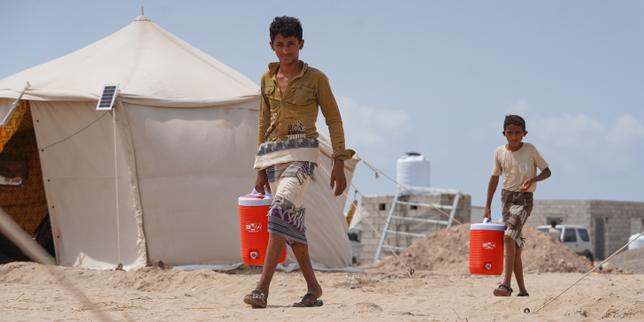
When the boats arrive in Obock, the port town on Djibouti’s northern coast, they do not pull into luxury marinas. They scrape against rough sand. Passengers stumble out, legs stiff from hours of cramped crouching, vomiting saltwater, weeping with a complex mixture of grief and relief.
They are processed by overworked aid workers who hand out high-energy biscuits, bottled water, and registration cards. In that moment, a human being transitions from a fleeing citizen into a refugee. A category. A file number in an international database.
Behind that bureaucratic transformation lies an immense psychological fracture. What happens to a person when their home is erased? When the school where they taught history is reduced to rubble, and the street where they played as a boy is mined?
Refugees do not just lose physical property. They lose the narrative arc of their own lives. Their past becomes an inaccessible country, locked behind a border of active conflict, and their future is suspended in a bureaucratic holding pattern inside a tent city built on unfamiliar, sun-baked earth.
The international community treats these crises as seasonal weather events. Headlines flare when a sudden spike in violence displaces thousands, prompting emergency pledges of aid and solemn speeches in air-conditioned conference halls in Geneva or New York. Then, as the news cycle shifts to newer fires, the funding dries up. The emergency phase transitions into a protracted limbo.
The two hundred and thirty thousand displaced Yemenis and the ten thousand refugees crossing toward Djibouti are not temporary anomalies. They are the systemic cost of a global order that has proven exceptionally skilled at starting conflicts and abysmally inept at resolving them.
Consider what happens next for Tariq and those who arrive with him. They will spend months, perhaps years, waiting in transit centers or cramped urban dwellings. They will learn a new cadence of survival, trading self-reliance for dependency on international aid agencies whose own budgets are perpetually stretched to the breaking point. The children will grow up speaking of Yemen as a mythic land their parents talk about in hushed, nostalgic tones—a place of green mountains and ancient mud-brick towers that now exists only in fading photographs stored on cracked smartphone screens.
This is the invisible architecture of modern displacement. It is built out of logistical plans, refugee camp perimeters, shipping manifests, and quiet endurance.
Night falls quickly over the Bab-el-Mandeb. Across the strait, the lights of Yemeni coastal towns flicker feebly through power outages and artillery smoke. On the Djiboutian shore, another boat cuts through the dark water, its engine a low, persistent drone against the vast silence of the desert. A hand reaches out from the gunwale, groping blindly in the dark for a foothold on the sand, searching for a place where tomorrow does not require dodging shrapnel, and where the horizon is just a line where the sea meets the sky, empty of everything except possibility.