Most people assume online pig-butchering and crypto fraud rings are strictly a Southeast Asian problem. They picture barbed-wire compounds tucked away in Myanmar border towns or coastal cities in Cambodia. That picture is outdated.
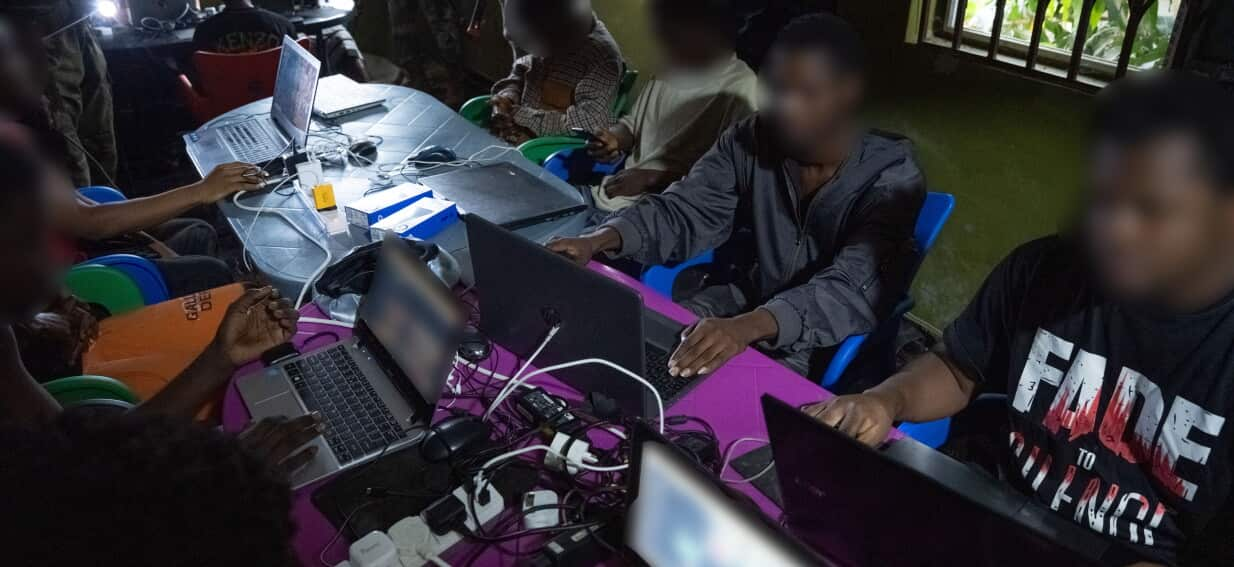
In August and September 2026, local police and FBI investigators raided 13 Chinese-run scam compounds right inside Antananarivo, the capital of Madagascar. Authorities seized more than 3,200 electronic devices and froze around $52 million worth of cryptocurrency in a single day. When law enforcement squeezed these criminal syndicates in Cambodia and along the Thai border, they didn't shut down. They packed their laptops, booked flights across the Indian Ocean, and rented out entire hotels in Madagascar.
How Scam Centres Relocated From Cambodia to Madagascar
Criminal networks treat cyber fraud like a multinational logistics business. When pressure mounts in one jurisdiction, they relocate their infrastructure to wherever oversight is weaker and local officials can be bought off.
According to Citohaina Ralihivao, coordinator of the cybercrime unit at Madagascar's Ministry of Communications, the island's sudden surge in scam compounds traced directly back to crackdowns near the Cambodia-Thailand border. Court documents from a U.S. Department of Justice indictment in October 2026 revealed that witnesses were moved from Southeast Asia to Antananarivo in May 2026 after fighting between Cambodia and Thailand disrupted regional operations.
At first, the operators kept a low profile. They rented quiet residential villas scattered around the capital. Within months, greed got the better of caution, and syndicates began taking over entire commercial hotels—including the Live Hotel in Antananarivo—converting guest rooms into around-the-clock call and messaging floors.
The Blueprint of a Modern Scam Compound
If you've never looked inside one of these operations, forget the cliché of a lone hacker in a dark basement. Modern scam centres run like aggressive corporate sales offices, complete with scripts, shift quotas, and strict management hierarchies.
- Targeted English-language recruitment: Syndicates moving into Africa realized they needed fluent English speakers to convince targets in the United States, Canada, and Pakistan. They recruited nationals from English-speaking African countries using fake job postings.
- Rehearsed social engineering: Workers operated fake dating profiles using photos of attractive women, building weeks-long emotional relationships before steering victims toward fraudulent cryptocurrency investment sites.
- Off-grid internet resilience: Across global operations, syndicates have increasingly relied on satellite internet terminals like Starlink to bypass local telecom monitoring, prompting the U.S. Scam Center Strike Force to disable thousands of terminals worldwide.
- Illicit money-laundering pipelines: Stolen funds flow through underground guarantee marketplaces—such as the Xinbi Guarantee Network targeted by U.S. authorities in late 2026—that supply pre-built scam websites and launder crypto proceeds.
The Human Trafficking Trap Inside African Scam Hubs
Here's the ugly truth that gets lost in headlines about stolen crypto: the person messaging you on WhatsApp or a dating app might be a prisoner.
The United Nations Office on Drugs and Crime (UNODC) classifies this model as trafficking in persons for forced criminality. Recruiters lure educated, tech-savvy jobseekers with promises of legitimate customer service, translation, or IT roles. Once victims arrive on tourist visas, handlers confiscate their passports, lock them inside guarded compounds, and force them to meet daily fraud quotas under threat of violence.
In the Madagascar raids, U.S. prosecutors named Malaysian national Chui Kok Wa and five co-defendants in an October 2026 indictment. Court filings noted that 15 workers who claimed they were trafficked and abused by Wa's network ended up held in a Madagascar jail as material witnesses rather than immediately receiving victim protection.
That gap between arrest and victim identification happens constantly. Local police raid a building, detain everyone holding a phone, and throw trafficked workers into the same cells as mid-level managers. Meanwhile, the actual ringleaders rarely face trial in the country where they got caught.
Why Law Enforcement Struggles to Catch the Ringleaders
You might think a joint FBI and local police raid ending in hundreds of arrests would mean open-and-shut prosecutions. Reality is messier.
During the Madagascar crackdown, local authorities arrested nearly 400 people across the 13 compounds. Yet before FBI agents could finish interviewing key suspects, Madagascar's Ministry of Justice repatriated 148 Chinese nationals—including roughly 30 identified compound leaders—directly to China. U.S. Attorney Jeanine Pirro publicly called out the lack of cooperation, noting that American investigators were blocked from questioning the alleged bosses behind schemes targeting U.S. citizens.
Corruption makes containment even harder. In August 2026, eleven Chinese nationals arrested separately during the scam crackdown walked free from a Madagascar prison in a scandal that implicated the head of the country's prison service.
This pattern isn't unique to Madagascar. The Global Initiative Against Transnational Organized Crime documented how China-linked scam networks began pivoting into South Africa as early as 2023 after facing pressure in Myanmar. And the International Organization for Migration (IOM) reported in July 2026 that trafficking victims pulled from scam centres now span more than 80 nationalities. When one country tightens enforcement, syndicates simply exploit jurisdictional blind spots elsewhere.
What the Global Spread of Scam Centres Means for Your Money
Southeast Asia-based scam centres alone stole an estimated $18.2 billion from Americans in 2025, according to U.S. Treasury figures. By late 2026, the U.S. Scam Center Strike Force had restrained over $1 billion in cryptocurrency tied to these networks and seized 700 fraudulent investment domains.
Those numbers tell a clear story. Fraud isn't shrinking—it's decentralizing.
Because operations are spreading across Africa, the Middle East, and Latin America, traditional geographic red flags no longer work. A scammer messaging you during North American business hours isn't necessarily calling from New York or London, and they aren't necessarily working the graveyard shift in Phnom Penh either. They could be sitting in a hotel room in Antananarivo, Johannesburg, or Dubai, speaking fluent English without a trace of a Southeast Asian accent.
How to Protect Yourself Right Now
You don't need technical security training to avoid pig-butchering and crypto investment traps, but you do need strict personal rules:
- Never mix romance or new friendships with financial advice. According to Congressional findings in 2026, dating apps and social media platforms serve as the primary hunting ground for scam syndicates before they move conversations onto encrypted messaging apps. If someone you met online brings up crypto trading, gold futures, or a "guaranteed" liquidity pool, cut contact immediately.
- Verify trading platforms independently. Scammers build convincing clone apps that show fake profits to trick you into depositing larger sums, or ask you to connect your crypto wallet to a malicious smart contract that drains your funds silently. Only use regulated exchanges downloaded directly from official app stores after checking regulatory registries.
- Scrutinize overseas job offers before traveling. If a recruiter offers high pay in customer support, tech, or marketing in a foreign country and tells you to enter on a tourist visa instead of a sponsored work permit, walk away. Legitimate employers never ask you to bypass immigration rules or surrender your passport upon arrival.
- Report losses immediately to freeze stolen funds. Law enforcement agencies like the FBI's Internet Crime Complaint Center (IC3) can only intercept stolen cryptocurrency if victims report transaction hashes within hours or days, before funds get washed through underground guarantee networks.
Treat every unsolicited message that pivots toward money as a live threat, verify overseas employers through independent diplomatic channels, and report suspicious crypto domains the moment you spot them.
For a closer look at how these compounds shifted operations from Cambodia into Madagascar's capital, watch Scam Centres Expand Into Madagascar After Crackdown in Cambodia.