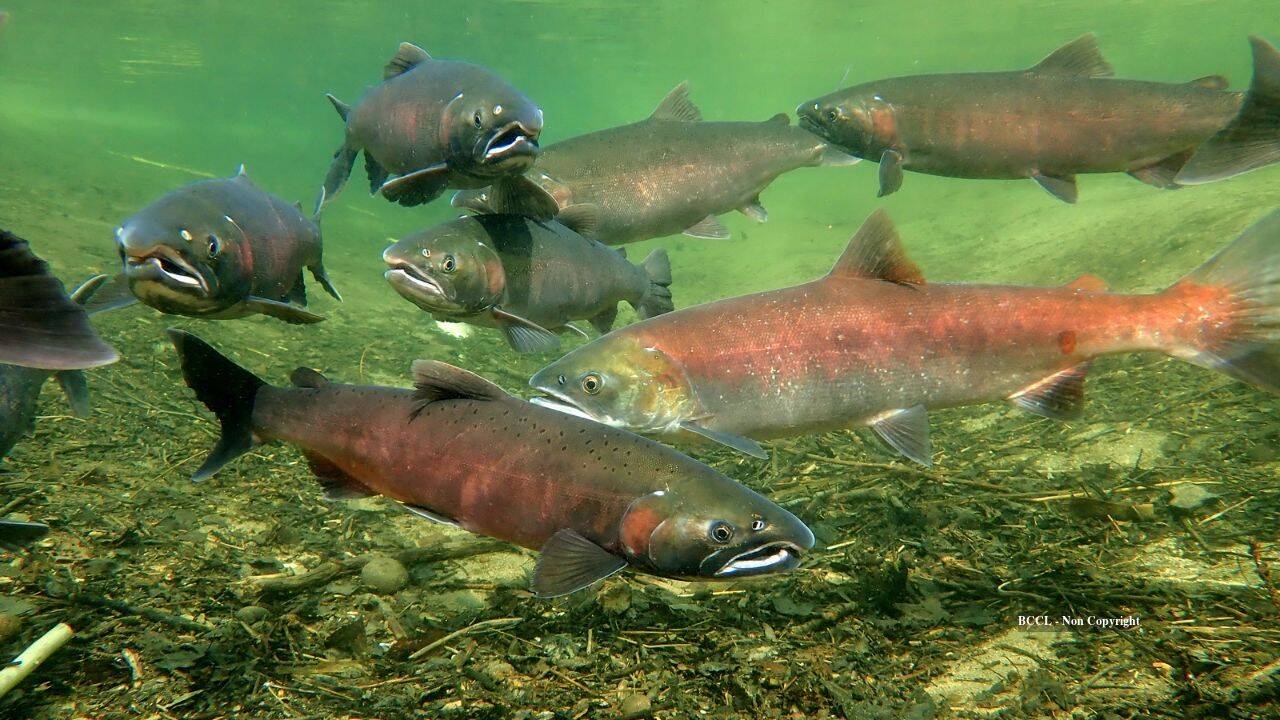
Celebratory headlines love a fast turnaround. Excavators pull away from a California riverbank, heavy rock is dumped into an engineered channel, and seventy-two hours later, a drone captures Chinook salmon swimming through the newly minted riffles. Press releases fly. Nonprofits declare victory. Donors open their checkbooks.
Everyone applauds the return of the king. Almost nobody asks whether those fish are swimming into a biological graveyard.
The mainstream environmental narrative treats river restoration like a field of dreams—build the gravel bed, and the salmon will thrive. That is a comforting fairy tale, and it is costing taxpayers billions of dollars while wild Pacific salmon populations continue their march toward functional extinction. Seeing adult salmon show up in a freshly dug side channel within days of construction proves only one thing: migratory fish have functioning fins and an evolutionary compulsion to swim upstream until they hit a wall or run out of energy. It says nothing about survival, reproduction, or population recovery.
The Field of Dreams Fallacy in Modern Hydrology
For three decades, I have watched watershed councils, state agencies, and engineering firms burn through nine-figure budgets chasing instant visual gratification. The formula rarely changes. You take a degraded, channelized river—often choked by agricultural runoff, choked behind massive dams, or bled dry by municipal water diversions—and you hire heavy machinery to sculpt a postcard. They call it "process-based restoration" or "habitat enhancement," throwing around terms like hyporheic exchange and large woody debris to justify the invoice.
Then comes the photo op. A few stray adults, often hatchery-born fish with clipped adipose fins and zero genetic adaptation to the local watershed, wander into the new gravel. Immediately, the project is declared a triumph.
Here is the reality that rarely makes the press release: spawning is the easy part.
Adult salmon are biological torpedoes designed to die. Once they enter freshwater, they stop eating, their organs begin to shut down, and their sole function is to dig a redd, deposit eggs, fertilize them, and expire. You could dump a truckload of clean river cobble into a concrete drainage ditch in downtown Los Angeles, run cold water over it for a week, and migrating salmon would dutifully dig nests in it.
The actual bottleneck for California salmon—whether you are looking at the Sacramento, the San Joaquin, the Klamath, or the Russian River—does not happen during the adult swim-up. It happens six months later, when millions of newly hatched fry emerge from the gravel and try to survive in a river system that remains fundamentally broken.
Ecological Traps and the Illusion of Life
In conservation biology, there is a specific term for what happens when you create attractive habitat inside a lethal system: an ecological trap.
Imagine a scenario where a restoration crew builds a pristine, shaded, gravel-bottomed spawning alcove along a warm, slow-moving stretch of the lower Sacramento River. The water temperature in October is just cool enough to lure passing Chinook. They spawn. Billions of dollars of engineering look brilliant on the quarterly report.
Then February arrives. Because the upstream dams are holding back cold snowmelt for agricultural irrigation contracts in the Central Valley, the river flow drops and water temperatures spike above 60 degrees Fahrenheit. The eggs suffocate in low-oxygen water. The few alevins that manage to hatch emerge into a barren channel stripped of its natural floodplain. Without seasonal floodwaters spreading across thousands of acres of tule marsh and riparian forest, the baby salmon have nowhere to hide from invasive striped bass and largemouth bass—predators that thrive in warm, stagnant, dam-controlled rivers. Worse, they have nothing to eat.
By April, 98 percent of those celebrated offspring are dead before they ever reach the brackish waters of the Sacramento-San Joaquin Delta.
You did not restore a salmon run. You built a luxury maternity ward inside a slaughterhouse.
The Numbers Behind the Spectacle
When you strip away the drone footage and look at the raw escapement data tracked by the California Department of Fish and Wildlife (CDFW) and the National Marine Fisheries Service (NMFS), the disconnect between restoration spending and actual fish returns becomes glaring.
Consider the Central Valley spring-run and winter-run Chinook. Despite tens of thousands of acres of localized gravel augmentation and side-channel projects over the last twenty years, commercial and recreational salmon fishing off the California coast was completely shut down in both 2023 and 2024 due to collapsing stock numbers. In the 1950s, the Sacramento River system routinely saw upwards of 500,000 to 600,000 returning salmon. Today, agencies celebrate when natural-origin winter-run returns crack 10,000.
Why does the public keep buying the hype? Because government agencies and environmental NGOs share a dirty secret: institutional incentives reward activity, not outcomes.
- Engineering firms get paid by the cubic yard of dirt moved and the ton of boulders placed. Nobody pays a civil engineer to tell a client to leave a river alone and fight a ten-year legal battle over water rights.
- State and federal agencies need tangible metrics to justify bond measures to voters. "Five miles of river restored" and "Salmon spotted in 48 hours" fit neatly onto a ballot summary. "Adjusted water allocation formulas by 14 percent to lower thermal stress during juvenile outmigration" puts voters to sleep.
- Nonprofits need immediate wins to keep foundation grants flowing. A donor wants to see a picture of a fish today, not a peer-reviewed cohort survival study seven years from now.
This alignment of incentives has created a multi-billion-dollar restoration industrial complex that treats symptoms with excavators while ignoring the systemic diseases killing the patient.
What Does It Actually Take to Save California Salmon?
If dumping gravel into rivers and celebrating forty-eight-hour salmon sightings is a distraction, what actually works? The answer is politically toxic, legally brutal, and visually boring: cold water, unimpeded passage, and real floodplains.
1. Water Volume and Thermal Refugia
Salmon are cold-water stenotherms. They require water temperatures below 56 degrees Fahrenheit for successful egg incubation. No amount of artfully arranged driftwood can cool a river if 60 to 80 percent of its natural flow is diverted into canals to grow almonds and alfalfa in the desert. Until California confronts senior water rights—the archaic "first in time, first in right" legal doctrine established during the Gold Rush—restoration projects are just rearranging deck chairs.
2. Dam Removal Over Fish Ladders
For decades, engineers insisted they could engineer their way around massive concrete barriers using fish ladders, trap-and-haul trucking programs, and juvenile bypass screens. Almost all of them fail at scale. Trucking juvenile salmon around dams in tanker trucks strips them of their olfactory imprinting—the chemical memory they use to navigate back to their natal streams years later—resulting in massive straying rates and genetic dilution.
The historic removal of four hydroelectric dams on the Klamath River, completed in 2024, succeeded precisely because it bypassed the engineering gimmickry and reconnected over 400 miles of cold, volcanic spring-fed habitat. When Chinook salmon swam past the former Iron Gate Dam site within days of the final cofferdam breach, that sighting actually meant something—not because someone dug a nice hole, but because the fish finally had access to an intact, cold-water ecosystem at the headwaters.
3. Reconnecting the Floodplain
A healthy California river is not a neat, single-thread channel lined with manicured boulders. It is a messy, sprawling, dynamic wetland that floods every winter. Research led by scientists at UC Davis—most notably Dr. Peter Moyle and Dr. Carson Jeffres—proved through the Nigiri Project that juvenile salmon raised on flooded rice fields and natural floodplains like the Yolo Bypass grow exponentially faster than their counterparts trapped in the main river channel.
Floodplains act as solar-powered food factories, generating massive blooms of zooplankton. A fat juvenile salmon entering the Pacific Ocean is up to ten times more likely to survive to adulthood than a starved, stunted smolt that fought its way down a rock-lined canal.
Why People Ask the Wrong Questions About River Restoration
Whenever a river project hits the news, public discourse immediately defaults to the same superficial questions. Let us dismantle them.
How fast do salmon return to a restored river?
Immediately, if the river is connected to the ocean and fish are already nearby. Asking how fast they show up is like asking how fast cars drive onto a newly paved highway ramp. Speed of entry measures physical access, not ecological viability. The only question that matters is: What is the smolt-to-adult return ratio five years from now? If fewer than two adults return for every two that spawned, the project is a net sink.
Are hatchery fish the same as wild salmon in these projects?
No, and pretending they are is ecological malpractice. Hatchery salmon are domesticated animals raised in concrete raceways on commercial fish pellets. Studies consistently show that hatchery fish have lower reproductive success in the wild—often half that of wild fish—and when they interbreed with native stocks, they drag down the genetic fitness of the entire population. When a press release boasts that "salmon" have returned to a restored creek, check the photos. If the little fleshy fin behind the dorsal fin is missing, you are looking at a hatchery clone, not a wild recovery.
Does every river restoration project fail?
Hardly. Projects that breach levees to let rivers reclaim their historic floodplains, remove obsolete diversion dams, and restore beaver populations—which naturally slow water, recharge groundwater tables, and create multi-layered cold-water wetlands—deliver extraordinary returns on investment. Notice the pattern: the projects that work involve removing human infrastructure, not building more of it.
The Uncomfortable Downside of Real Restoration
Advocating for real, systemic river recovery comes with steep costs that pure environmentalists rarely admit. If you want self-sustaining wild salmon runs in California, you have to accept trade-offs that hurt real people and alter the state's economy.
Breaching agricultural levees takes prime, fertile farmland out of production permanently. Restricting water diversions during critical spring outmigration windows means fallowing hundreds of thousands of acres in the San Joaquin Valley, wiping out farmworker jobs, and driving up food prices. Removing hydroelectric dams eliminates zero-carbon baseload power from the electrical grid at the exact moment California is trying to electrify its transportation sector.
These are brutal, zero-sum choices. It is much easier for politicians to cut a ribbon on a ten-million-dollar gravel-dumping project, point at a swimming fish on the evening news, and pretend we can have infinite agriculture, cheap hydro-power, suburban sprawl, and thriving wild salmon all at the same time.
Stop Building Aquariums in Broken Watersheds
The next time you read a breathless story about salmon swimming into a brand-new restoration site within forty-eight hours of completion, look past the drone shot. Look upstream at the concrete wall holding back the snowmelt. Look sideways at the levee walling off the floodplain. Look downstream at the massive pumps reversing the flow of the delta.
An adult salmon swimming over fresh gravel is not proof that we saved the river. It is proof that the fish are still trying to survive despite everything we refuse to change. Until we give them back their water and their floodplains, those viral videos are nothing more than a well-lit funeral procession.