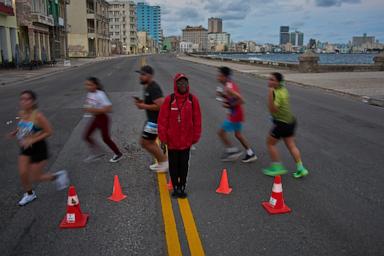
At 5:30 in the morning, before the Caribbean sun burns the salt haze off the Malecón, Havana sounds like a city holding its breath.
You do not hear the low rumble of commuter buses. You do not hear the sharp clatter of delivery trucks unloading crates of mangoes and bread. Instead, if you stand near the Capitolio in the humid dark, you hear a softer, stranger percussion. It is the rhythmic slap of worn rubber soles hitting cracked asphalt, accompanied by the heavy, synchronized breathing of thousands of people who woke up in the dark after a night with no electricity.
Breath. Step. Breath. Step.
For most of the world, a city marathon is an exercise in leisure. It is a weekend hobby for people with carbon-plated racing shoes, wearable GPS trackers, and recovery smoothies waiting at the finish line. In Havana, during the annual Marabana marathon, running forty-two kilometers is something else entirely. It is a physical argument against erasure.
To understand what happened on the streets of the Cuban capital when thousands of runners laced up their shoes—many turning the race into an open, moving demonstration against United States sanctions—you have to look past the finish line tape. You have to look at the soles of their shoes, the empty shelves in their kitchens, and the invisible walls closing in around an island that has spent more than six decades fighting for air.
The Weight of an Invisible Wall
Consider a hypothetical runner we will call Mateo, a thirty-four-year-old high school physics teacher from the municipality of Cerro. While Mateo is a composite character, his daily reality mirrors that of thousands of actual participants who stood at the starting line of Marabana.
Mateo has been training for six months. He did not buy a training plan online, because mobile data is expensive and slow. He wrote his weekly mileage in pencil on the back of an old lesson plan. His running shoes are four years old; the tread on the outer heel has worn down to the gray foam beneath, and he patched a tear near his left big toe with dental floss and superglue.
Why does Mateo run?
Ask him at mile five, as he passes the faded pastel facades of Centro Habana, and he will tell you it is the only time he feels completely free. Ask him at mile eighteen, when the tropical heat climbs past thirty degrees Celsius and his legs feel like wet concrete, and you get a different answer. He runs because standing still feels like surrendering.
When international headlines report that thousands ran Cuba’s Marabana marathon while protesting the U.S. embargo, the words tend to land with a dull, political thud. Embargo. Sanctions. Blockade. They sound like abstract chessboard moves made by men in air-conditioned rooms in Washington and Havana.
In Mateo’s kitchen, the embargo has a smell. It smells like rancid cooking oil stretched across too many meals, and the acrid smoke of charcoal stoves lit on apartment balconies because the power grid collapsed again at midnight.
Think of an island economy like a human circulatory system. Trade, banking, fuel, and medical supplies are the oxygen-rich blood keeping the extremities alive. Since 1962, the United States has maintained a comprehensive economic, commercial, and financial embargo against Cuba—known to Cubans simply as el bloqueo. Over the past several years, tightened financial restrictions, the designation of Cuba as a State Sponsor of Terrorism, and the lingering economic shockwaves of the pandemic have acted like a tourniquet pulled tighter and tighter around the island’s main arteries.
When a foreign bank refuses to process a transaction involving a Cuban entity out of fear of massive U.S. Treasury fines, the consequence is not an abstract diplomatic victory. The consequence is a cargo ship sitting idle in a foreign port because nobody can clear the payment for fuel oil. That missing fuel oil means twelve-hour blackouts in Santiago de Cuba. It means hospitals rationing anesthesia. And for a distance runner in Havana, it means no imported athletic gear, no electrolyte gels, and no certainty that there will be chicken or eggs for dinner after burning three thousand calories on the pavement.
The Starting Gun in the Dark
Marabana began in 1987 as a modest local race, growing over the decades into Cuba’s premier international sporting event, traditionally held each November to commemorate the founding of Havana and the island's National Day of Physical Culture and Sports. In its peak years before 2020, thousands of foreign runners from dozens of countries flew in to run alongside locals, drawn by the electric atmosphere, classic American cars lining the route, and the sheer joy of Cuban street culture.
Recent editions have looked starkly different.
The crowds at the starting line near the Capitolio are overwhelmingly Cuban now, joined by a smaller, fiercely dedicated contingent of international runners who navigated labyrinthine flight schedules and currency restrictions just to be there. Before the starting horn even blows, the political undercurrent is impossible to miss.
Runners arrive wearing hand-lettered shirts. Banners stretch across the metal barricades reading Abajo el bloqueo—Down with the blockade. Around the perimeter, spectators hold up homemade cardboard signs demanding the removal of Cuba from the U.S. list of state sponsors of terrorism, a designation reinstated in January 2021 that effectively severed the island from much of the global financial system.
Critics outside the island often dismiss these demonstrations as state-choreographed theater. It is true that the Cuban government actively promotes the anti-embargo message and relies on the external blockade to deflect blame from its own deeply entrenched economic mismanagement, centralized bureaucracy, and sluggish reforms. Both things can be true at the exact same time. A government can fail its people through rigid policy, while a superpower simultaneously strangles those exact same people through economic warfare.
If you stand in the middle of that crowd at 6:00 AM, watching an elderly man in his seventies tape a handwritten sign condemning sanctions to his chest with masking tape, you realize the emotion is not manufactured in a ministry office. It is visceral. It is the exhaustion of a population caught between a rock and a hard place, using the only international microphone left to them: their own bodies in motion.
Forty-Two Kilometers of Truth
The gun fires.
A roar goes up, bouncing off the neoclassical columns of the Capitolio and rolling down the Prado toward the sea. For the first five kilometers, adrenaline masks every deficit. Thousands of feet drum a steady beat down the wide boulevard, past statues of lions and balconies crowded with families still in their pajamas, banging pots and wooden spoons in encouragement.
"¡Dale, mi hermano!" Go, my brother!
It is a metaphor made flesh: a nation running forward on worn-out soles, fueled by stubbornness and communal noise.
By kilometer ten, the course swings onto the Malecón, Havana’s famous eight-kilometer seawall. Here, the ocean spray cools the air, and the marathon reveals its true character. There are no corporate hydration stations staffed by paid event planners handing out branded isotonic drinks in waxed paper cups. Volunteers—students, retirees, neighborhood doctors—stand behind folding tables pouring tap water from plastic jugs into tiny cups or handing out sliced oranges.
Look closely at the runners passing through Miramar and Vedado, the leafy neighborhoods along the western stretch of the route, and you see the staggering inequality of global sport laid bare.
A visiting runner from Europe or North America glides past in a two-hundred-dollar pair of super-shoes, a sleek hydration vest strapped across their chest, checking pace splits on a titanium smartwatch. Ten meters behind them runs a twenty-two-year-old university student from Havana’s sports institute, wearing heavy, faded cotton shorts, running in sneakers borrowed from a cousin, carrying nothing at all.
Yet they are matching stride for stride.
How do you train for an endurance event when inflation has driven the price of basic protein beyond a monthly state salary? How do you recover from a thirty-kilometer long run when rolling blackouts prevent you from sleeping through the sticky, mosquito-heavy nights?
You adapt, or you quit. Cubans have spent sixty years mastering the art of resolver—figuring it out with nothing. Runners pool money to buy bulk sacks of oats or bananas on the informal market. They run at dawn before the heat turns dangerous because they cannot afford to lose fluids they cannot easily replace. They share shoes. When one runner finishes a half-marathon, they unlace their sneakers at the finish chute and hand them to a friend waiting to run a shorter distance.
The Wall at Kilometer Thirty-Two
Every marathoner knows about "the wall."
Around kilometer thirty-two, the human body exhausts its stored glycogen. The brain begins sending urgent, panicked signals to shut down muscular effort. Vision narrows. Every step feels like lifting a lead weight out of deep mud.
In Havana, the wall hits along the long, punishing incline leading away from the coast and back toward the heart of Old Havana. The shade disappears. The humidity sits on your skin like a wet wool blanket.
This is the moment where the protest stops being a slogan printed on a t-shirt and becomes a physical reality.
Consider what happens when a runner stumbles near an aid station at kilometer thirty-five. A volunteer rushes over with water and a piece of guava paste. Around them, runners slow down to shout encouragement, clapping on weary shoulders, refusing to let a stranger drop out alone.
There is a profound psychological pattern at work here. Psychologists who study collective resilience under extreme scarcity note that shared physical struggle creates a rapid, intense bond—a temporary community where status disappears and survival becomes cooperative. On a normal Tuesday in Havana, people are exhausted by standing in lines for bread, stressed by currency fluctuations, and anxious about relatives who have migrated to Miami, Madrid, or Mexico City. Over the past few years, Cuba has experienced the largest demographic exodus in its modern history, losing roughly ten percent of its population as young people flee economic hopelessness.
Empty chairs sit at every dinner table. Empty desks sit in every classroom.
On Marabana Sunday, the streets belong to the people who stayed.
When they chant against U.S. sanctions as they round the final bends toward the finish line, they are not chanting in defense of abstract ideology. They are protesting the isolation that keeps medicines out of their pharmacies, keeps spare parts away from their power plants, and forces their brothers and sisters onto dangerous migrant routes through Central America just to send remittances back home.
Why the World Looks Away
It is easy, from a comfortable distance, to reduce Cuba to a postcard or a political talking point.
To one side, it is a romantic relic of vintage Chevrolets, salsa music, and revolutionary nostalgia. To the other, it is simply a failed socialist state getting what it deserves. Both narratives are lazy. Both erase the eleven million human beings living inside the pressure cooker.
When you actually listen to the runners catching their breath past the finish line, the confusion and frustration of their daily lives spill out without ideological polish. They are tired. They are angry at shortages that never seem to end. Many are deeply frustrated by domestic policies that stifle private enterprise and trap wages at survival levels. At the same time, they look north across ninety miles of water and see a policy that explicitly aims to make their daily lives as painful as possible in the hope that misery will spark political change.
Sixty-four years of history have proven one thing beyond doubt: economic strangulation does not liberate a people. It just starves them while hardening the lines of division.
Yet, remarkably, it has not broken their capacity to gather, to sweat, and to insist on their own dignity.
The Final Stretch
Near the end of the race, the course turns back toward the Capitolio, its massive dome gleaming white against the blinding midday blue of the tropical sky.
The crowds along the metal fences are three deep now. Music blares from battered loudspeakers—timba and son rhythms vibrating through the soles of your feet. Runners who finished an hour ago lean over the barriers, hoarse from cheering, waving Cuban flags and handmade signs.
Watch the back-of-the-pack finishers coming down that final straightaway.
Some are limping. Some have salt crusts dried white across their foreheads and shoulders. A middle-aged woman with a blue bandana tied around her head and a handwritten sign pinned to her singlet—Sin bloqueo corremos mejor (Without the blockade we run better)—raises both arms above her head as she crosses the timing mat. Her face is a mask of pure, unfiltered exhaustion and triumph.
She has no medal made of precious metal. There is no prize money waiting for her. When she walks home, the power in her apartment building might still be out, and the tap in her kitchen might only drip lukewarm water.
She stops ten meters past the line, bends over with her hands on her knees, and takes a long, ragged breath of Havana air—still running, still here, refusing to disappear.