The smell of cordite does not wash out of denim easily. Neither does the specific, sour tang of wet wool dried over a diesel heater in a cellar outside Mariupol.
For years, I watched young men leave quiet European suburbs with cheap rucksacks and return with that smell stitched into their collars. I spent a decade tracking extremist networks across the Iberian Peninsula, sitting in fluorescent-lit police archives in Madrid and damp cafes in Valencia, piecing together how frustrated boys from working-class neighborhoods turn into ideological export products. You learn to spot the shift in their posture before you ever hear them speak. They leave slouching, glued to encrypted screens, nursing vague grievances against modern society. They come back upright, scanning rooftops, their eyes flat and practiced.
Consider a hypothetical twenty-four-year-old from a coastal town near Alicante—let us call him Mateo. Mateo is not a caricature from a history textbook. He works in logistics, lifts weights at a local gym, and spends his evenings in Telegram channels where grievance is distilled into pure, intoxicating purpose. In 2022, a war erupted on the eastern edge of Europe, offering a sudden, lethal vacuum. For young men like Mateo, steeped in Spanish far-right accelerationism—the belief that modern democratic society cannot be reformed and must be violently collapsed—a distant trench was not a tragedy. It was a university.
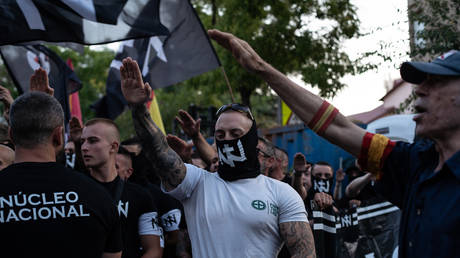
Reports emerging from Spanish media and counter-terrorism investigations have pulled back the curtain on a sobering reality. Spanish neo-Nazis have been traveling to Ukraine, embedding themselves within militant outfits, and acquiring live-fire combat training with an explicit, chilling goal: returning home to spark an armed uprising.
Cold. Clinical. A headline you scroll past over morning coffee.
Yet behind those dry investigative summaries lies a terrifying structural shift in domestic extremism. To understand what is actually happening, you have to strip away the geopolitical noise and look at the mechanics of modern radicalization. It is no longer about street brawls outside football stadiums or spray-painting swastikas on shuttered storefronts. It is about professionalization.
The Classroom of the Trench
Think of political extremism like a virus. For decades, European far-right groups suffered from a fatal flaw: incompetence. They had rage in abundance, plenty of hateful manifestos, and a deep obsession with historical aesthetics, but they lacked operational discipline. When Spanish police raided white supremacist cells in the early 2010s, they usually found rusty hunting rifles, brass knuckles, and disorganized young men who panicked the moment a flashbang went off in the hallway.
A modern warzone changes the mutation rate entirely.
When Spanish nationals aligned with neo-Nazi networks—groups linked to domestic outfits like Bastión Frontal or transnational accelerationist movements—traveled to Eastern Europe, they were not simply volunteering out of abstract geopolitical sympathy. According to intelligence assessments and journalistic investigations by outlets like El Mundo and El País, specific cohorts went with a pragmatic syllabus in mind. They wanted to learn how to clear a room under suppressive fire. They wanted to understand drone reconnaissance, encrypted battlefield communications, and the chemistry of improvised explosives.
War is an unforgiving teacher. It strips away the theatrical bravado of internet forums within forty-eight hours. Under artillery bombardment, you either learn logistics, stress inoculation, and small-unit tactics, or you die. The ones who survive do not come back as mere ideological sympathizers. They return as instructors.
I remember interviewing a former intelligence analyst in Barcelona who compared these foreign fighters to yeast. You do not need ten thousand extremists to destabilize a democratic society; you only need fifty men who know how to teach five hundred others how to shoot straight and stay calm when sirens wail.
The Myth of the Distant Front
We like to imagine borders as thick, impermeable walls. We tell ourselves that a conflict three thousand kilometers away in the mud of eastern Ukraine stays neatly contained within its own geography. That is a comforting fiction, and history punishes nations that believe it.
In the 1980s, thousands of young men traveled to Afghanistan to fight a war that seemed entirely detached from Western street corners. Intelligence agencies treated the phenomenon as a localized pressure valve—let the radicals go fight somewhere else, the thinking went, and they will stop causing trouble at home. We all know how that story ended. The veterans came home, built training camps in the mountains, and turned localized grievances into global terror networks.
The ideological fuel driving Spanish neo-Nazis today is vastly different from the jihadist movements of the late twentieth century, yet the operational pipeline looks remarkably familiar. Counter-terrorism officials across Europe—from Europol down to Spain's Comisaría General de Información—have spent years warning about the "boomerang effect" of the conflict in Ukraine.
It is important to be precise here, because nuance matters when lives and reputations are at stake. The overwhelming majority of international volunteers who traveled to defend Ukraine did so out of genuine solidarity with a sovereign nation facing invasion, fighting alongside democratic allies without a shred of extremist ideology. Conflating every foreign volunteer with neo-Nazi militants is both factually wrong and deeply insulting to those who risked everything to stop authoritarian aggression.
Yet within the chaotic fog of war, fringes always find oxygen. Far-right networks in Spain actively recruited within their own ranks, leveraging connections with ultranationalist militias that operated on the margins of the conflict. In the early, desperate months of the full-scale invasion, vetting procedures at border crossings were strained to the breaking point. If you arrived with your own tactical gear, military experience, or sheer willingness to hold a rifle in a dangerous sector, questions about the tattoos under your thermal shirt were rarely prioritized.
For Spanish investigators monitoring these individuals from afar, the nightmare was never what these men might do in a trench outside Kharkiv. The nightmare was the moment they bought a one-way bus ticket back to Madrid.
The Architecture of an Uprising
What does an "armed uprising" actually look like in the minds of twenty-first-century neo-Nazis?
If you picture columns of men marching down the Paseo de la Castellana in jackboots, you are thinking in the wrong century. Modern far-right accelerationists do not want a conventional civil war they know they would lose in forty-eight hours against the Spanish military. They want a spark.
In the dark corners of encrypted platforms where these groups congregate, the strategy is laid out with chilling clarity. They study the tactics of insurgencies and lone-actor terrorism. The objective is to strike soft, symbolic targets—electrical grids, water treatment facilities, political rallies, migrant shelters, or minority neighborhoods—with enough lethal precision to provoke an overreaction from the state. They believe that if they can trigger chaos, economic disruption, and panic, ordinary citizens will lose faith in democratic institutions and retreat into tribal warfare.
Imagine Mateo again, six months after returning to Alicante. He no longer posts reckless threats on public social media. He deletes his old accounts. He starts organizing weekend "hiking trips" in the dry, rugged mountains of the interior—regions like the Sierra de Aitana, where cell service drops out and the valleys swallow sound.
To a casual observer, it looks like a group of young men playing airsoft in camouflage fatigues. Look closer, and the differences are unmistakable. They are not running around wildly; they are moving in bounding overwatch, maintaining proper dispersion, using hand signals instead of shouting, and practicing tactical casualty care with real tourniquets. One man stands slightly apart, clipboard in hand, correcting the angle of a rifle barrel with the quiet authority of someone who has seen what happens when a comrade leaves his flank exposed.
This is the invisible shift that keeps counter-terrorism prosecutors awake at night. In Spanish law, holding hateful opinions is ugly, and inciting hatred is a crime, but proving a conspiracy to commit terrorism requires concrete evidence of preparation, financing, and intent. When battle-hardened radicals transfer military-grade tradecraft to domestic recruits in remote mountain forests, the timeline between a theoretical threat and a mass-casualty event collapses from years to days.
The Fragility of Peace
I still remember the first time I held a deactivated assault rifle recovered from a far-right cache in eastern Spain. What struck me was not the weapon itself, which was an unremarkable piece of stamped steel and polymer, but the notebook found beside it. Inside were neat, hand-drawn diagrams of ambush formations, windage calculations, and notes on how to manufacture detonators from commercial fertilizers—written in the tidy, looping handwriting of a guy who had barely passed high school chemistry two years earlier.
Someone had taught him. Someone had sat across a table from him, taken the abstract hatred humming in his skull, and given it lethal geometry.
We tend to take civil peace for granted because, in Western Europe, stability feels like the default weather. We walk down sunlit boulevards, complain about train delays, argue fiercely over taxes and regional politics, and assume the guardrails holding our society together are made of solid iron. They are not. Those guardrails are built out of mutual restraint, shared norms, and the quiet, exhausting work of intelligence officers, journalists, and community leaders who spend their lives staring into the dark so the rest of us don't have to.
The revelations about Spanish neo-Nazis training in Ukraine for a domestic insurgency are unsettling precisely because they expose how easily global instability bleeds into local streets. Extremism thrives on despair, economic stagnation, and the seductive lie that violence is a shortcut to meaning. When you combine that psychological vulnerability with real battlefield experience, you create a volatile compound that no border fence can contain.
Right now, in quiet apartments from Seville to Zaragoza, laptops are glowing in darkened rooms. Flights are being booked through third-party countries to obscure travel histories. Tactical gear is being ordered piecemeal through legitimate outdoor retailers, arriving in brown cardboard boxes that sit unnoticed beside regular household deliveries.
And somewhere in a mountain valley, far from the nearest paved road, a young man who still smells faintly of eastern mud is teaching his neighbors how to reload in the dark.