The smell of burning rubber at Silverstone stays with you. It is a mix of acrid chemicals and hot asphalt, a scent that clings to the back of your throat long after the garages have fallen silent. If you sit in the grandstands after the crowds leave, you can still hear the phantom whine of V6 hybrid engines echoing off the concrete.
For twelve years, that sound belonged to one man more than any other. Lewis Hamilton in a silver car was an ecosystem. It was a mathematical certainty. You knew the cadence of his voice over the team radio; you knew the precise trajectory he would take through Copse corner.
Then, the world tilted.
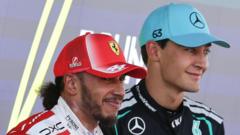
When Hamilton announced his move to Ferrari, it felt less like a sports transfer and more like a geopolitical shift. It was a tearing of fabric. George Russell, sitting in the parallel garage, watched the tectonic plates move from a front-row seat. To the casual observer, it was a headline, a bit of winter drama to spice up the off-season. But to those who live inside the paddock—who breathe the exhaust and watch the telemetry lines twitch in real-time—it was the first rumbling of an incoming storm.
Russell knows exactly what is coming. He sees the data. He knows that the combination of the sport’s most successful driver and its most mythologized team is not just a marketing triumph. It is a threat.
The Ghost in the Brackley Garages
To understand why this move sends shivers down the spines of the grid, you have to understand the psychological weight of the color red.
Every racing driver is haunted by a ghost. For some, it is the memory of a karting rival who never made it. For others, it is the shadow of Ayrton Senna or Michael Schumacher. When you put on a Ferrari race suit, you are choosing to wear that ghost on your sleeve.
Mercedes built a machine. A cold, efficient, brilliant machine that won eight consecutive constructors' titles through clinical precision and relentless engineering. It was a factory of logic. Ferrari, however, is a religion. It operates on passion, political intrigue, and an intense, almost suffocating pressure from an entire nation. When Ferrari wins, Italy dines for free. When Ferrari loses, it is a national tragedy.
Imagine stepping into that colosseum at forty years old. Hamilton does not need the money. He does not need the validation. He is chasing something elusive—the final, ultimate confirmation of his legacy.
Russell, who climbed through the Mercedes junior ranks watching Hamilton dominate, understands the mechanics of motivation better than most. He recognizes that a content, comfortable champion is dangerous, but a champion seeking a mythic redemption arc is terrifying. Hamilton at Ferrari is a man trying to capture lightning in a bottle one last time.
Consider what happens next: the infrastructure of Maranello is shifting to accommodate this ambition. Fred Vasseur, the Ferrari team principal, has been quietly restructuring the team, stripping away the tactical fragility that plagued them for a decade. He is building a fortress. Hamilton is the final piece.
The Anatomy of a Threat
Formula One is a sport of fractions. A millimetre of ride height can be the difference between a pole position and a spin into the barriers. A tenth of a second on a pit stop can alter the course of a world championship.
When Russell talks about Ferrari being a massive title threat, he is not playing nice for the media. He is reading the telemetry of momentum.
Let us look at the cold reality of the technical changes ahead. The sport is hurtling toward a massive regulations overhaul. History tells us that whenever the rules change drastically, the hierarchy shatters. The team that gets the head start holds the keys to the kingdom for half a decade.
Ferrari has been pouring immense resources into their project. They are not looking at the next race; they are looking at the next era. By pairing Hamilton’s unmatched racecraft and development feedback with their new power unit architecture, they are creating a leviathan.
2026 Technical Regulation Overhaul:
┌───────────────────────────┬───────────────────────────┐
│ Old Era                   │ New Era                   │
├───────────────────────────┼───────────────────────────┤
│ High aerodynamic reliance │ Active aerodynamics       │
│ Complex MGU-H technology  │ Increased electrical power│
│ Stable engine baselines   │ 100% sustainable fuels    │
└───────────────────────────┴───────────────────────────┘
The grid is hyper-aware of this. The engineering paddock is a small village. Whispers travel fast over espresso in the hospitality suites. The whisper right now is that Ferrari’s single-cylinder dyno tests are hitting numbers that make rival engineers uncomfortable.
Russell faces a dual reality. He must lead Mercedes out of the wilderness and back to the top step of the podium, while simultaneously watching his mentor build a rival superpower down the pit lane. It is a lonely position. The apprentice has been handed the keys to the house, but the master has just bought the mansion across the street and is throwing a party.
The Human Toll of 200 Miles Per Hour
We watch these drivers on television and see helmets, carbon fiber, and sponsor logos. It is easy to forget that inside that survival cell is a human heart beating at 180 bpm, enduring lateral forces that try to rip their head off their shoulders.
The emotional strain of this transition is already warping the paddock dynamic. Every mistake Mercedes makes is viewed through the lens of Hamilton’s departure. Every step forward Ferrari takes is seen as a validation of his choice.
For Russell, the stakes are deeply personal. He is no longer the young prodigy with time on his side. He is the present and the future of Mercedes. If Hamilton succeeds at Ferrari, it cements Lewis as the greatest to ever live. But if Russell can beat him—if he can keep the silver cars ahead of the red ones—he becomes a giant killer.
The battle lines are not drawn in the sand; they are etched into the tarmac of twenty-four tracks across the globe.
You can feel the tension building in the pre-race briefings. The interactions between Hamilton and Russell have changed. The easy camaraderie of teammates has been replaced by the watchful, polite distance of impending rivals. They still smile for the cameras, but the eyes tell a different story. They are evaluating each other. Looking for cracks. Searching for weaknesses in the armor.
The Red Car in the Mirror
The true test will not come during a sunny afternoon practice session. It will come on a wet November evening, with three laps to go, when the championship hangs in the balance.
Russell knows that when you look in your mirrors and see a red car, it looks closer than it is. The color bleeds into your vision. It demands your attention. It forces mistakes.
The combination of Hamilton and Ferrari is a psychological weapon as much as a mechanical one. They are betting that the sheer weight of their collective history will cause opponents to blink.
But Russell is not a driver who blinks easily. He has spent his entire life preparing for the moment the safety net is removed. He welcomes the threat because he knows that beating a legend in a standard car is impressive, but denying a legend their fairytale ending in a Ferrari is the stuff of immortality.
The garage doors are lowering now. The mechanics are packing away the tire blankets. The sun is setting over the paddock, casting long, distorted shadows across the asphalt. The quiet before the season begins is almost deafening. But underneath the silence, you can hear the faint, rhythmic ticking of a countdown clock. The red storm is coming, and everyone on the grid is running out of time to find shelter.