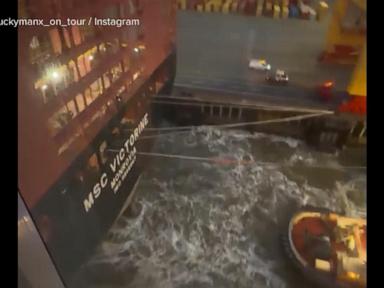
Watching a 100,000-ton floating hotel drift sideways into parked steel freighters looks like slow-motion chaos. Viral clips of a cruise liner colliding with docked cargo ships always trigger the exact same reaction online. People ask how a captain with million-dollar radar and GPS could possibly hit a stationary target in broad daylight.
They're looking at the wrong problem.
When a massive passenger vessel scrapes or slams into berthed cargo ships, it's rarely because someone fell asleep at the wheel. Physics wins every single argument in a tight harbor. Once wind, current, or a sudden propulsion glitch pushes a hull sideways, stopping that momentum takes way more space than a busy port gives you.
Why Massive Ships Lose Control in Tight Harbors
A modern cruise ship isn't built like an ocean liner from the 1950s. It's essentially a giant sail made of aluminum and glass sitting on top of a relatively shallow hull.
Think about the surface area. A ship carrying 4,000 passengers easily rises 200 feet above the waterline, while only 25 to 30 feet of steel sits underneath. When a sudden crosswind of 35 or 40 knots hits that flat side profile, it generates hundreds of tons of lateral force.
Harbor pilots and captains fight this constantly. To hold position or slide sideways into a berth, they rely on bow thrusters, stern thrusters, and azipods—giant rotating propulsion pods hanging under the stern.
Here's the catch. Thrusters lose almost all their bite once a ship moves forward faster than three or four knots. And if a sudden electrical blackout trips the breakers on those thrusters during a tight turn? You're suddenly piloting a skyscraper on ice with zero brakes.
The Squat Effect and Bank Suction
Even without high winds or mechanical failure, water physics inside narrow port channels plays nasty tricks on deep-draft hulls.
When a large ship moves through shallow, confined water, water rushing under the hull speeds up. Pressure drops. The ship literally sinks deeper into the water—a phenomenon mariners call the squat effect.
If the ship gets too close to a concrete pier or a row of moored cargo ships, water gets squeezed between the two hulls. That creates low pressure on the near side and high pressure on the open-water side. The ship gets sucked sideways straight toward the parked vessels before the crew can even swing the stern clear.
Anatomy of a Port Allision
In maritime law and Coast Guard accident reports, hitting a moving vessel is a collision. Hitting a stationary object—like a pier, a bridge, or a tied-up freighter—is technically called an allision.
Most dockside allisions follow a painfully predictable sequence over three or four minutes:
- The Approach Drift. The ship enters the turning basin slightly too fast or angled into a cross-current.
- Thruster Saturation. The bridge team cranks bow and stern thrusters to 100% power to check the swing, maxing out available lateral thrust.
- The Point of No Return. A gust hits, a tugboat line parts, or an engine trips offline. The stern begins swinging wide toward the cargo terminal.
- Steel on Steel. Because reversing main engines takes precious seconds to bite in the water, the overhanging lifeboat deck or hull flare makes contact with the docked cargo ships.
That overhang matters more than people realize. Cruise ships flare outward several decks above the waterline to maximize cabin space. A ship's underwater hull might clear a cargo vessel by fifteen feet, while its upper promenade deck or lifeboat davits sheer straight through the cargo ship's cranes and railings.
Notable Real-World Dockside Collisions
You don't have to look far to see how fast a routine port maneuver turns into international news.
In June 2019, the MSC Opera lost engine control while approaching a terminal in Venice's Giudecca Canal. Despite blaring its horn and dropping anchors, the 65,000-ton liner couldn't stop its forward momentum. It slammed into the concrete dock and struck the docked river cruise vessel River Countess, injuring several people and sparking global protests over mega-ships entering historic city centers.
Back in April 2016, the MSC Fantasia was caught by sudden severe winds in Palma de Mallorca, Spain. Gusts snapped its mooring lines and pushed the massive vessel across the harbor, where its stern swung into a docked cargo ferry.
Then there was the 2022 incident in Hamburg, Germany, involving the AIDAprima, and multiple fender-benders in busy Caribbean ports like Cozumel and Nassau where cross-currents funnel between piers. In almost every official investigation by bodies like the National Transportation Safety Board (NTSB) or European maritime bureaus, the root cause boils down to environmental forces exceeding thruster limits or sudden propulsion faults during critical maneuvering windows.
What Happens to the Ships and Crew Immediately After
The viral video cuts off right after the crunch of tearing metal. The real work starts ten seconds later.
First, the bridge crew hits the general alarm or makes a crew-only code announcement to assess structural integrity. Modern cruise ships are divided into dozens of watertight compartments below the waterline. Unless the impact tears open the hull below the draft line, the ship isn't going to sink.
Local port authorities immediately dispatch tugboats to pin the cruise liner against a safe berth so it doesn't drift into a second wave of parked vessels. Once tied up, the ship is placed under an immediate detention order. Nobody sails anywhere until classification societies—organizations like DNV or Lloyd's Register—inspect the steel.
The Investigation Checklist
Port State Control officers and marine casualty investigators board within hours. They pull data straight from the ship's Voyage Data Recorder (VDR)—the maritime equivalent of an airplane's black box.
Investigators check specific data points:
- Bridge audio recordings to hear commands between the captain and the local harbor pilot.
- Exact wind speed and direction logs from the ship's anemometer at the moment of impact.
- Engine room telemetry showing whether thrusters or generators tripped offline.
- Mandatory drug and alcohol screening results for the entire bridge team.
For the docked cargo ships, the damage is often deceptively expensive. Even a low-speed scrape at two knots carries millions of foot-pounds of kinetic energy. Bent hull plates, cracked weld seams, or damaged cargo cranes take a freighter out of commission for weeks. Dry dock repairs plus lost charter revenue easily run into millions of dollars, all settled through marine protection and indemnity (P&I) insurance clubs.
Why Viral Footage Makes It Look Worse Than It Is
Smartphone videos shot from neighboring balconies distort what's actually happening on the water.
Telephoto lenses compress distance, making two ships look stacked on top of each other long before they touch. On top of that, bystander clips almost never capture the five minutes of frantic corrective action happening underwater. You don't see the boiling white water from full-astern thrusters fighting a four-knot current, and you don't hear the harbor pilot screaming for emergency tug assistance over VHF Channel 16.
Lifeboats also take the brunt of the visual damage. Because lifeboats hang out past the hull edge on heavy steel davits, they act like sacrificial bumpers during a glancing blow. Watching fiberglass lifeboats crush and dangle looks terrifying on TikTok, even when the primary steel hull behind them only suffers scraped paint and a minor dent.
What Cruise Passengers Should Actually Do During a Port Incident
If you're ever standing on a deck rail watching another vessel get way too close, don't stand there filming until the moment of impact.
Flying glass, snapping mooring lines, and falling metal debris cause far more injuries in port collisions than the impact itself. A synthetic mooring rope snapping under 50 tons of tension whips back across a deck fast enough to take a limb off.
Step back inside the superstructure immediately, move away from large floor-to-ceiling windows, and hold onto a fixed handrail until the ship comes to a complete stop. Keep your cruise keycard and phone on you in case port authorities temporarily evacuate the deck levels near the damage. Once the crew confirms watertight doors are secure, listen to the captain's PA announcements rather than rumors spreading across ship Wi-Fi.