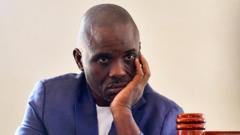
The arrest and subsequent charging of prominent Ugandan attorney Erias Lukwago with misprision of treason marks a dangerous expansion of the state security apparatus designed to completely isolate political dissidents from legal representation. By weaponizing archaic colonial-era statutes against the defense bar, the administration of President Yoweri Museveni is moving beyond the persecution of political rivals to target the legal professionals who defend them. Lukwago was seized by military forces while attempting to serve a court summons to the nation’s military chief, Muhoozi Kainerugaba, who also happens to be the president’s son. This coordinated legal assault effectively short-circuits the constitutional right to a fair trial.
The pattern is clear to anyone who has monitored East African politics over the last few decades. The state relies heavily on a specific legal playbook whenever its monopoly on power faces a legitimate challenge.
The Weaponization of Misprision
When the state cannot credibly tie a defense lawyer to an actual act of rebellion, it falls back on an exceptionally vague offense known as misprision of treason. This charge criminalizes the mere knowledge of an alleged treasonous plot if the individual fails to immediately report it to a magistrate or police officer. It is a perfect tool for a state looking to criminalize the attorney-client privilege.
Under traditional legal principles, an attorney must keep communications with a client strictly confidential. By charging Lukwago with failing to report the activities of his client, veteran opposition leader Kizza Besigye, the state creates an impossible dilemma. An attorney must either violate their professional oath by becoming an informant for the state or face years in a maximum-security prison for remaining silent.
Lukwago denied the charges in a Kampala court. He was promptly remanded to custody. The environment outside the courtroom reflected a judicial system operating under extreme military duress rather than the rule of law.
Reports from Lukwago’s immediate legal team indicate that his detention has involved severe physical mistreatment. His lawyers stated publicly that he collapsed while in custody after being forced to undergo grueling physical drills by military guards. The use of physical exhaustion and psychological pressure against an officer of the court signals a total breakdown of institutional boundaries.
The Digital Braggadocio of the Military Elite
The state is no longer hiding its methods. Shortly after the arrest, military chief Muhoozi Kainerugaba openly posted on social media that he was proud of all the hurt and pain he would inflict on Lukwago.
This public admission from the top commander of the armed forces highlights the total absence of accountability within the ruling family. Kainerugaba, widely believed to be positioned to succeed his 81-year-old father, uses social media as an enforcement tool to threaten dissidents, journalists, and now lawyers. He has previously issued explicit public threats to hang Besigye and eliminate other opposition leaders like Bobi Wine, who currently lives in exile.
When the highest ranking military officer boasts about inflicting pain on a defense attorney, the entire judicial process becomes a farce. Judges are acutely aware of who holds the real power. The subtle pressure on the bench is immense, as any magistrate who dares to grant bail to a political target risks immediate professional ruin or physical retaliation from state security agents.
Systematic Denials of Basic Defense Infrastructure
The assault on the defense team goes far beyond physical arrests. In the weeks leading up to this escalation, the state quietly dismantled the practical ability of the defense to prepare for the upcoming treason trial.
Lawyers attempting to visit Besigye at the Luzira Upper Prison were systematically stripped of their tools. Prison authorities banned laptops, tablets, and case files from the consultation rooms. The defense team was even denied a private space free from audio surveillance equipment, making confidential strategy sessions completely impossible.
A trial cannot be fair if a lawyer cannot show their client the evidence accumulated against them. The state expects the defense to walk into a capital trial completely blind. When the legal team protested these restrictions, the state simply removed the lead lawyer from the equation entirely by tossing him into a cell.
This tactic serves a dual purpose. It cripples Besigye’s current defense while sending a chilling warning to any other lawyer in Kampala who might consider taking on a political case. The message is simple. If you defend an enemy of the state, you will become an enemy of the state.
Historical Isolation of the Legal System
This is not an isolated incident of overreach. It is the logical progression of a regime that has spent forty years systematically neutralizing independent institutions.
During previous election cycles, paramilitary groups frequently surrounded the High Court building to intimidate judges during sensitive political hearings. The deployment of the Black Mambas urban elite commando unit during a previous trial remains a permanent stain on the history of the Ugandan judiciary. The latest tactic of arresting the lawyers themselves is merely a more direct approach to achieving the exact same result.
The international community routinely issues statements expressing deep concern over these developments. These diplomatic rebukes have proven entirely ineffective. The Museveni administration understands that as long as it remains a key security partner in regional counter-terrorism efforts, Western governments will rarely go beyond rhetorical condemnation.
The true casualty of this strategy is the domestic credibility of the courts. When citizens see that the law cannot even protect the former mayor of the capital city and a senior advocate of the High Court, they lose all faith in peaceful legal remedies. The legal system ceases to be an arena for justice and becomes an extension of the state security apparatus.
The trial of Kizza Besigye will likely proceed with a heavily compromised defense team or a state-appointed replacement willing to follow the script. Lukwago remains locked away in a system he spent his life navigating. The transition from officer of the court to political prisoner is complete, and the line separating the two has been permanently erased.