The Islamic Republic of Iran is discovering that surviving a war is entirely different from surviving the aftermath. As backroom negotiations hint at a potential end to the recent military conflicts, the ruling establishment in Tehran faces a domestic reality far more treacherous than foreign missiles. Decades of command-based economic governance, compounded by devastating naval blockades and structural degradation, have brought the country to an unprecedented tipping point.
Peace requires stability, but the economic landscape of post-war Iran is built on quicksand. The immediate danger to the regime is no longer external bombardment, but an internal economic implosion driven by triple-digit food inflation, systemic infrastructure collapse, and a population that has lost all fear of the state security apparatus. For the clerical leadership, signing a peace deal is not a triumph. It is the beginning of a perilous domestic reckoning.
The Mirage of Sanctions Relief
The prevailing assumption among outside observers is that a diplomatic breakthrough will automatically rescue the Iranian economy. This is a profound misunderstanding of how deeply the rot has set in.
Iranian state planners are quietly calculating the staggering costs of recent hostilities. The war has inflicted an estimated $270 billion in losses on an already fragile economy. Infrastructure has been pulverized, shipping lanes are choked, and the national currency, the rial, recently plummeted to a catastrophic record low of 1.45 million per US dollar.
Even if a diplomatic agreement is reached, any promised financial relief will be a drop in the ocean. Economists within the country warn that a sudden influx of $12 billion or even $24 billion in unfrozen assets will fail to stabilize the market. The structural damage is simply too vast.
The core issue is not merely a lack of cash, but the total dominance of short-term political expediency over transparent, rule-based governance. For years, the government has used state resources to fund external proxies and domestic repression rather than maintaining the country’s industrial backbone. Now, that backbone is breaking.
Life Under Hyperinflation and Blackouts
The statistics coming out of the Statistical Centre of Iran paint a grim picture of daily survival. Annual food inflation has soared past 130 percent, a level not seen since the Second World War. The price of basic staples like meat and poultry has surged by an astonishing 176 percent.
This is no longer an abstract macroeconomic crisis. It is a biological one. Dairy products have effectively vanished from the dinner tables of regular citizens, prompting public health officials to warn of a looming national crisis of malnutrition and stunted childhood growth.
At the same time, the country's energy grid is failing. Decades of underinvestment, worsened by recent wartime damage, have left the Ministry of Energy unable to meet basic electricity demands. Controlled daily blackouts are becoming a permanent feature of Iranian life.
To prevent total grid collapse, the government has resorted to offering 30 percent price discounts to citizens who voluntarily cut their energy consumption. But factories cannot run on discounts. The head of the energy commission of the Iranian Chamber of Commerce recently warned that manufacturing plants must prepare for mandatory daily shutdowns just to keep the lights on in residential areas. An economy cannot rebuild when it cannot guarantee power to its factories.
The Evolution of Domestic Dissent
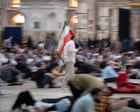
The socioeconomic misery has dissolved the traditional barriers that once kept different segments of Iranian society apart. What began as a localized strike by electronics merchants in Tehran’s Alaeddin Shopping Centre quickly evolved into a nationwide uprising.
Historically, the conservative merchants of the Grand Bazaar were considered a foundational pillar of support for the Islamic Republic. That support has officially evaporated. Driven by market instability and the freefall of the rial, shopkeepers shut their doors, realizing that continued compliance meant certain bankruptcy.
The protests rapidly transformed from economic grievances into an explicit challenge to the legitimacy of the ruling regime. Unlike previous waves of unrest, such as the 2022 demonstrations which were heavily defined by generational and cultural divides, the current movement cuts across every demographic line.
- Geographic Spread: Active protests have been documented in hundreds of locations across all 31 provinces, from the capital to historically neglected border regions.
- Demographic Convergence: Wealthy urbanites, working-class laborers, bazaar merchants, and university students are marching together.
- Political Demands: Slogans have shifted entirely from economic relief to explicit calls for systemic change, separation of religion and state, and the end of clerical rule.
The regime's response has followed a familiar, brutal script. Security forces and units of the Islamic Revolutionary Guard Corps implemented a ruthless crackdown, resulting in thousands of casualties and widespread detentions. To prevent the world from seeing the scale of the violence, the state instituted an unprecedented, near-total internet blackout.
Yet, this digital isolation has created its own economic blowback. The prolonged internet blockade has directly or indirectly thrown at least two million Iranians out of work, destroying the digital economy and fueling the exact anger the government is trying to suppress.
The Perilous Peacetime Transition
During active conflict, an authoritarian regime can appeal to wartime unity to justify rationing, censorship, and the crushing of dissent. Peace strips away that shield.
Once the immediate external threat recedes, the Iranian public will demand an accounting for the ruined economy, the worthless currency, and the missing dead. The ruling elite is acutely aware of this vulnerability. The internal debates currently fracturing the leadership are not about the philosophy of peace, but about regime survival.
If a diplomatic resolution does not immediately lift the economic blockade, end asset freezes, and allow the entry of foreign capital and technology, the current devastation will harden into a permanent social condition. The state will find itself ruling over an exhausted, starving population with nothing left to lose.
The Islamic Revolutionary Guard Corps has proven it can reorganize for battle. It has not proven it can reorganize for peace. Addressing the structural corruption, the ruined infrastructure, and the total lack of public trust requires a level of reform that the current leadership is ideologically incapable of delivering. Tehran may soon discover that an ongoing, low-intensity conflict was far easier to manage than the explosive domestic realities of an unsustainable peace.